
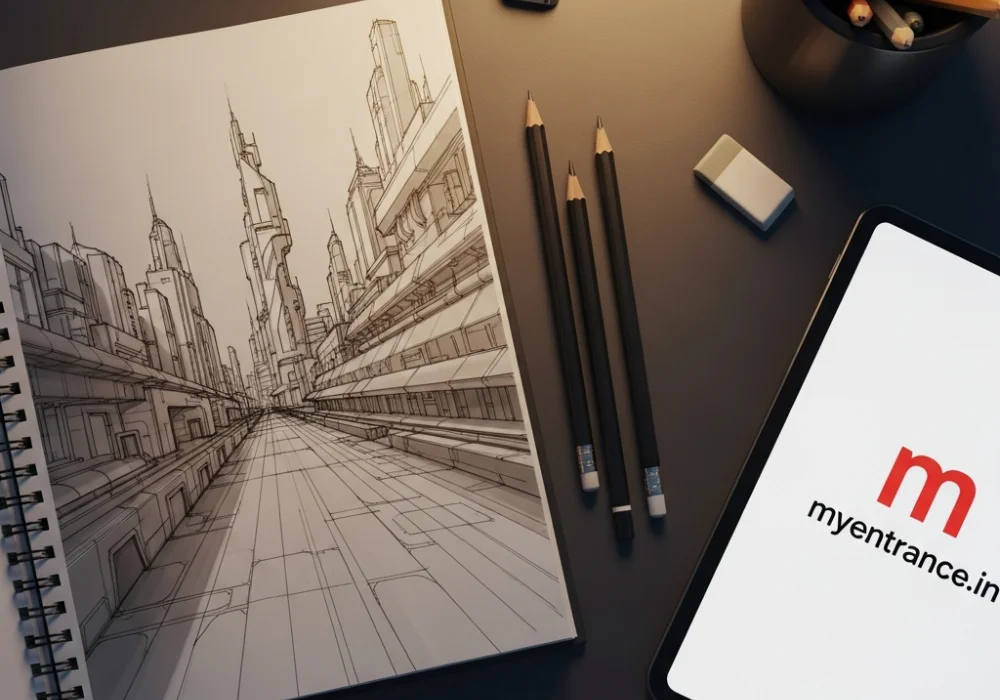
Mastering the Creative Ability Test (CAT)
To ace the NID DAT Creative Ability Test (CAT), you must focus on improving your sketching speed, mastering perspective, and developing unique storytelling abilities. The CAT evaluates your imagination, observation skills, and ability to communicate complex ideas through visual representation rather than just artistic flair.
In this comprehensive guide, we will explore the latest patterns of the NID entrance exam and provide actionable tips to help you secure a seat in one of India’s premier design institutes. Explore our curated mock tests at myentrance.in to benchmark your progress.
Table of Contents
What is the NID DAT Creative Ability Test?
The Creative Ability Test (CAT) is a subjective segment of the National Institute of Design’s Design Aptitude Test (NID DAT). While the GAT (General Ability Test) focuses on logic and language, the CAT measures your creative aptitude.
Success in this section requires more than just drawing. You must demonstrate how you perceive the world. Do you notice the subtle details of a busy street? Can you imagine a product from a different era? These are the questions the NID CAT seeks to answer through your sketches.
💡 Pro-Tip: The Purpose of CAT
The NID evaluators are not looking for a Da Vinci. They are looking for a designer. This means your concepts, problem-solving skills, and clarity of thought carry more weight than purely decorative shading.
Which skills are essential for the NID CAT?
Preparation for the NID CAT should be multidimensional. You cannot rely on a single skill to carry you through the three-hour examination.
- Visual Observation: The ability to recreate scenes from memory with accurate details.
- Perspective Drawing: Mastery of one-point, two-point, and three-point perspectives is non-negotiable.
- Human Anatomy: Understanding proportions and gestures to depict realistic human interaction.
- Composition: Organizing elements within a frame to create a balanced and meaningful visual narrative.
- Ideation: Thinking outside the box to provide unconventional solutions to common design problems.
By practicing regularly with the mock materials at myentrance.in, you can refine these skills under timed conditions, which is crucial for the actual exam day.
What is the syllabus for the NID Creative Ability Test?
While NID does not provide a rigid syllabus, historical data suggests several core topics that appear frequently in the latest patterns.
1. Composition and Layout
You may be asked to design a poster, a postage stamp, or a book cover based on a specific theme like ‘Environment Day’ or ‘Modern Transportation’.
2. Object Transformation
This involves morphing one object into another in a series of steps. For example, transforming a light bulb into a hot air balloon.
3. Storyboarding and Sequential Drawing
You might be given a short scenario and asked to illustrate it in 3 to 6 frames. This tests your narrative ability and consistency in character design.
4. Memory Drawing
Questions like “Draw a scene of a local fish market from the perspective of a fish” test your spatial awareness and imaginative reach.
How to prepare effectively for the NID CAT?
Effective preparation requires a mix of technical practice and mental conditioning. Follow this structured approach to maximize your score.
Daily Sketching Rituals
Spend at least 30 minutes every day sketching surroundings. Do not use an eraser. This builds confidence in your lines and improves hand-eye coordination.
Mastering the Fundamentals
Learn the physics of light and shadow. Understand how different textures like glass, wood, and metal reflect light. Use high-quality reference materials and mock tests from myentrance.in to stay updated on current design trends.
Time Management Techniques
The CAT is notoriously time-constrained. Practice dividing your time: 10 minutes for ideation, 10 minutes for rough layouts, and 40 minutes for the final rendering. Never leave a question incomplete; even a clean line drawing is better than a half-shaded mess.
💡 Pro-Tip: The ‘Why’ Behind the Sketch
Always write a 1-2 sentence explanation of your design if the question allows. Explaining your rationale shows the examiner that your design choice was intentional and not accidental.
Sample Questions for NID CAT Practice
Try solving these questions within a 30-minute window each to simulate exam pressure.
- Question 1: Draw a scene from the perspective of an ant looking at a rainy street. Show at least three distinct elements (e.g., a puddle, a leaf, a shoe).
- Question 2: Design a multipurpose tool for a space traveler that functions as a spoon, a torch, and a communication device.
- Question 3: Illustrate the process of a seed growing into a tree in four sequential frames using a comic-strip format.
💡 Hint for Question 1
For an ant’s perspective, use a very low horizon line. Objects like blades of grass or pebbles should appear gigantic. This is called ‘Worm’s Eye View’.
Understanding the Exam Format: CAT vs. GAT
It is important to understand how the CAT fits into the overall NID DAT Prelims structure.
| Feature | Creative Ability Test (CAT) | General Ability Test (GAT) |
|---|---|---|
| Question Type | Subjective/Drawing based | Objective/Multiple Choice (MCQ) |
| Focus Areas | Imagination, Visualization | GK, Math, English, Logic |
| Weightage | Usually 70% of Prelims score | Usually 30% of Prelims score |
| Medium | Paper-pencil (Manual) | Optical Mark Recognition (OMR) |
Frequently Asked Questions (FAQs)
Can I use watercolors in the NID CAT?
While NID provides a list of allowed materials, dry media like color pencils and oil pastels are usually preferred over wet media to avoid smudging and paper warping.
Is coaching mandatory for clearing the NID entrance?
Not at all. With the right resources, mock tests from platforms like myentrance.in, and consistent practice, self-study is highly effective.
How many questions are usually in the CAT section?
Typically, there are 3 to 4 major descriptive questions, each carrying 15-20 marks, though this can vary based on the latest pattern.
Quick Knowledge Check
Test your design knowledge with these 3 quick questions!
1. What is ‘Negative Space’ in design?
Show Answer
Negative space is the empty area around and between the subjects of an image. It is often used to create secondary meanings or to balance a composition.
2. Which perspective uses three vanishing points?
Show Answer
Three-point perspective. It is typically used for drawing objects from a high (bird’s eye) or low (worm’s eye) angle.
3. What does GAT stand for in NID exams?
Show Answer
General Ability Test.
Need help with your Design Entrance Preparation?
Get personalized guidance, updated study materials, and access to the best mock tests for NID, NIFT, and Kerala PSC exams.
💬 Chat with our Experts on WhatsApp (+91 9526806124)




