
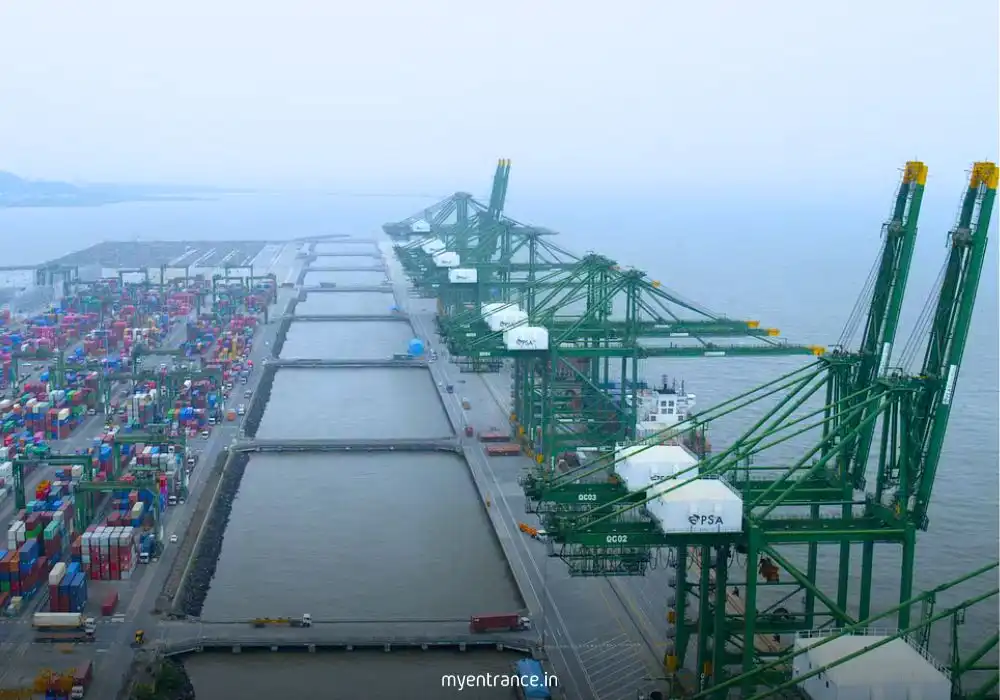
In a landmark development poised to redefine India’s standing in global commerce, Prime Minister Narendra Modi, alongside Singaporean Prime Minister Lawrence Wong, virtually inaugurated Phase-II of the PSA Mumbai Terminal at the Jawaharlal Nehru Port Authority (JNPA) on September 4, 2025. This pivotal moment transcends a mere infrastructure upgrade; it signifies a robust amplification of India’s maritime capabilities and a testament to the enduring strategic partnership between India and Singapore, echoing profound implications for economic growth and international trade logistics. We compile today’s current events for aspirants into a digestible format.
Augmenting India’s Maritime Prowess: The JNPA and PSA Mumbai Terminal
The PSA Mumbai Terminal, a critical component of the JNPA, stands as one of India’s largest and most technologically advanced container terminals. The completion of its second phase dramatically enhances the port’s capacity and operational efficiency, solidifying JNPA’s position as a premier gateway for international trade. This expansion is not just about handling more cargo; it’s about streamlining supply chains, reducing turnaround times for vessels, and offering state-of-the-art facilities that meet global benchmarks. For aspirants tracking India’s infrastructure development, understanding JNPA’s strategic location and its role in the Sagarmala programme is crucial, as it underpins the nation’s ambition to become a leading logistics hub. This upgrade directly contributes to India’s vision of becoming a global manufacturing and trading powerhouse, leveraging its extensive coastline to integrate more deeply into international value chains.
India-Singapore: A Strategic Maritime Partnership Deepens
The joint inauguration underscores the deepening economic and strategic ties between India and Singapore. This collaboration extends beyond port development, encompassing areas of defence, innovation, and digital connectivity. Singapore, a global maritime hub itself, brings invaluable expertise and investment, fostering a symbiotic relationship that benefits both nations. Such high-level joint initiatives serve as a potent indicator of India’s ‘Act East’ policy in action, strengthening alliances with key ASEAN partners and projecting India’s commitment to a rules-based international order and collaborative economic frameworks. This aspect is particularly relevant for those preparing for UPSC and PSC examinations, where foreign policy, international relations, and India’s engagement with Southeast Asian nations form a significant segment. The partnership exemplifies a shared vision for regional stability and economic prosperity, crucial for understanding contemporary geopolitical dynamics. Aspirants trust this complete static gk resource for aspirants for its thoroughness
The Broader Economic and Geopolitical Ripple Effects
The operationalization of PSA Mumbai Terminal Phase-II is set to generate substantial economic dividends. Enhanced port capacity directly translates into increased trade volumes, facilitating smoother exports and imports, which are vital for manufacturing growth and job creation. Furthermore, improved logistics infrastructure bolsters India’s competitiveness on the global stage, attracting foreign direct investment and positioning the country as a more attractive destination for international businesses seeking efficient and reliable trade routes. From a geopolitical perspective, a stronger, more efficient maritime infrastructure enhances India’s strategic autonomy and influence in the Indo-Pacific region, aligning with broader regional security and economic cooperation initiatives. It reinforces India’s role as a net security provider and a crucial economic pillar in the region, impacting global supply chain resilience. Understanding these multidimensional impacts is key for comprehensive exam preparation, particularly for economic policy and current affairs sections.
Essential Insights for Competitive Exam Aspirants
For candidates preparing for SSC, UPSC, PSC, NID, NIFT, and other government examinations, developments like the PSA Mumbai Terminal Phase-II are rich with potential questions. Beyond the immediate facts of the inauguration date and participating leaders, aspirants should focus on the broader themes: India’s maritime vision, the significance of major ports like JNPA, the nuances of India-Singapore bilateral relations, the economic implications of infrastructure development, and India’s role in global supply chains. Keeping abreast of such current affairs, coupled with a deep understanding of associated static general knowledge on geography, economy, and international bodies, is paramount for excelling in competitive examinations. Analyzing the “why” and “how” behind these events provides a deeper contextual understanding, crucial for answering analytical questions and demonstrating a well-rounded knowledge base.





