Translate Language
How IIT’s New Tech Generates Electricity from Thin Air
In a remarkable leap for sustainable technology, researchers at IIT Indore have developed a unique device that produces clean electricity. This innovation harnesses a simple natural process—water evaporation—to generate power without sunlight, batteries, or any moving parts.
How Does This Groundbreaking Device Actually Work?
Forget everything you know about traditional power generation. This device isn’t powered by burning fuel or catching sunlight. Instead, it cleverly taps into the ever-present natural energy of evaporating water. Here’s a breakdown of the science made simple:
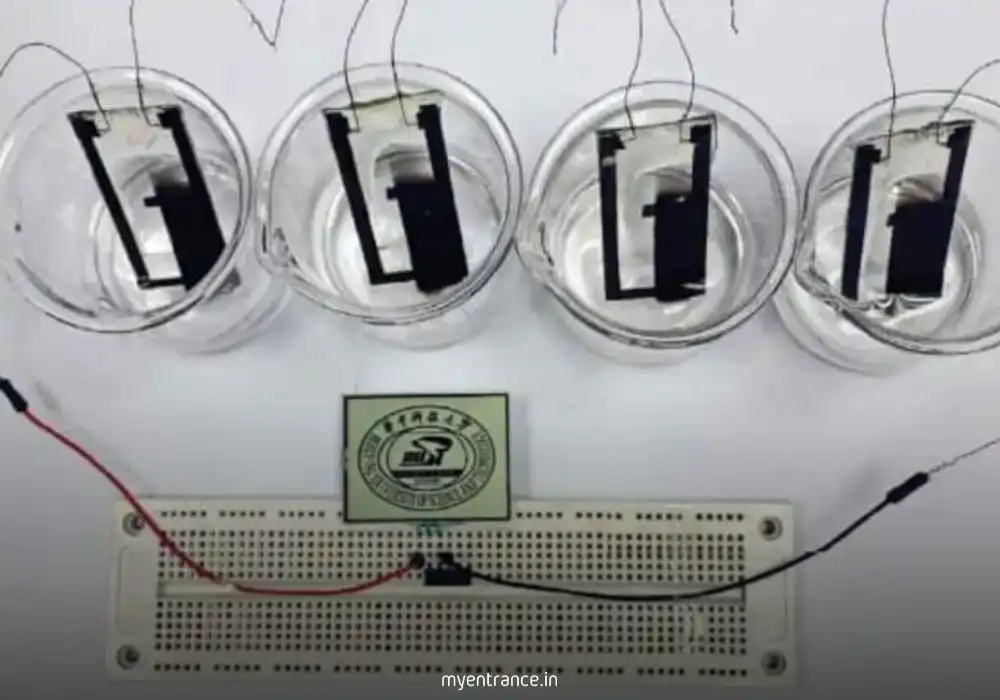
The Core Component: The heart of the invention is a specially designed membrane. This isn’t an ordinary sheet; it’s engineered from graphene oxide (an ultra-thin form of carbon) and a stabilizing compound called zinc-imidazole.
The Setup: The process begins when this membrane is partially dipped into water. The water, through a process called capillary action, starts traveling upwards through incredibly tiny nano-channels within the membrane.
The Magic of Evaporation: As this water eventually evaporates from the top of the membrane, it creates a continuous upward pull. This steady flow is the engine of the device.
Generating Power: This movement of water molecules causes a separation of positive (H⁺) and negative (OH⁻) ions. This separation creates a difference in electrical potential, much like the positive and negative terminals of a battery, resulting in a steady voltage across the membrane.
The beauty of this system is its simplicity and reliability. A single small unit can generate up to 0.75V, and connecting multiple membranes can scale up the power output for practical use. It works with tap water, saline water, and even muddy water, making it incredibly versatile for real-world applications.
Why This Technology is a Game-Changer (Sample Q&A for Exams)
This innovation is prime material for competitive exams, touching on themes of science, technology, environment, and current affairs.
1. What is the primary natural process harnessed by the IIT Indore device to generate electricity?
Answer: The device harnesses the natural process of water evaporation to generate electricity.
2. Name the key materials used in the membrane of this evaporation-driven generator.
Answer: The membrane is made from Graphene Oxide and Zinc-Imidazole.
3. Unlike solar panels, what is a key advantage of this new device?
Answer: It can generate electricity indoors, at night, and under any weather condition, as it does not rely on sunlight.
4. What makes this technology particularly suitable for rural and off-grid areas?
Answer: It is suitable because it is lightweight, portable, works with unfiltered water, has no moving parts (low maintenance), and provides a continuous source of power as long as there is water and air.
5. The research for this device was led by which lab at IIT Indore?
Answer: The research was conducted at the Sustainable Energy and Environmental Materials (SEEM) Lab.
Why is This Important for Your Exams?
For aspirants of exams like UPSC, SSC, Kerala PSC, NID, and NIFT, this story is not just a news item; it’s a multidimensional case study.
Science & Technology (GS Paper 3 for UPSC): It directly relates to topics like developments in science & technology, indigenous technology, and advancements in renewable energy sources.
Environment & Ecology: It represents a breakthrough in green and sustainable technology, a hot-button issue in all competitive exams. You can discuss it in questions about alternative energy, reducing carbon footprint, and eco-friendly innovations.
Current Affairs: It highlights the role of Indian institutions like IITs in pioneering research that addresses global challenges, a common theme in essay and interview questions.
Problem-Solving & Innovation (NID/NIFT): For design entrance exams, this is a brilliant example of biomimicry (imitating nature) and frugal innovation—solving a complex problem with an elegant, simple solution.
Understanding such cutting-edge Indian innovations gives you a significant edge, providing concrete examples to substantiate your answers and showcase your awareness of India’s scientific progress.
Read More Topics