
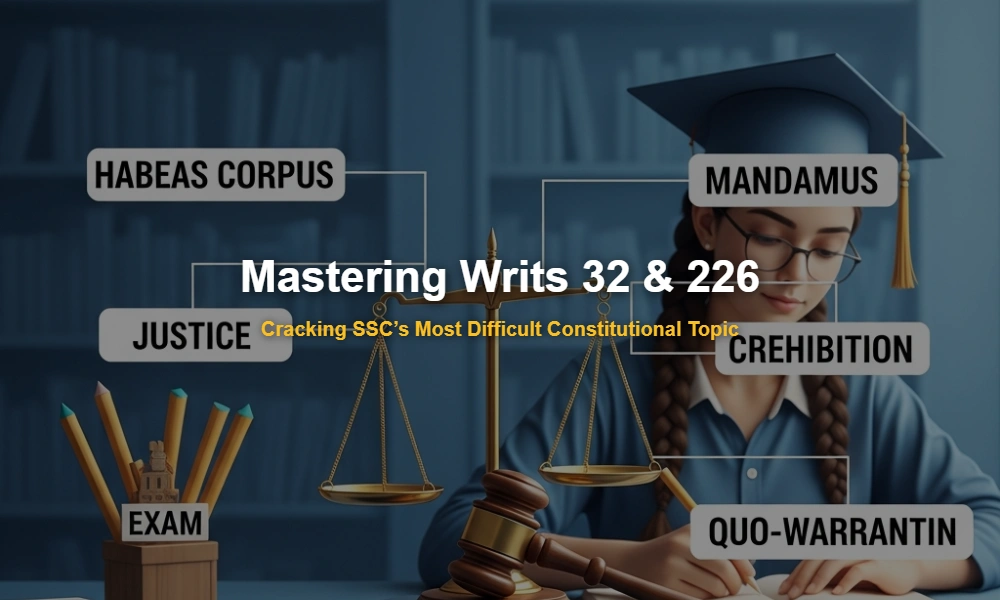
The Fatal Mistake Aspirants Make with Constitutional Remedies
Most candidates treat Article 32 and 226 as mere page-fillers, but in the SSC CGL and CPO exams, these are the lethal traps that separate the toppers from the rest. Article 32, which Dr. B.R. Ambedkar famously called the ‘Heart and Soul’ of the Indian Constitution, provides a guaranteed remedy for the enforcement of Fundamental Rights. Without this, Part III would be a toothless tiger. Understanding the nuance between the Supreme Court’s power under Fundamental Rights and the High Court’s broader jurisdiction under Article 226 is non-negotiable for success.
🚀 Key Takeaways
- Article 32 is a Fundamental Right itself, whereas Article 226 is a Constitutional Right.
- High Courts have a wider reach than the Supreme Court in writ jurisdiction.
- Suspension of Article 32 only occurs during a National Emergency under Article 359.
- Five distinct writs: Habeas Corpus, Mandamus, Prohibition, Certiorari, and Quo-Warranto.
The Shocking Truth: Why the High Court Power is Wider than the Supreme Court?
The High Court’s power under Article 226 is wider because it can issue writs not only for Fundamental Rights but also for any other legal right. In contrast, the Supreme Court’s jurisdiction under Article 32 is strictly limited to the enforcement of rights guaranteed in Part III of the Constitution. This is a recurring SSC Civics Prep question that catches thousands off-guard.
| Feature | Article 32 (Supreme Court) | Article 226 (High Court) |
|---|---|---|
| Scope | Fundamental Rights ONLY | Fundamental Rights + Legal Rights |
| Nature | Mandatory (It is a FR) | Discretionary |
| Territory | Entire India | Respective State/Territory |
💡 Pro-Tip: Can Article 32 be refused?
Unlike Article 226, the Supreme Court cannot refuse to exercise its power under Article 32 because the right to move the SC is itself a Fundamental Right. High Courts can direct you to alternative remedies, but the SC is the ultimate guardian.
The 5 Lethal Writs: Don’t Enter the Exam Without Knowing These!
Writs are formal written orders issued by a court to provide legal remedies to individuals whose rights have been violated. These five Latin terms define the boundary between state power and individual liberty, serving as the primary tool for Judicial Review in India.
1. Habeas Corpus (To have the body)
Habeas Corpus is the most powerful writ for personal liberty, used to release a person who has been illegally detained. It can be issued against both public authorities and private individuals—a unique feature you must remember for the exam.
2. Mandamus (We command)
Mandamus is issued to a public official or lower court that has failed to perform a mandatory duty. Note: It cannot be issued against the President, Governors, or private individuals.
3. Prohibition (To forbid)
Prohibition is a preventive writ issued by a higher court to a lower court or quasi-judicial body to stop them from exceeding their jurisdiction. It is only issued while the proceedings are pending.
4. Certiorari (To be certified)
Certiorari is both preventive and curative. It is used to quash the order of a lower court or tribunal that has already been passed. It is issued on grounds of excess of jurisdiction or error of law.
5. Quo-Warranto (By what authority)
Quo-Warranto prevents illegal usurpation of a public office. Unlike other writs, any interested person (not necessarily the aggrieved party) can seek this writ. This is the exception to the rule of ‘Locus Standi’.
🏆 The Ultimate SSC Writ Challenge (10 Questions)
Q1. Which writ is known as the ‘Bulwark of Individual Liberty’ against arbitrary detention?
Q2. Which Article was described by Dr. B.R. Ambedkar as the ‘Heart and Soul’ of the Constitution?
Q3. Against whom can the writ of Mandamus NOT be issued?
Q4. Which writ can be issued to quash the order of a court that has already given a judgment?
Q5. Which of the following is true regarding Article 226?
Q6. Which writ can be filed by any interested person and not just the aggrieved party?
Q7. During a National Emergency, which of the following happens to Article 32?
Q8. Which writ is issued to prevent a lower court from exceeding its jurisdiction?
Q9. Territory-wise, whose writ jurisdiction is wider?
Q10. Can Mandamus be issued against a private individual?
Master the Constitution and Secure Your Govt Job
Constitutional law is the backbone of the General Awareness section in SSC exams. These writs under Article 32 and 226 are high-yield topics that appear in almost every shift. To dominate this section, you need structured guidance and consistent practice. Don’t leave your selection to chance—get expert help today!
💬 Chat with our Experts on WhatsApp (+91 9526806124)




