
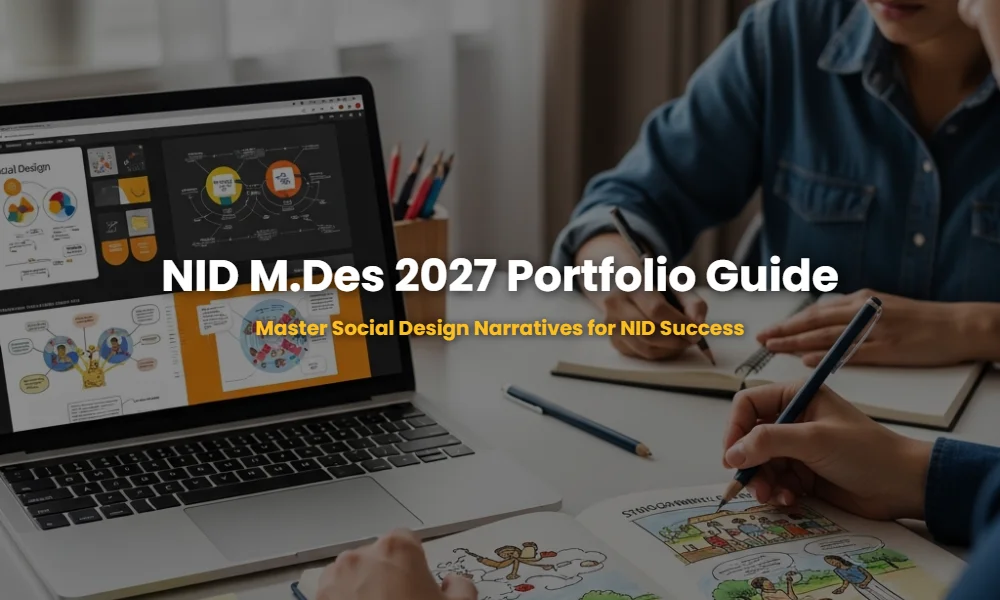
How Can You Construct a High-Impact Digital Portfolio for NID M.Des 2027 Focusing on Social Design Narratives?
The National Institute of Design (NID) is no longer looking for just “good designers”; they are hunting for visionary problem-solvers. As we approach the NID M.Des 2027 admissions cycle, the shift toward Social Design Narratives has become the ultimate game-changer. If your portfolio only showcases aesthetic renders without a soul, you are likely to be filtered out in the preliminary rounds. This guide uncovers the high-stakes strategy required to build a digital portfolio that screams impact, empathy, and systemic change.
🚀 Key Takeaways
- ✅ Narrative Over Aesthetics: Focus on the ‘Why’ behind every design decision.
- ✅ Social Impact Metrics: Show how your design improves lives or environments.
- ✅ Systemic Thinking: Demonstrate an understanding of the broader ecosystem.
- ✅ Digital Storytelling: Optimize your PDF or website for high-speed evaluation.
- ✅ Process Transparency: Document your failures and iterations relentlessly.
The Secret Blueprint for Social Design Narratives: What Examiners Secretly Crave
To satisfy NID’s rigorous standards, your social design narrative must center on a specific stakeholder, showcase primary research (interviews, observations), and detail the iterative co-creation process. It is about moving from being an “expert designer” to a “facilitator of solutions” within a community context.
When constructing your projects, integrate Human-Centered Design (HCD) frameworks. Show your “Empathy Map” and “User Journey.” But here is the FOMO-inducing truth: most students stop at the persona. To beat the competition for 2027, you must show the Ripple Effect—how your design impacts the user’s family, village, or the environment over a 5-year period.
Why You Cannot Ignore ‘Systems Thinking’ in 2027
Social design projects often fail in portfolios because they look like isolated “good deeds.” NID wants to see that you understand the economic, political, and cultural systems surrounding your project. If you are designing for menstrual hygiene, have you considered the waste management system? If you are designing a digital literacy app, have you considered the electricity grid in Tier-3 cities? This depth separates the masters from the amateurs.
Are You Sabotaging Your Chances with a Clunky Digital Format?
A digital portfolio for NID must be a high-performance PDF or a lightning-fast responsive website that prioritizes readability and navigation above all else. If your file takes more than 10 seconds to load or if the text is too small to read on a standard laptop screen, you have already lost the jury’s attention.
For NID DAT preparation, focus on a 16:9 aspect ratio for your digital slides. This fits perfectly on most monitors used by the NID jury. Use a clear hierarchy: large headings for the problem statement, bullet points for research insights, and high-quality hero shots for the final prototype.
💡 Click to Reveal: The File Size Hack
Never upload a file larger than 15MB unless specified. Use tools like Adobe Acrobat’s “Reduce File Size” or SmallPDF, but ensure your images remain sharp. Blurry sketches are a red flag for the NID admissions board.
Generic Portfolio vs. NID-Level Social Design Portfolio
Compare the two approaches below to see where you currently stand. If you find yourself in the left column, it’s time for a radical overhaul.
| Feature | Generic “Good” Portfolio | NID 2027 Social Impact Portfolio |
|---|---|---|
| Focus | Final Product / Aesthetic Beauty | Human Process / Social Change |
| Research | Secondary (Google/Pinterest) | Primary (Fieldwork/Interviews) |
| Narration | Technical Specifications | Storytelling & Stakeholder Voice |
| Feedback | Self-Evaluated | User-Tested & Validated |
The Sneaky Examiner Traps You Must Avoid at All Costs
NID examiners are trained to spot “over-designed” portfolios that lack substance. The most common trap is focusing on the tool (Photoshop, Figma, SolidWorks) rather than the problem. Your portfolio should emphasize that you are the master of the tool, not a slave to it.
Another trap is the “All-Rounder” fallacy. While NID likes versatile candidates, your NID portfolio for M.Des 2027 should have a clear “anchor.” If your anchor is Social Design, every project should reflect that lens. Don’t throw in a random fashion illustration project if it doesn’t serve the social narrative you’ve established.
The Power of the “Reflective Conclusion”
At the end of each project, include a section titled “What I Learned.” This is where you admit what went wrong. Did your initial prototype offend a community member? Write it down. Did your material choice prove unsustainable? Explain why. This level of self-awareness is the hallmark of an M.Des candidate.
Common Doubts About NID M.Des Social Design Portfolios
How many projects should I include for NID M.Des 2027?
Quality over quantity is key. Aim for 3-5 deep-dive projects. Each project should have 4-6 slides detailing the journey from research to final validation.
Can I use personal art in my social design portfolio?
Yes, but only if it showcases your observational skills or cultural sensitivity. A standalone ‘pretty’ painting is less valuable than a series of sketches documenting urban poverty or rural life.
Do I need a website, or is a PDF enough?
NID usually accepts a PDF upload. However, having a supplemental website link can demonstrate your digital proficiency. Just ensure the PDF contains all the core information required for the first round of review.
Ready to Master Your NID 2027 Journey?
Building a portfolio that stands out in the social design category requires expert mentorship and rigorous critique. Don’t leave your NID dreams to chance.
💬 Chat with our Experts on WhatsApp (+91 9526806124)




