
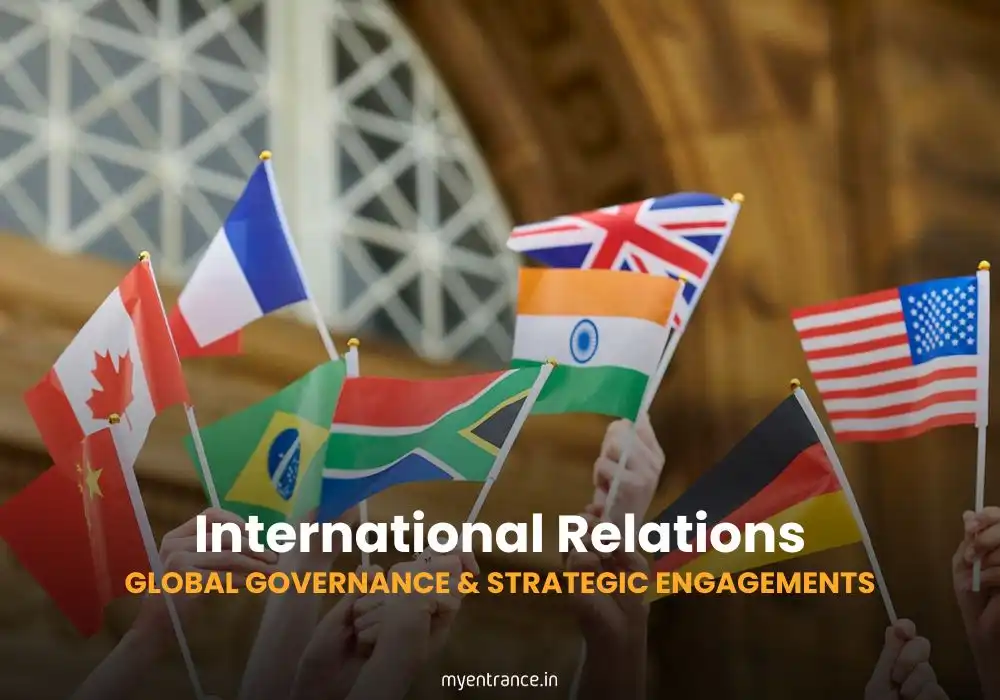
Decoding Global Power: Your Essential Guide to International Relations for UPSC & PSC Success
Mastering International Relations (IR) is paramount for aspirants targeting competitive examinations like UPSC, SSC, PSC, NID, NIFT, and other government roles, serving as a critical differentiator in an increasingly complex world. This section offers an indispensable resource for understanding global dynamics through interactive examinations, current affairs analyses, and targeted quizzes designed to solidify your knowledge and sharpen your analytical edge. Here at myentrance.in, we provide the ultimate toolkit to navigate the nuances of global diplomacy, empowering you to ace your examinations with confidence. STATIC GK GUIDE: This curated static gk syllabus for all exams helps you focus on what truly matters.
The World Stage: Decoding International Relations for Competitive Exams
International Relations stands as a cornerstone in the syllabi of major competitive examinations, testing not just your factual recall but also your profound understanding of global events, strategic alliances, and diplomatic paradigms. Aspirants must develop a comprehensive grasp of the interplay between nations, the functions of international organizations, and the historical context shaping contemporary foreign policies. This subject demands a dynamic approach, integrating static general knowledge with an acute awareness of daily news and evolving geopolitical landscapes. From multilateral forums to bilateral agreements, every aspect contributes to the intricate web of global governance that examiners expect you to comprehend.
Global Governance & Strategic Engagements: Deep Dive into Key Concepts
A significant component of International Relations involves a thorough understanding of major global institutions and pivotal international agreements. Bodies such as the United Nations Security Council (UNSC) are frequently highlighted, requiring aspirants to be well-versed in their structure, functions, challenges, and the implications of their resolutions. Knowledge extends to crucial international declarations and treaties that shape global norms, economic interactions, and security frameworks. For instance, comprehending the historical significance and impact of various declarations or accords – whether on counter-terrorism, trade, or climate change – is essential, demonstrating an ability to connect specific events to broader global trends. Our resources provide in-depth analyses, ensuring you grasp these complex topics and their far-reaching consequences on the world stage.
Current Affairs: The Pulse of International Relations
The nexus between current affairs and International Relations is undeniable; daily news acts as the living embodiment of IR theories and practices. Success in government exams necessitates not merely passively consuming news, but actively analyzing it through an IR lens. Our daily news quiz and current affairs modules are meticulously crafted to bridge this gap, transforming headlines into examinable concepts. These interactive examinations challenge your ability to link recent developments – be it a diplomatic summit, a shift in regional power dynamics, or a major international crisis – with the foundational principles of IR and global affairs. Consistent engagement with these resources is key to developing the critical thinking skills required to interpret complex scenarios and formulate informed answers.
Why Practice Matters: Sharpening Your Edge with Interactive Quizzes
Regular practice with subject-wise quizzes, particularly Multiple Choice Questions (MCQs), is indispensable for honing your preparation for examinations like UPSC Prelims. Our extensive collection of interactive examinations and quizzes offers an invaluable opportunity to test your knowledge, identify areas requiring further study, and refine your time management skills. By simulating exam conditions, these practice sessions help you acclimatize to the pressure, enabling quicker and more accurate decision-making. Beyond mere recall, these MCQs are designed to probe your conceptual clarity and analytical abilities, ensuring a holistic preparation that transcends rote learning. Coupled with our expert examination tips, you gain a significant advantage in tackling even the most challenging questions. Get the gist of the news with these important daily news summaries for exams
Sample Questions & Answers: Decoding Global Dynamics
Here are five sample questions, typical of what you might encounter in competitive examinations, along with their correct answers. Understanding the rationale behind such questions is crucial for comprehensive preparation.
Question 1: The United Nations Security Council (UNSC) is primarily responsible for maintaining international peace and security. Which of the following nations is NOT a permanent member with veto power?
Answer: C) Germany
*(Explanation: The five permanent members are China, France, Russia, the United Kingdom, and the United States.)*
Question 2: Non-permanent members of the United Nations Security Council (UNSC) are elected by the General Assembly for a specific term. What is the duration of this term?
Answer: B) Two years
*(Explanation: Ten non-permanent members are elected for two-year terms by the General Assembly, with five members replaced each year.)*
Question 3: The concept of ‘Soft Power’, which refers to a country’s ability to influence others through attraction and persuasion rather than coercion, was popularized by which prominent International Relations theorist?
Answer: A) Joseph Nye Jr.
*(Explanation: Joseph Nye Jr. of Harvard University is widely credited with coining and developing the concept of ‘Soft Power’ in the late 1980s and early 1990s.)*
Question 4: A recent declaration between two nations outlining mutual cooperation in specific sectors such as infrastructure development and environmental protection would primarily fall under which category of international agreements?
Answer: C) Bilateral Strategic Partnership
*(Explanation: This describes a bilateral agreement, indicating cooperation between two specific states on a broad range of shared interests and objectives.)*
Question 5: Which international body’s primary mandate includes promoting international monetary cooperation and financial stability, facilitating international trade, promoting high employment and sustainable economic growth, and reducing poverty around the world?
Answer: D) International Monetary Fund (IMF)
*(Explanation: The IMF focuses on monetary cooperation, financial stability, trade, employment, growth, and poverty reduction, distinct from the World Bank’s long-term development loans or the WTO’s trade rules.)
The Crucial Role of These Questions in Your Examination Journey
These types of questions are fundamental because they test your foundational knowledge of global institutions, key concepts, and the practical application of International Relations theories. Examiners utilize them to assess your understanding of the structure and functioning of critical international bodies like the UNSC, your awareness of influential IR concepts like ‘Soft Power’, and your ability to categorize and comprehend various international agreements. Furthermore, by linking current events to these static general knowledge areas, such questions evaluate your preparedness for the dynamic nature of competitive exams. Mastering these aspects through our comprehensive educational resources ensures you are well-equipped to articulate nuanced answers and secure top ranks in any government examination.





