
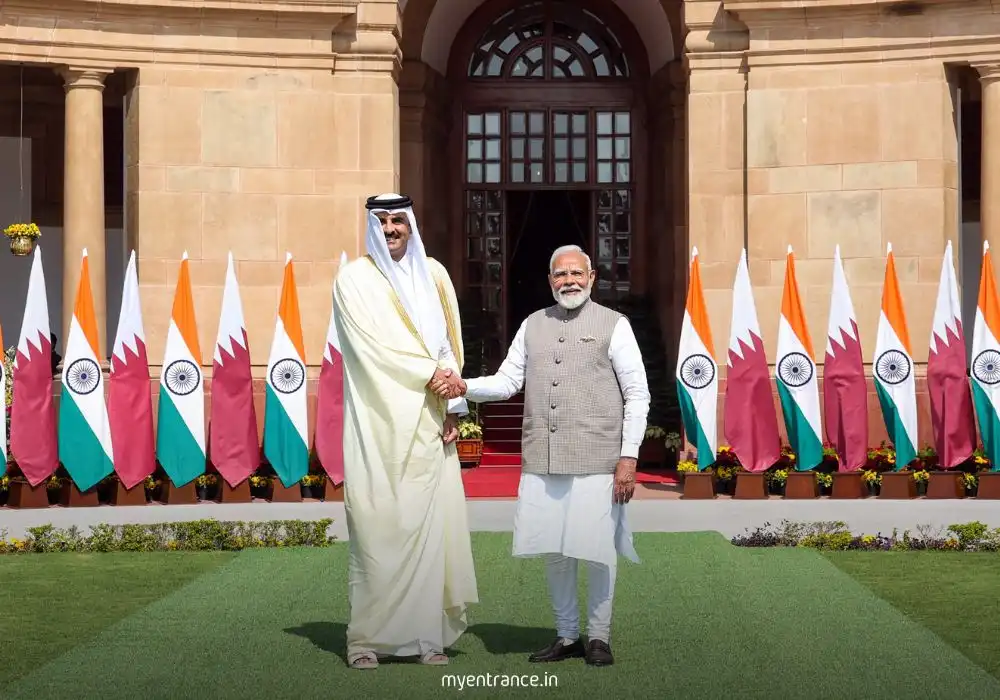
The world of international relations is a complex web of diplomacy, strategic alliances, and sometimes, unforeseen challenges. For aspirants preparing for competitive examinations like UPSC, SSC, PSC, NID, NIFT, and various other government exams, understanding these global dynamics is not just about memorizing facts, but about comprehending the ‘why’, ‘what’, and ‘how’ behind nations’ interactions. Recently, a significant diplomatic exchange between India and Qatar highlighted crucial principles of foreign policy and international conduct, offering a valuable case study for your current affairs and general knowledge preparation. It’s important to test your knowledge with our news pointers to identify weak areas.
Decoding Diplomatic Exchanges: What Happened and Why It’s Exam-Relevant
Prime Minister Narendra Modi recently engaged in a direct conversation with the Amir of Qatar, Sheikh Tamim Bin Hamad Al-Thani, concerning reported incidents in Doha. During this crucial call, Prime Minister Modi conveyed India’s deep apprehension regarding the situation. Critically, India explicitly stated its condemnation of any actions that infringe upon the sovereignty of Qatar. This stance underscores a fundamental principle of international law: the respect for national sovereignty and territorial integrity. Furthermore, New Delhi reiterated its long-held belief in resolving complex issues through peaceful dialogue and sustained diplomatic efforts, rather than confrontation.
For competitive exams, this specific event serves as an excellent illustration of several key concepts. Firstly, it falls squarely under ‘Current Affairs’ and ‘International Relations’. Questions could arise about India’s foreign policy principles, its relations with Middle Eastern countries, or the concept of national sovereignty. Understanding the nuances of such high-level conversations helps you analyze and interpret similar events effectively, moving beyond mere rote learning to a deeper understanding of global geopolitics.
India-Qatar Relations: A Strategic Partnership to Understand
Qatar, a strategically vital nation in the Middle East, holds immense importance for India. Geographically situated on the northeastern coast of the Arabian Peninsula, it is a major energy supplier, particularly for India’s burgeoning needs. Beyond energy, Qatar hosts a large and vibrant Indian diaspora, whose welfare is a significant aspect of India’s foreign policy. The recent diplomatic exchange reaffirms the robust and multi-faceted relationship between the two nations, built on mutual respect and shared economic interests.
For your General Knowledge and static GK sections, knowing about key countries like Qatar – its capital (Doha), its form of government (monarchy), and its economic pillars (natural gas and oil) – is essential. Furthermore, understanding the strategic importance of the Middle East for India, in terms of energy security, trade routes, and the Indian expatriate community, provides a holistic perspective crucial for answering analytical questions in UPSC and other descriptive examinations.
The Bedrock of Global Harmony: Principles of International Law and Diplomacy
India’s firm stance on condemning sovereignty violations and advocating for dialogue reflects its commitment to established international norms and principles. Respect for a nation’s sovereignty means that no external power should interfere in its internal affairs without legitimate cause. Dialogue and diplomacy are the primary tools nations use to prevent conflicts, resolve disputes, and foster cooperation. These principles are not just theoretical constructs; they are the practical framework governing state-to-state interactions, ensuring a semblance of order in a globalized world.
Aspirants for UPSC’s GS Paper II, which covers International Relations, will find this especially relevant. It provides a real-world example of how these principles are applied in practice. Being able to articulate India’s foreign policy based on such events showcases a comprehensive understanding of the subject matter, going beyond textbook definitions. Our daily news quizzes and detailed current affairs analysis on myentrance.in are designed to help you connect these dots, preparing you to articulate these connections in your examinations.
Mastering Current Affairs: Your Gateway to Examination Success
Staying updated with daily news and current affairs is not merely a task but a strategic necessity for competitive exams. Events like the India-Qatar diplomatic call can be the source of direct questions or form the basis for essay topics. Myentrance.in provides comprehensive daily news analysis, interactive current affairs quizzes, and static general knowledge resources precisely to equip you for this challenge. By regularly engaging with these materials, you learn to identify critical information, understand its context, and connect it with the broader syllabus. This systematic approach ensures that you are not just memorizing headlines, but developing an analytical mindset crucial for cracking exams like SSC, UPSC, and various PSC selections. Examination tips available on our platform further guide you on how to effectively integrate current events into your overall study plan, ensuring you are well-prepared for any question that comes your way. You can build a strong foundation with our comprehensive static gk guide.
Frequently Asked Questions
Q1: Why is understanding diplomatic exchanges important for competitive exams?
A1: Diplomatic exchanges are crucial as they reflect a country’s foreign policy, international relations, and adherence to global principles. They often form the basis for current affairs questions, essay topics, and analytical discussions in exams like UPSC, SSC, and PSC, testing your understanding of geopolitics and India’s role in the world.
Q2: What is “national sovereignty” and why did India emphasize it in this context?
A2: National sovereignty refers to a state’s supreme and independent authority within its territory, free from external interference. India emphasized it to condemn any potential violation of Qatar’s internal affairs, upholding a fundamental principle of international law and its own foreign policy stance against external intervention.
Q3: How does India’s relationship with Qatar benefit India?
A3: India’s relationship with Qatar is multi-faceted. Qatar is a vital source of India’s energy imports (natural gas), crucial for India’s economic growth and energy security. Additionally, it hosts a large Indian diaspora, whose remittances and welfare are significant. The relationship ensures regional stability and provides trade opportunities.
Q4: How should I prepare current affairs related to international events for my exams?
A4: To prepare effectively, focus on understanding the ‘who, what, where, when, why, and how’ of each event. Connect current events to static general knowledge (e.g., countries, capitals, international organizations, historical context). Regularly take daily news quizzes, analyze news articles, and practice answering questions that require both factual recall and analytical thinking.
Q5: Are incidents like these relevant for exams beyond UPSC, such as SSC or PSC?
A5: Absolutely. While UPSC delves deeper into analysis, SSC, PSC, and other government exams frequently include questions on major international current affairs, India’s foreign policy, and static general knowledge related to prominent countries and global issues. Staying updated is essential for all competitive examinations.





