
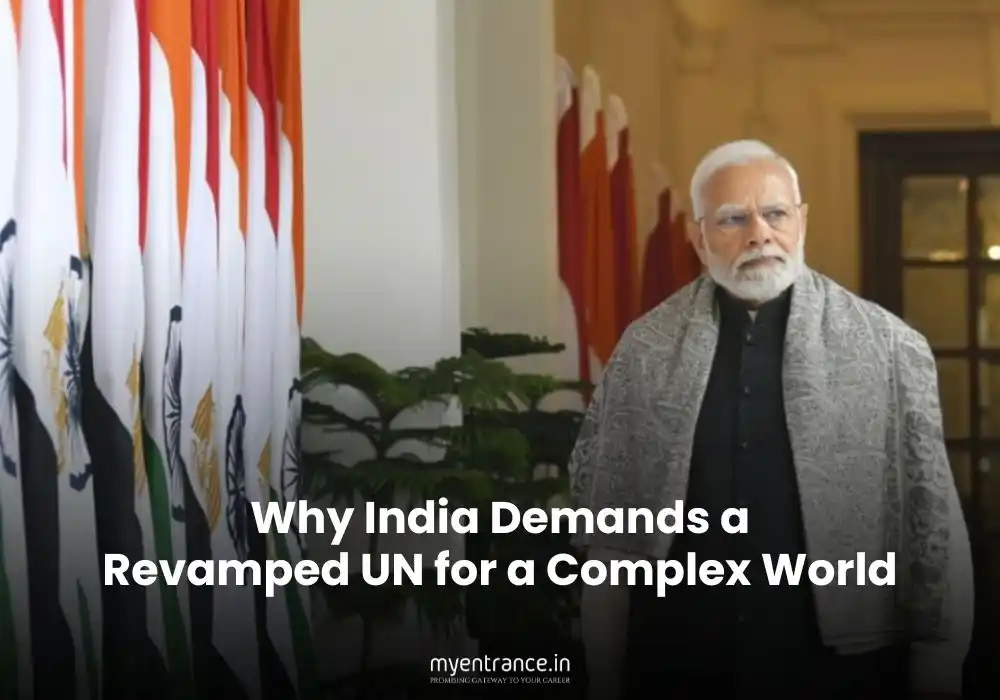
Defence Minister Rajnath Singh’s recent assertion that a new United Nations and a reformed international order are essential to effectively address global conflicts has sparked crucial discussions. This powerful statement, delivered at the ‘International Conference of Chief Justices of the World’ in Lucknow, underscores India’s consistent position on the urgent need for a more representative and effective global governance framework. For students preparing for competitive examinations, understanding the rationale behind this call, its implications, and the historical context is vital for comprehensive knowledge of International Relations and India’s foreign policy. Prepare for your government career with our complete guide to SSC Exams.
The Imperative for Change: Why a New United Nations?
The Defence Minister’s call for a ‘new UN’ is rooted in the widely perceived limitations of the current international system, established in the aftermath of World War II. While the United Nations has undeniably played a crucial role in maintaining peace, promoting human rights, and fostering cooperation for over seven decades, its structure and operational mechanisms often appear anachronistic in today’s rapidly evolving, multipolar world. The global landscape is now characterized by complex challenges such as asymmetric warfare, cross-border terrorism, cyber threats, climate change, and persistent humanitarian crises, alongside traditional interstate conflicts.
One of the most significant criticisms revolves around the UN Security Council (UNSC), its most powerful organ. The permanent five members (P5) – China, France, Russia, the United Kingdom, and the United States – wield veto power, which frequently leads to paralysis on critical issues where their national interests diverge. This often prevents timely and decisive action on pressing global conflicts, as alluded to by Mr. Singh. The current structure does not adequately reflect the geopolitical realities of the 21st century, where emerging powers like India, Brazil, Germany, and Japan contribute significantly to the global economy and security but lack commensurate representation in decision-making bodies. This lack of inclusivity diminishes the UN’s legitimacy and effectiveness, hindering its ability to forge global consensus on pressing issues. Access official notifications and preparation strategies for the SSC Combined Graduate Level Exam.
Deconstructing the Existing International Order
The current international order largely stems from the Bretton Woods system and the post-1945 arrangements that saw the establishment of the UN and its associated institutions. Designed to prevent another catastrophic global war, this order prioritized the security interests of the victorious powers of World War II. While it succeeded in averting large-scale direct conflicts between major powers for an extended period, it has struggled to adapt to the shifting power dynamics and the emergence of non-state actors as significant threats. The principles of state sovereignty, non-interference, and collective security, while foundational, are increasingly challenged by transnational issues that demand a more integrated and flexible response.
The world has moved from a bipolar Cold War era to a unipolar moment and now to an increasingly multipolar configuration, where power is diffused among several state and non-state actors. The economic weight has shifted towards Asia, and global challenges demand global solutions that require the buy-in and active participation of a broader set of nations. When the existing framework fails to accommodate these changes, it leads to growing dissatisfaction and calls for reform from nations that feel underrepresented or marginalized.
India’s Vision for a Reformed Global Architecture
India has been a staunch advocate for comprehensive UN reforms, particularly the expansion of the UN Security Council in both permanent and non-permanent categories. As a founding member of the UN and the world’s largest democracy with a rapidly growing economy and significant contributions to UN peacekeeping missions, India believes it is deserving of a permanent seat on the UNSC. This is not merely about national prestige but about ensuring greater representativeness, legitimacy, and operational effectiveness of the world body.
A ‘new UN’ from India’s perspective would entail a more democratic and equitable decision-making process, a reduction in the arbitrary use of the veto power, and an enhanced capacity to respond to contemporary global challenges. It would reflect the demographic, economic, and political realities of the 21st century, ensuring that solutions to global problems are genuinely collective and widely accepted. India also emphasizes multilateralism as the most viable path to addressing interconnected challenges like climate change, terrorism, and pandemics, requiring robust international cooperation rather than unilateral actions or narrowly defined alliances.
The Significance of the Forum: International Conference of Chief Justices
Defence Minister Rajnath Singh’s remarks at the ‘International Conference of Chief Justices of the World’ in Lucknow were strategically significant. This forum brings together legal luminaries from across the globe, providing a platform to discuss the role of international law and justice in maintaining world peace and order. By addressing this audience, Mr. Singh underscored the inextricable link between a robust, fair, and reformed international legal framework and the ability to resolve conflicts effectively.
His statement implies that the failure to address global conflicts is not just a political or military challenge but also a failure of the international legal and institutional order to provide timely and just solutions. The Chief Justices, as custodians of justice and proponents of the rule of law within their respective nations, represent an influential voice that can advocate for the strengthening and reform of international legal instruments and institutions, including the UN itself. This setting further highlighted India’s commitment to a rules-based international order, provided it is just and equitable.
Charting the Course: How to Achieve International Order Reform?
Achieving reforms in a complex multilateral organization like the UN is an arduous process, requiring extensive diplomatic efforts, consensus-building, and political will from member states, especially the existing P5. The path forward involves sustained advocacy through various international forums, engaging in dialogues with key stakeholders, and building broad coalitions of like-minded nations. India, through its G4 grouping (with Brazil, Germany, and Japan) and other multilateral platforms, consistently pushes for Security Council reform.
The process demands a recognition that the current structure serves narrow interests and often fails the broader global community. It necessitates a shift towards genuine multilateralism where diverse voices are heard and power is shared more equitably. While immediate radical overhauls may be challenging, incremental reforms, coupled with a persistent vision for a truly representative global order, are essential. India’s leadership in articulating this need contributes significantly to the global discourse on building a more resilient, just, and peaceful international system for future generations.
Frequently Asked Questions (FAQs)
1. What are the primary criticisms leveled against the current structure of the United Nations?
The main criticisms include the outdated composition and power dynamics of the UN Security Council (UNSC), where the five permanent members (P5) hold veto power, often leading to gridlock and inaction on critical global issues. There’s also a perceived lack of representation for major emerging economies and demographic realities of the 21st century, along with challenges in effectively addressing new-age threats like cyber warfare and climate change.
2. What specific reforms is India advocating for within the United Nations?
India is a leading voice for comprehensive UN reforms, particularly the expansion of the UN Security Council in both permanent and non-permanent categories. India seeks a permanent seat in the UNSC, arguing for greater representation for emerging economies and major democratic nations. It also advocates for a review of the veto power and a more democratic decision-making process within the UN system.
3. Why did Defence Minister Rajnath Singh choose the ‘International Conference of Chief Justices of the World’ to make this statement?
The choice of forum was strategic, linking the need for a reformed international order with the principles of justice and the rule of law. By addressing Chief Justices, Mr. Singh highlighted that ineffective global governance is also a failure of the international legal and institutional framework to provide just solutions to conflicts. It underscored India’s belief in a rules-based international order, provided it is fair and equitable.
4. How does the veto power impact the UN Security Council’s ability to address global conflicts?
The veto power, held by the P5, allows any one of them to block a resolution, regardless of the level of support from other members. This often leads to paralysis or watered-down resolutions, especially when a conflict involves the interests of a P5 member or its allies. It prevents timely and decisive action, undermining the Security Council’s mandate to maintain international peace and security and limiting the UN’s effectiveness in resolving conflicts.
5. What are the historical origins of the current international order and why is it considered outdated by many?
The current international order was largely established after World War II, primarily by the victorious Allied powers, leading to the creation of the United Nations and institutions like the Bretton Woods system. It was designed to prevent another global conflict and reflected the power dynamics of the mid-20th century. Many consider it outdated because the world has dramatically changed; it is now multipolar, with new economic powers, complex transnational threats, and demographic shifts that are not adequately represented in the current governance structures.





