
Introduction to the NIFT Creative Ability Test (CAT)
The National Institute of Fashion Technology (NIFT) is the dream destination for aspiring designers in India. To secure a seat in this prestigious institution, candidates must excel in the Creative Ability Test (CAT). Unlike the General Ability Test (GAT) which focuses on logic and language, the CAT evaluates your intuition, power of observation, and most importantly, your sketching skills. For beginners, the prospect of drawing professionally can be daunting, but with the right foundational exercises, anyone can master the art of visual expression. In this guide, we will explore the essential sketching exercises that will help you build confidence and precision for the upcoming exams.
The Importance of Muscle Memory in Sketching
Sketching for design is different from fine arts. It requires speed, clarity, and the ability to convey an idea effectively. The first step for any beginner is to develop muscle memory. Your hand should move as fluidly as your thoughts. This is achieved through repetitive, non-judgmental practice. By focusing on basic strokes, you train your brain and hand to work in tandem, reducing the friction between a creative concept and its physical manifestation on paper. At myentrance.in, we emphasize these core basics in our comprehensive mock tests to ensure students are prepared for the latest pattern of the exam.
Exercise 1: Mastering Freehand Lines and Circles
One of the most common mistakes beginners make is using a ruler or a compass. In the NIFT CAT, you are expected to draw freehand. Start your daily practice with these two simple drills:
- Horizontal and Vertical Lines: Draw parallel lines across a full A4 sheet without lifting your pencil. Try to keep the spacing equal and the lines as straight as possible.
- Infinity Circles: Draw circles over and over in the same spot, then move across the page. Focus on making them perfectly round rather than oval.
- Diagonal Grids: Create a mesh of diagonal lines to improve your control over different angles.
Exercise 2: Understanding 2D to 3D Transformation
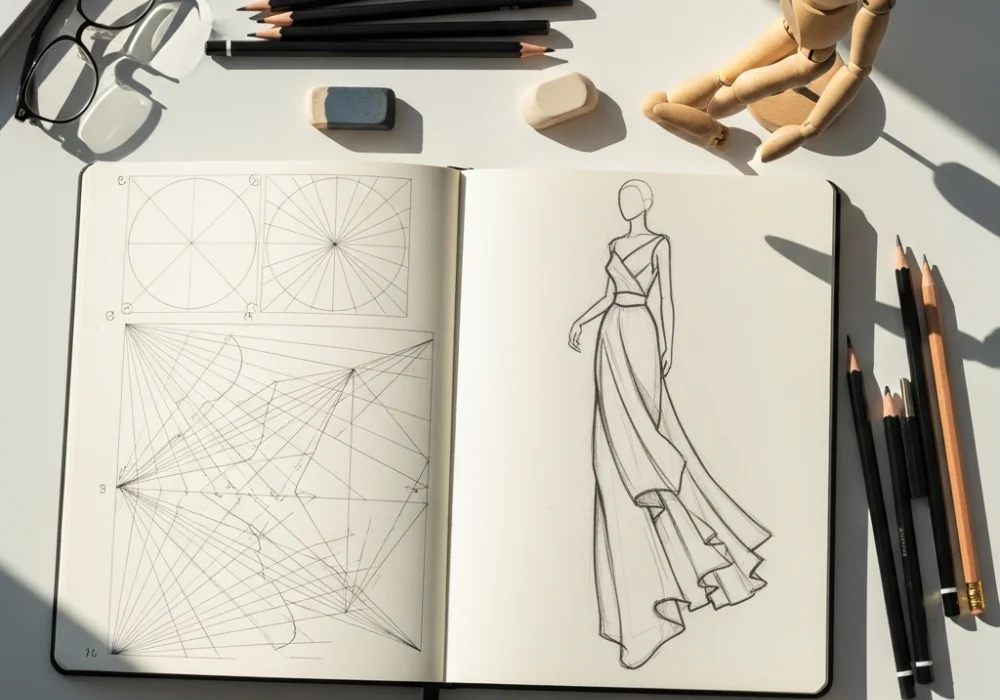
Designers must think in three dimensions. This exercise involves taking basic geometric shapes—circles, squares, and triangles—and turning them into spheres, cubes, and cones. Understanding how a flat shape gains volume through light and shadow is crucial for the NIFT entrance. Practice drawing these forms from various angles, focusing on how their appearance changes as you rotate them in your mind.
Exercise 3: Perspective Drawing for Scene Creation
The NIFT CAT often asks students to draw a scene, such as a busy marketplace, a room interior, or a futuristic city. To do this accurately, you must understand perspective. Beginners should focus on:
- One-Point Perspective: Ideal for drawing roads, railway tracks, or looking straight into a room. All lines converge at a single vanishing point on the horizon.
- Two-Point Perspective: Essential for drawing buildings or objects seen from a corner. This adds a level of realism and depth to your compositions.
Mastering these will allow you to create realistic environments that impress the examiners.
Exercise 4: Human Anatomy and Proportions
Fashion design is centered around the human body. However, for the CAT, you don’t just need to draw fashion croquis; you need to draw people in action. Start with the ‘Stick Figure’ method to understand movement, then move to the ‘Block Method’ to add volume. Practice the 8-head or 10-head theory to maintain correct proportions. Remember, the examiners look for posture, gesture, and the way clothes drape over a moving body.
Exercise 5: Texture and Material Rendering
Can you make paper look like silk? Can you make a sketch look like it is made of wood or glass? Rendering textures is a vital skill. Use different pencil grades (from 2B to 6B) to practice shading. Create small ‘texture squares’ where you practice mimicking surfaces like brick, fur, water, and metallic finishes. This attention to detail shows the evaluators that you have a keen eye for materials.
Comparing Your Progress: Basic vs. Advanced Sketching
To help you track your improvement, refer to the table below which highlights the transition from beginner to exam-ready skills.
| Skill Area | Beginner Level Focus | Advanced (Exam Ready) Focus |
|---|---|---|
| Line Quality | Wobbly, broken lines using a ruler. | Confident, smooth, freehand strokes. |
| Perspective | Flat, 2D drawings with no depth. | Dynamic 1, 2, and 3-point perspectives. |
| Human Figure | Stiff, unnatural stick figures. | Fluid anatomy with realistic gestures. |
| Shading | Uniform gray smudging. | Varied tones, highlights, and textures. |
| Composition | Cluttered and disorganized. | Balanced, storytelling-driven layouts. |
Utilizing Mock Tests for Real-Time Improvement
Practicing in a vacuum is not enough. You need to simulate the exam environment. This is where myentrance.in comes in. Our NIFT mock tests are designed based on the current syllabus and latest pattern. By taking these tests, you can practice sketching under time pressure, which is a significant factor in the actual CAT. Our platform provides the resources you need to transition from a beginner to a top-tier candidate.
Frequently Asked Questions (FAQ)
What pencils should I use for NIFT CAT sketching?
Beginners should start with a standard HB pencil for light sketching and move to 2B, 4B, and 6B for shading and detailing. Avoid using mechanical pencils for large drawings as they lack tonal range.
How much time should I spend on sketching daily?
Consistency is key. Spend at least 1 to 2 hours every day. Dedicate the first 20 minutes to warm-up exercises like lines and circles before moving to complex compositions.
Do I need to be a great artist to clear NIFT CAT?
No, you do not need to be a ‘fine artist’. NIFT looks for creativity, observation, and the ability to communicate an idea. As long as your sketches are neat, proportional, and creative, you can score highly.
Can I use colors in the CAT exam?
Yes, the CAT often requires you to use dry colors like pencil colors or oil pastels. Practice rendering with these mediums to ensure you can add vibrancy to your designs without smudging the work.
Conclusion
Sketching is a skill that is built over time through patience and practice. By mastering lines, understanding perspective, and practicing human anatomy, you set a strong foundation for your design career. Use the resources and mock tests at myentrance.in to stay ahead of the competition and refine your skills for the upcoming exams.
Need Personalized Guidance?
Whether you have doubts about a specific sketching technique or want access to the best mock tests for NIFT, Kerala PSC, or SSC, our experts are here to help you succeed!
💬 Chat with our Experts on WhatsApp (+91 9526806124)




