
Introduction
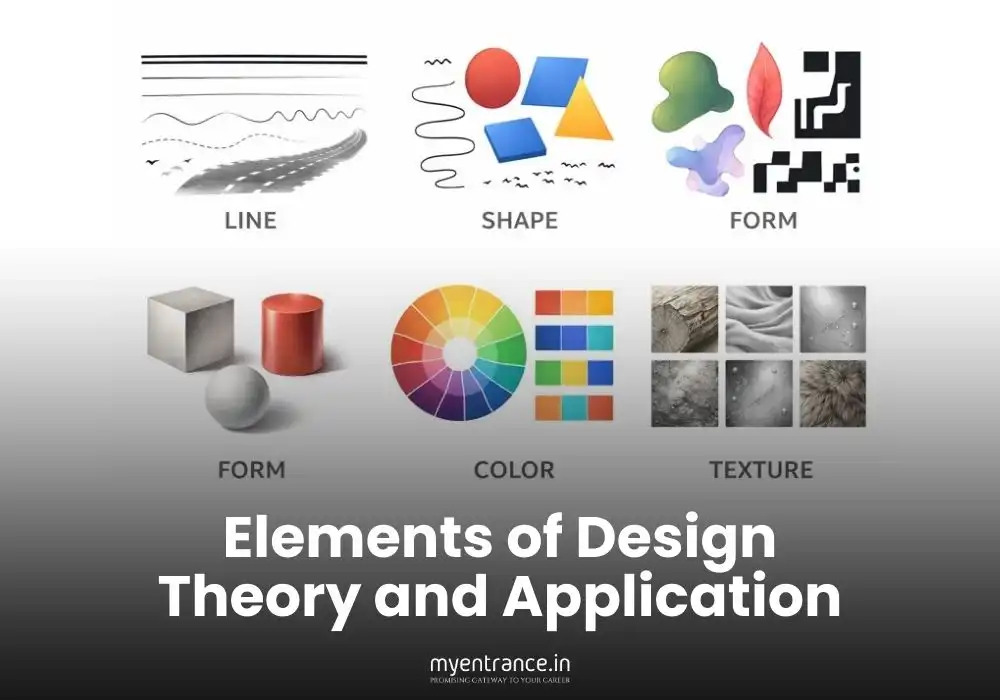
Design is a visual language. Just as language has alphabets and grammar, design has elements and principles. The Elements of Design are the most basic components that a designer uses to create any visual composition, object, space, or system. These elements do not function independently; they work together to communicate ideas, evoke emotions, and solve problems.
A designer’s ability is not judged by decoration alone, but by how effectively these elements are understood, controlled, and applied. For design entrance exams, a clear conceptual understanding of elements is crucial, as questions often test observation, logic, creativity, and justification, not just artistic skill.
The five primary elements of design are:
Line
Shape
Form
Color
Texture
1. LINE
Definition
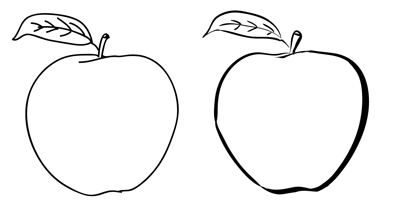
Line is the most fundamental element of design and forms the basis of visual expression. It is used to define boundaries, create direction, suggest movement, and convey emotions. Variations in line quality—such as thickness, continuity, and direction—help establish rhythm, hierarchy, and structure in a composition. Lines can be actual or implied and play a crucial role in guiding the viewer’s eye. A line is a mark connecting two points. It can be thick or thin, straight or curved, continuous or broken. Though simple, line is the foundation of all visual forms.
Application:
Used in wayfinding and signage systems to guide people through public spaces like airports or campuses..

Characteristics of Line
Length
Width (weight)
Direction
Texture
Continuity
Types of Lines and Their Meaning
| Type of Line | Visual Effect | Emotional / Symbolic Meaning |
|---|---|---|
| Horizontal | Stable, calm | Peace, rest, grounding |
| Vertical | Upright, strong | Power, growth, dignity |
| Diagonal | Dynamic | Movement, tension, speed |
| Curved | Flowing | Softness, grace, femininity |
| Zigzag | Sharp | Energy, chaos, excitement |
| Spiral | Continuous | Growth, evolution |
| Broken / Dotted | Interrupted | Fragility, rhythm |
Functions of Line in Design
Creates boundaries and outlines
Divides space
Guides the viewer’s eye
Creates emphasis and hierarchy
Suggests motion and direction
Builds texture through repetition
Exam Relevance
Used to show movement in compositions
Express emotions in storytelling questions
Create perspective and depth
Define textures in drawing tests
👉 Strong line quality = confident designer
2. SHAPE
Definition
Shape is a two-dimensional enclosed area formed by lines, colors, or contrast. Shapes can be geometric, organic, or abstract and are essential for organizing visual elements. It has height and width, but no depth. They help in creating patterns, symbols, and layouts while contributing to balance and visual interest. Effective use of positive and negative shapes enhances clarity and composition.
Application:
Used in logo and icon design to create easily recognizable visual identities.


Classification of Shapes
a) Geometric Shapes
Squares, rectangles, circles, triangles
Precise, structured, mathematical
Associated with order, stability, logic
Common in architecture, logos, UI design
b) Organic (Freeform) Shapes
Irregular, flowing shapes
Found in nature
Associated with freedom, softness, movement
Common in illustration, fashion, craft design
c) Abstract Shapes
Simplified or stylized forms
Represent ideas rather than reality
Used in conceptual and symbolic design
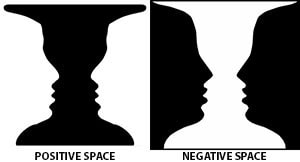
Positive and Negative Shapes
Positive shape: the main object
Negative shape: background space around it
Good design balances both.
Role of Shape in Design
Defines objects
Creates patterns and motifs
Establishes balance and rhythm
Builds identity (logos, symbols)
Communicates meaning visually
Exam Relevance
Pattern making
Logo and symbol design
Composition questions
Space organization tasks
👉 Designers think in shapes before details.
3. FORM
Definition
Form refers to three-dimensional objects that possess length, width, and depth. It defines volume and mass and is crucial in understanding spatial relationships. Forms can be real or implied and influence functionality, ergonomics, and visual weight. Good form balances aesthetics with usability.
Application:
Used in product and furniture design, such as shaping a chair for comfort and stability.

Difference Between Shape and Form
Shape is flat (2D)
Form is solid (3D)
Types of Forms
Geometric Forms
Cube, sphere, cone, cylinder
Structured, man-made
Used in products, furniture, architecture
Organic Forms
Irregular, natural, flowing
Inspired by living forms
Used in sculpture, fashion, biomimicry
Real vs Implied Form
Actual form: physical objects
Implied form: illusion of depth created through shading, overlap, perspective
Importance of Form in Design
Determines functionality
Influences ergonomics
Affects balance and stability
Creates visual weight
Defines spatial experience
Exam Relevance
Model making
Product design questions
3D visualization tasks
Furniture and space design problems
👉 Good form balances beauty and usability.
4. COLOR
Definition
Color is a powerful visual element that influences mood, perception, and communication. It is defined by hue, value, and intensity and can be organized using color schemes for harmony or contrast. Color also carries psychological and cultural meanings, making it a critical tool in conveying messages and emotions effectively.
Application:
Used in branding and packaging design to attract attention and convey brand personality.

Properties of Color
Hue – name of the color
Value – lightness or darkness
Intensity (Saturation) – brightness or dullness
Color Wheel
Primary: Red, Blue, Yellow
Secondary: Green, Orange, Violet
Tertiary: Mix of primary + secondary

Color Schemes
Monochromatic – single hue variations
Analogous – neighboring colors
Complementary – opposite colors
Triadic – three evenly spaced colors
Psychological & Cultural Impact
Red – passion, danger, energy
Blue – trust, calm, professionalism
Yellow – optimism, alertness
Green – nature, sustainability
Black – power, elegance
White – purity, simplicity
(Color meanings vary by culture—important for exams!)

Exam Relevance
Mood-based compositions
Product usability
Branding questions
Emotional storytelling
👉 Right color choice = right communication.
5. TEXTURE
Definition
Texture refers to the surface quality of an object, whether actual (tactile) or implied (visual). It adds depth, realism, and sensory appeal to a design. Texture influences user interaction, comfort, and material perception, making it vital in both functional and aesthetic design decisions.
Application:
Used in fashion and interior design, such as selecting fabrics or wall finishes to enhance comfort and experience.
Types of Texture
Tactile Texture
Actual physical feel
Rough, smooth, soft, hard
Visual Texture
Illusion created through drawing, patterns, shading
Role of Texture
Adds realism
Enhances sensory experience
Improves comfort and grip
Creates contrast and interest
Influences material selection
Texture in Different Fields
Fashion: fabric comfort and drape
Product design: grip, safety
Interiors: warmth and acoustics
Graphics: depth and richness
Exam Relevance
Material-based questions
Surface rendering
Craft and textile topics
Realistic drawing improvement
👉 Texture makes design feel real.
Conclusion
The Elements of Design—Line, Shape, Form, Color, and Texture—are the core vocabulary of visual communication. They allow designers to transform ideas into meaningful visual solutions. A strong understanding of these elements helps aspirants not only draw better but think like designers.
For entrance exams, these elements are tested through:
Observation
Logical composition
Creativity
Concept justification
Mastery of elements leads naturally to understanding principles of design, design thinking, and innovation. Every great design begins with these fundamentals.





