
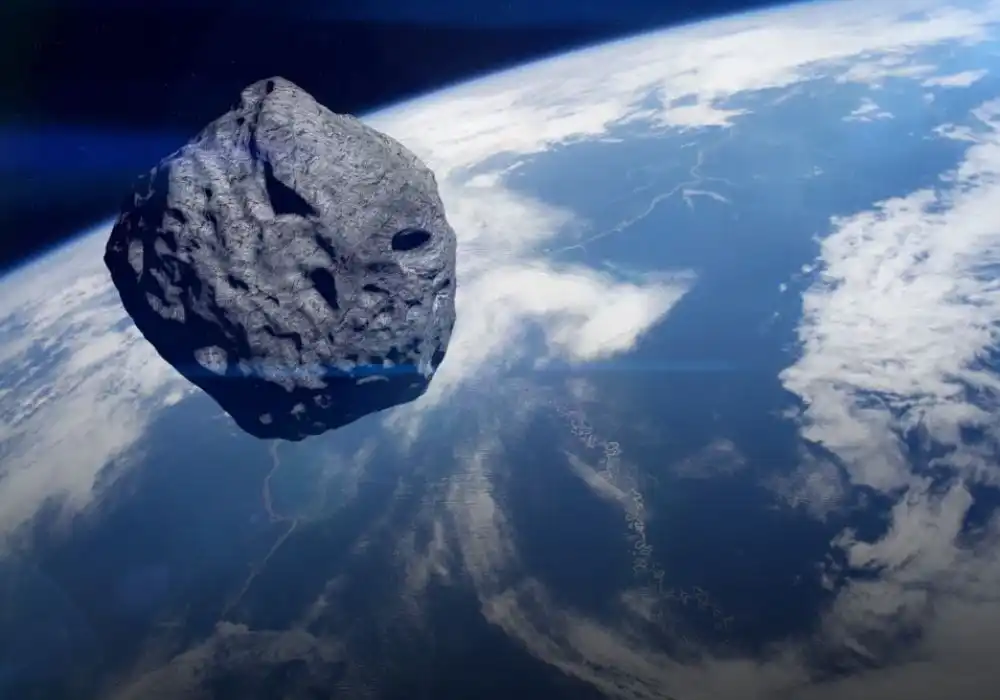
When we think of Earth’s celestial partners, our minds instantly go to the magnificent Moon, our planet’s singular, prominent natural satellite. Yet, the cosmos holds many more secrets just beyond our grasp. Far from being alone, Earth is often accompanied by a fascinating array of smaller, fleeting cosmic visitors – objects known as mini-moons and quasi-moons. Understanding these lesser-known companions is not just a treat for curious minds but also a crucial area of study for science, planetary defense, and even future space missions. For aspirants tackling competitive exams like UPSC, SSC, and other government services, grasping these astronomical phenomena enriches your General Knowledge and Science & Technology sections. Enhance your knowledge with our curated daily news analysis for GK.
What Exactly Are Mini-Moons? Earth’s Temporary Captives
Imagine a small asteroid, perhaps no bigger than a car or a small house, drifting through the vastness of space. Occasionally, such an asteroid might wander too close to Earth, getting snared by our planet’s gravitational pull. When this happens, it can temporarily enter into orbit around Earth, much like our main Moon, but for a significantly shorter period. These are what scientists call mini-moons.
Unlike our stable, long-term Moon, mini-moons have a chaotic and transient existence in Earth’s vicinity. Their orbits are often irregular and unstable, making them difficult to track. Typically, Earth might host a mini-moon for a few months, or sometimes up to a few years, before its orbit is disturbed by other gravitational forces (like the Sun or the Moon itself), sending it back into its solar orbit. Their small size and dim appearance mean they are only discovered through powerful telescopes, often serendipitously.
Understanding Quasi-Moons: Earth’s Distant Dance Partners
While mini-moons are truly Earth-orbiting bodies for a brief spell, quasi-moons present a different kind of cosmic relationship. These objects do not orbit Earth directly. Instead, they orbit the Sun, just as Earth does. However, their orbital period around the Sun is nearly identical to Earth’s, and their paths are subtly influenced by Earth’s gravity, causing them to appear to “follow” or “accompany” our planet from a distance.
Picture a complex celestial dance where Earth leads, and the quasi-moon performs an intricate, horseshoe-shaped or kidney-bean-shaped loop around it, always staying relatively close. They are gravitationally “bound” to Earth in a broader sense, maintaining their proximity over much longer timescales than mini-moons, sometimes for thousands of years. From Earth’s perspective, a quasi-moon never strays far, making it seem like a companion, even though its true orbit is around the Sun. A notable example is (3753) Cruithne, one of the earliest identified quasi-satellites of Earth.
Why Do These Celestial Objects Matter? Their Significance for Science and Beyond
The study of mini-moons and quasi-moons extends far beyond mere astronomical curiosity; it holds profound implications across several critical domains:
* Planetary Defense: These objects are essentially small asteroids that come very close to Earth. Studying their capture mechanisms, orbital dynamics, and composition provides invaluable data for understanding how Near-Earth Objects (NEOs) behave. This knowledge is crucial for developing strategies to detect and potentially mitigate the threat of asteroid impacts. By tracking them, we enhance our early warning systems.
* Insights into Solar System Formation: Mini-moons and quasi-moons are often pristine remnants from the early days of our solar system. Analyzing their composition can offer vital clues about the materials present when planets were forming and how asteroids have evolved over billions of years. They act as natural samples from the asteroid belt, delivered right to Earth’s doorstep without the need for expensive space missions.
* Future Space Exploration and Resource Utilization: Imagine future space missions needing resources like water or rare metals. Instead of launching heavy payloads from Earth, these temporary companions could potentially serve as accessible “pit stops” for mining operations. They could be targets for robotic missions to test new technologies for asteroid rendezvous and resource extraction, paving the way for sustained human presence beyond Earth.
* Understanding Gravitational Dynamics: The complex orbital interactions of mini-moons and quasi-moons with Earth, the Moon, and the Sun provide unique opportunities to study intricate gravitational mechanics. This helps scientists refine models of celestial motion and predict the paths of various cosmic bodies more accurately.
How Are They Discovered and Where Do They Originate?
The discovery of these dim, small objects requires persistent observation and sophisticated technology. Powerful ground-based telescopes, equipped with advanced survey systems, continuously scan the night sky for moving objects. The challenge lies in their small size and faintness, making them easily missed. Once detected, their paths are meticulously plotted to determine if they are indeed temporary satellites or merely passing asteroids.
Most mini-moons and quasi-moons are believed to originate from the main asteroid belt located between Mars and Jupiter. Over millions of years, gravitational perturbations can nudge these asteroids out of their stable orbits, sending them on paths that eventually bring them into Earth’s proximity. Some might even be fragments from larger comets or asteroids.
For anyone preparing for competitive exams, staying updated on such scientific discoveries and understanding the underlying principles of astronomy, physics, and space technology is paramount. These topics frequently appear in General Science, Current Affairs, and Environment & Ecology sections, demanding a clear comprehension of their ‘why,’ ‘what,’ ‘how,’ and ‘where.’ This guide simplifies learning static general knowledge for quick revision.
Frequently Asked Questions on Mini-Moon (FAQs)
1. What is the primary difference between a mini-moon and a quasi-moon?
The main difference lies in their orbit. A mini-moon is an asteroid temporarily captured by Earth’s gravity, truly orbiting Earth for a short period (months to a few years). A quasi-moon, however, orbits the Sun, but its path is gravitationally influenced by Earth, causing it to appear to “follow” or “accompany” Earth from a distance for much longer periods, without actually orbiting Earth itself.
2. How long do mini-moons typically stay in Earth’s orbit?
Mini-moons are very temporary. Once captured, they usually remain in Earth’s unstable orbit for a few months, or sometimes up to a few years, before eventually escaping Earth’s gravitational pull and returning to a solar orbit.
3. Why are mini-moons and quasi-moons difficult to spot?
They are challenging to detect primarily due to their small size and lack of significant brightness. Being much smaller than our Moon, they reflect very little sunlight, making them extremely faint and requiring powerful telescopes and diligent observation to discover.
4. Can mini-moons or quasi-moons ever pose a threat to Earth?
While both are asteroids that come close to Earth, their direct threat is generally low. Mini-moons are usually small and would likely burn up in the atmosphere if they were to de-orbit. Quasi-moons maintain a safe, albeit close, distance from Earth. However, studying them helps us understand the behavior of Near-Earth Objects (NEOs) in general, which is vital for planetary defense against potentially hazardous asteroids.
5. What is the most famous example of a quasi-moon of Earth?
One of the most well-known and extensively studied quasi-moons of Earth is (3753) Cruithne. Discovered in 1986, its complex “horseshoe” orbit around the Sun keeps it gravitationally linked to Earth, making it a classic example of this unique celestial phenomenon.





