Translate Language
Do You Know the Fascinating History of Kerala That Every PSC Aspirant Must Learn?
Kerala’s history is one of cultural confluence, global trade, and political transformations. Known since antiquity for its spice trade, the region attracted Greeks, Romans, Arabs, Portuguese, Dutch, and British powers. For Kerala PSC exam preparation, having a clear understanding of Kerala’s historical journey is crucial, as many exam questions are drawn directly from this heritage.
Important Facts About the History of Kerala
Ancient Mentions and Trade Connections
The earliest known reference to Kerala appears in the 3rd century BCE, when Emperor Ashoka mentioned “Keralaputra” in one of his rock edicts. In the later centuries BCE, Kerala became renowned for its spice exports, especially black pepper, which made it a significant trading hub for Greeks and Romans. During the first five centuries CE, Kerala formed part of Tamilakam and often came under the influence of the Cheras, Pandyas, and Cholas.
Jewish settlers are believed to have arrived in the 1st century, and as per tradition, St. Thomas the Apostle visited Kerala during the same period, laying the foundation for St. Thomas (Mar Thoma) Christian communities.
Medieval Period and Cultural Developments
From the 6th to the 8th centuries, Kerala’s history is less documented, but this era marked the arrival of Arab traders who introduced Islam. Under the Kulashekhara dynasty (800–1102 CE), Malayalam evolved as a distinct language, and Hinduism became a dominant force.
The Cholas intermittently controlled Kerala during the 11th and 12th centuries. By the 14th century, Ravi Varma Kulashekhara from Venad briefly established supremacy over southern India. After his death, Kerala splintered into smaller kingdoms, with Kozhikode (Calicut) in the north and Venad in the south emerging as key centers.
The Age of European Powers
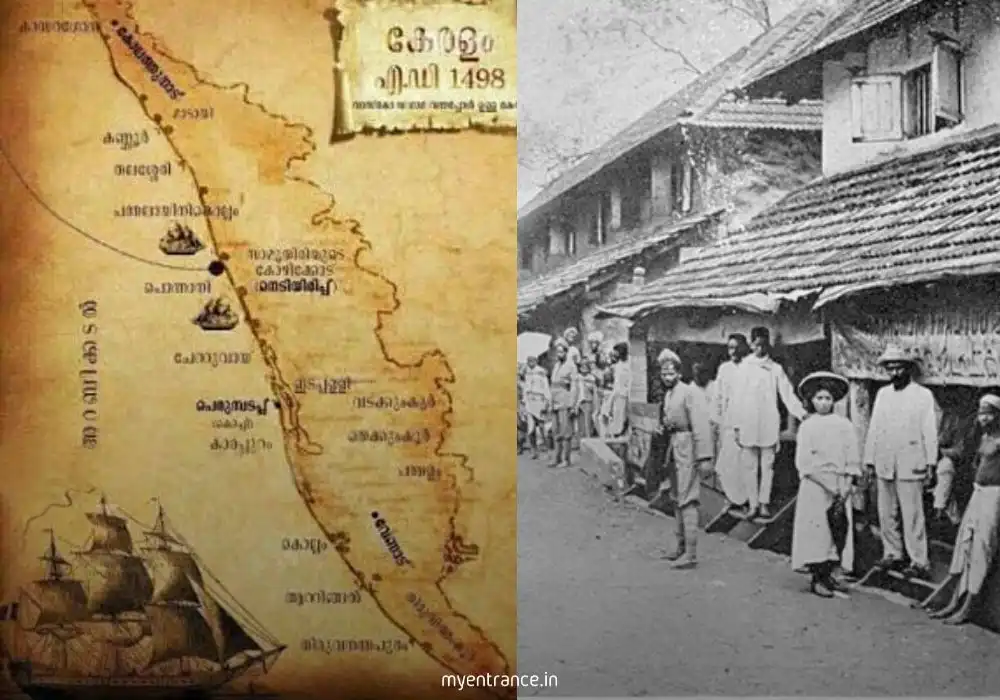
Kerala’s global exposure intensified when Vasco da Gama arrived at Calicut in 1498. The Portuguese initially controlled trade but faced resistance from the Zamorin of Calicut. By the 17th century, the Dutch replaced the Portuguese as dominant traders.
Marthanda Varma of Travancore, who came to power in 1729, decisively defeated the Dutch at the Battle of Kolachel (1741). He modernized Travancore’s army on European lines and expanded his kingdom. His strategic alliance with the Cochin Raja in 1757 safeguarded Cochin against the Zamorin.
By the early 19th century, however, Travancore, Cochin, and the Malabar region were brought under the control of the British Madras Presidency.
Towards Modern Kerala
After India gained independence in 1947, Travancore and Cochin merged in 1949 to form Travancore-Cochin. Later, in 1956, the reorganization of states on a linguistic basis led to the creation of modern Kerala. The new state included Malabar, Kasargod, and the earlier Travancore-Cochin region, while southern parts of Travancore were merged with Tamil Nadu.
Why Kerala’s History is Important for PSC Aspirants
For anyone preparing for Kerala PSC exams, history is not just about remembering dates but about connecting cultural, political, and social developments. Many questions in Daily Current Affairs, Static GK, and Daily News Quiz sections are linked to Kerala’s rich past.
Building a strong historical foundation also helps in Last Minute Preparation for competitive exams, since history often overlaps with polity, geography, and culture-based questions.
Read More Topics