
Introduction: The Gateway to NID DAT Mains
Passing the National Institute of Design (NID) Design Aptitude Test (DAT) Prelims is a monumental achievement, but it is only the first half of the journey. The second phase, commonly known as the NID Studio Test or DAT Mains, is where your theoretical knowledge meets practical execution. Unlike the Prelims, which focuses on your ability to visualize and represent ideas on paper, the Studio Test challenges your hands-on skills, material comprehension, and psychological resilience under pressure. At myentrance.in, we understand that this transition from 2D sketching to 3D modeling can be daunting, which is why we have curated this expert guide to help you navigate the nuances of the upcoming exams.
1. Understanding the Structure of NID Studio Test
The NID Studio Test is not a single exam but a series of diverse tasks designed to evaluate a candidate’s holistic design potential. While the exact pattern may vary across different NID campuses (Ahmedabad, Bengaluru, Kurukshetra, etc.), the core modules typically include material handling, sensory tests, and observation exercises. The objective is to see how you interact with physical objects and how you translate a concept into a tangible form. This stage carries significant weightage in the final merit list, making it crucial to approach each exercise with a blend of creativity and technical precision.
💡 Pro-Tip: Time Management
In the Studio Test, 3 hours might seem like a lot, but time flies when you are working with materials like clay or wire. Always dedicate the first 10 minutes to conceptualization and the last 15 minutes to cleaning your workspace and refining the stability of your model.
2. Mastering Material Handling and 3D Modeling
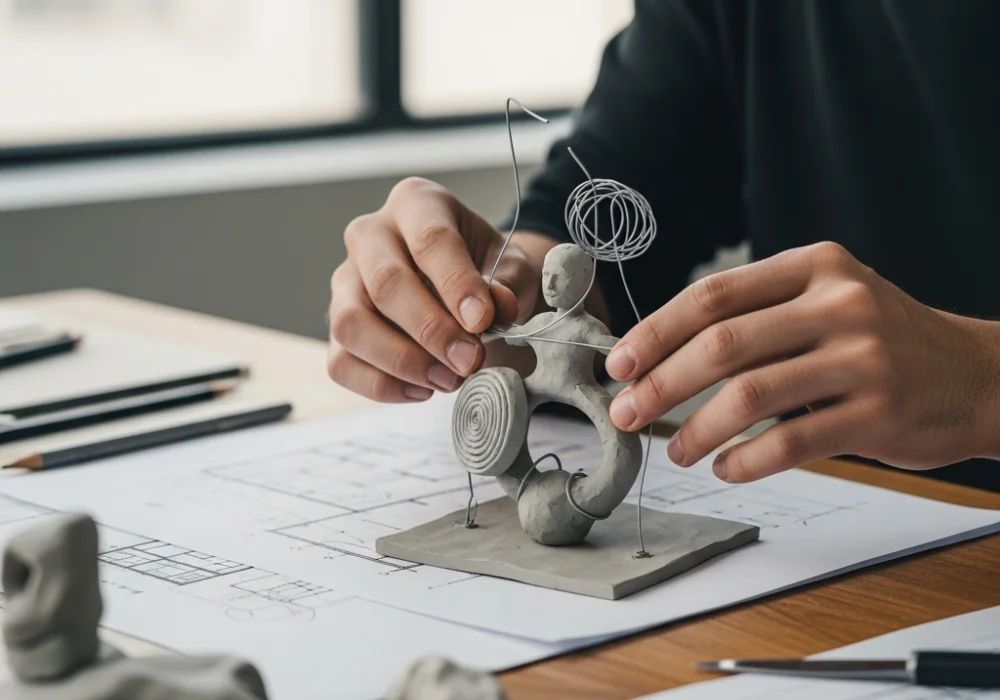
Material handling is the heart of the NID DAT Mains. Candidates are provided with a variety of materials such as wire, clay, thermocol, cardboard, plasticine, fabric, and even unconventional items like pins and straws. The task usually involves creating a 3D model that represents a specific theme or solves a particular problem. For instance, you might be asked to create a ‘Device for an Elderly Person to Pick Fruits’ or ‘A Sculpture Representing Chaos’.
Key Materials You Should Practice With:
- Clay/Terracotta: Focus on understanding texture, moisture control, and structural integrity. Practice making hollow forms and detailed textures.
- Wire (Copper/GI): Learn to create frameworks and skeletal structures. Practice bending, twisting, and joining without using excessive adhesive.
- Paper and Cardboard: Master the art of scoring, folding, and creating volume from 2D sheets. This is essential for architectural and product design concepts.
- Scrap/Found Objects: Use your imagination to repurpose everyday items like bottle caps, sticks, or cloth scraps into meaningful parts of your model.
At myentrance.in, our mock tests simulate these material-based challenges to help you build the necessary tactile skills and confidence.
3. Creative Thinking and Problem Solving
Innovation is the most important criteria for the NID Studio Test. The jury is not looking for the most beautiful model; they are looking for the most thoughtful solution. Before you touch the materials, ask yourself: Who is the user? What is the environment? How can this be made more efficient? Design empathy plays a massive role here. If the task is to design a workspace, think about ergonomics, lighting, and accessibility. Use your model to tell a story or solve a real-world friction point.
4. Observation and Sensory Tests
Designers must have heightened senses. The Studio Test often includes observation exercises where you might watch a short film and answer questions, or identify objects through touch alone. These tests measure your attention to detail and your ability to retain visual and tactile information. Sometimes, you may be asked to sketch an object from memory after seeing it for only 30 seconds.
💡 Pro-Tip: Sensory Awareness
Try practicing with a ‘Mystery Box’ exercise. Have a friend place a random household object in a bag. Without looking, feel the object for 1 minute and then sketch it in detail. This builds incredible tactile-to-visual memory.
5. Comparison: Prelims vs. Studio Test
Understanding the difference between the two stages helps in shifting your preparation mindset. Here is a quick comparison of what is expected in each phase:
| Feature | NID DAT Prelims | NID Studio Test (Mains) |
|---|---|---|
| Format | Pen and Paper / MCQ | Hands-on Workshops |
| Focus | Theoretical Visualization | Practical Application |
| Dimension | 2D Sketching | 3D Modeling & Execution |
| Criteria | Artistic Skill & GK | Material Handling & Observation |
6. Practical Exercises for Daily Practice
To excel in the Studio Test, you must move beyond textbooks. Here are three exercises you can start doing today to sharpen your skills for the upcoming exams:
- Exercise A: Wire Manipulation. Take a 1-meter long GI wire. Try to create the silhouette of a famous landmark (like the Eiffel Tower) using only the wire. No glue allowed! This teaches you about tension and structural balance.
- Exercise B: Paper Engineering. Take a standard A4 sheet. Without using any adhesive or tape, create a structure that can support the weight of your mobile phone. This exercise forces you to think about folds, ridges, and load-bearing designs.
- Exercise C: Thematic Clay Work. Use clay to represent abstract emotions like ‘Anxiety’, ‘Growth’, or ‘Stability’. Focus on how the texture of the clay (smooth vs. rough) can convey the message.
For more structured guidance and advanced exercises, check out the specialized NID prep modules available at myentrance.in. Our platform provides the latest pattern mock tests specifically designed for DAT Mains aspirants.
Frequently Asked Questions (FAQs)
Is the Studio Test only about 3D modeling?
No. While 3D modeling is a major part, the Studio Test also includes doodling, sensory tests, group discussions, and sometimes individual interviews to assess your overall design personality.
Can I bring my own materials to the NID Studio Test?
No. NID provides all the necessary materials for the test. You are usually only allowed to carry basic stationery like pencils, erasers, and sometimes a simple toolkit if specified in the admit card.
What if my model falls apart during the evaluation?
Structural stability is a grading criterion. However, if your concept is brilliant and your process description is strong, you may still score well. Always prioritize building a stable base before adding intricate details.
Quick Knowledge Check
Test your understanding of the NID Studio Test requirements with these quick questions:
1. Which material is best for creating a skeletal structure for a large model?
💡 Click to Reveal Answer
Wire (specifically GI or Copper wire) is ideal for creating skeletal frameworks due to its flexibility and strength.
2. What does ‘Scoring’ mean in the context of paper modeling?
💡 Click to Reveal Answer
Scoring is the process of making a shallow cut on the surface of the paper or cardboard to allow for a clean, sharp fold without tearing.
3. Why is the ‘Process Note’ important in the Studio Test?
💡 Click to Reveal Answer
It explains your thought process, choice of materials, and the problem you are solving, helping the jury understand your design rationale even if the model isn’t perfect.
Ready to Ace Your Design Exams?
Get access to expert-led mock tests and study material tailored for NID, NIFT, and other top entrance exams. Start your journey with myentrance.in today!
💬 Chat with our Experts on WhatsApp (+91 9526806124)




