
Introduction: The Digital Transformation of 2026
As of April 21, 2026, the landscape of Information Technology in India has shifted from basic digitization to a sophisticated ‘Intelligent Governance’ model. For aspirants of UPSC, SSC, and State PSCs, understanding these nuances is critical because the integration of AI, Quantum Computing, and advanced Semiconductors is no longer just a technical evolution but a socio-political priority. Today’s analysis focuses on how India is positioning itself as a global ‘Sovereign Tech’ leader, balancing innovation with stringent regulatory frameworks. We will explore the latest developments in AI ethics, the progression of the National Quantum Mission, and the second phase of the India Semiconductor Mission (ISM). This comprehensive guide is designed to provide you with the conceptual clarity required for Mains answers and the factual accuracy needed for Prelims and SSC exams.
💡 UPSC Mains Strategy: IT & Internal Security
In UPSC Paper III, Information Technology is often linked with Internal Security. When writing about AI or 6G, always mention the ‘Dual-Use’ nature of these technologies—how they benefit the economy while posing threats to data sovereignty and cybersecurity.
1. The India AI Accountability Act 2026
A landmark piece of legislation was tabled today regarding the ‘Artificial Intelligence Accountability Framework’. Unlike the earlier consultative papers, the 2026 Act categorizes AI systems into four risk levels: Unacceptable Risk, High Risk, Limited Risk, and Minimal Risk. This mirrors the EU AI Act but includes a unique ‘Indian Context Clause’ that mandates AI developers to ensure linguistic diversity and cultural sensitivity in their Large Language Models (LLMs). For SSC and PSC aspirants, remember that the nodal agency for this act is the Ministry of Electronics and Information Technology (MeitY). The act mandates that any AI system used in public service delivery must undergo an annual ‘Algorithmic Audit’ to prevent bias. This is a significant step toward ‘Ethical AI’, ensuring that marginalized communities are not excluded by automated decision-making processes in government schemes like PM-Kisan or Direct Benefit Transfers (DBT).
2. National Quantum Mission (NQM): Reaching Milestone 3
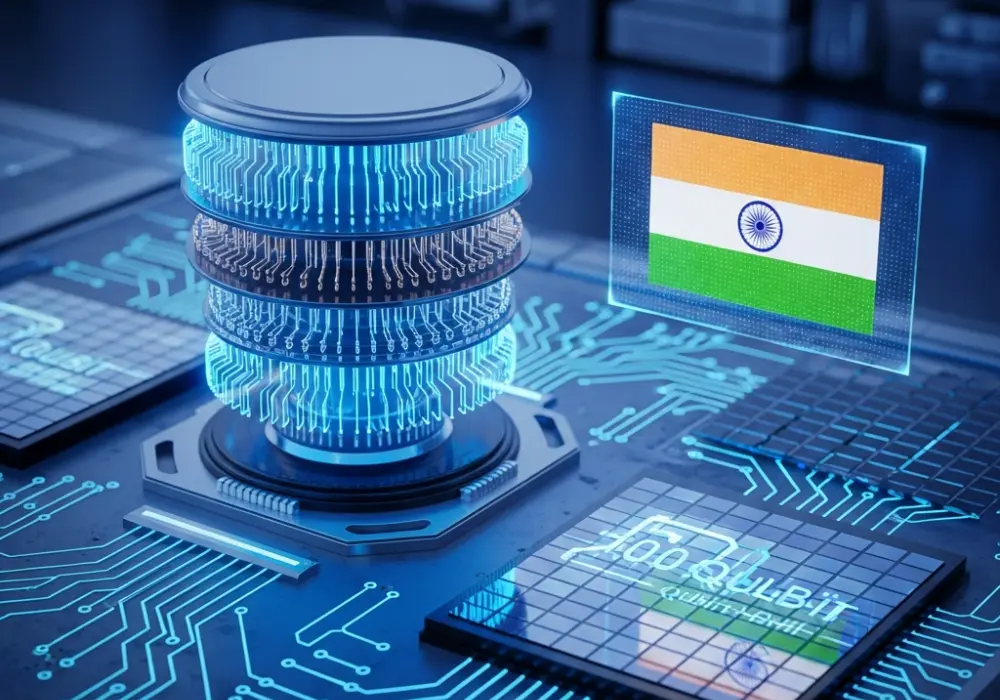
The National Quantum Mission, launched in 2023, has reached a critical milestone on this day in 2026. The Department of Science and Technology (DST) announced the successful deployment of a 100-qubit quantum processor developed natively by a consortium of IIT-Madras and TIFR. This puts India in a select group of nations capable of manufacturing quantum hardware. Why does this matter for your exams? Quantum computing uses ‘qubits’ instead of classical ‘bits’, allowing for simultaneous calculations through superposition and entanglement. In the context of national security, this development triggers the need for ‘Post-Quantum Cryptography’ (PQC) to protect India’s strategic assets from being hacked by future quantum computers. For Kerala PSC or other state exams, note that the first ‘Quantum Communication Hub’ is being piloted in the Kochi-Bengaluru industrial corridor to secure sensitive financial transactions.
💡 Terminology Alert: Superposition vs. Entanglement
Superposition allows a qubit to be in multiple states at once (0 and 1). Entanglement is a phenomenon where the state of one qubit is instantly connected to another, regardless of distance. These are core concepts for Science & Tech MCQs.
3. India Semiconductor Mission (ISM) 2.0
On April 21, 2026, the Union Cabinet approved the second phase of the India Semiconductor Mission (ISM 2.0) with an additional outlay of ₹40,000 crore. The focus has shifted from establishing ‘fabs’ (fabrication units) to ‘Design-Linked Incentives’ (DLI) for Indian startups. While the Dholera plant in Gujarat has started commercial production of 28nm chips, ISM 2.0 aims to push for 14nm and 7nm technology. Semiconductors are the ‘new oil’ of the 21st century, essential for everything from smartphones to missile guidance systems. For aspirants, the geographic distribution of these units is vital: Gujarat (Dholera), Assam (Jagiroad), and Tamil Nadu are emerging as the ‘Silicon Triangles’ of India. This decentralization helps in regional economic development and mitigates the risk of supply chain disruptions caused by geopolitical tensions in the Taiwan Strait.
4. 6G Trials and the Gati Shakti Sanchar Portal
While 5G penetration has reached 95% of India by 2026, the Department of Telecommunications (DoT) has today initiated the first pilot for 6G technology in urban clusters like New Delhi and Mumbai. The 6G Vision Document aims for speeds 100 times faster than 5G. For PSC aspirants, the integration of the ‘Gati Shakti Sanchar Portal’ is a key point. This portal streamlines the Right of Way (RoW) permissions, allowing for faster laying of optical fiber cables. This is crucial for ‘last-mile connectivity’ in rural India. The 6G ecosystem will rely heavily on Terahertz (THz) frequencies and ‘Intelligent Reflective Surfaces’. From an exam perspective, understand that 6G is not just about speed; it is about ‘Ubiquitous Connectivity’, integrating satellite communication (SatCom) with terrestrial networks to eliminate ‘no-network zones’ in the Himalayas and the North East.
5. Cybersecurity: The Rise of Deepfake Forensics
With the 2026 elections approaching in various states, the challenge of ‘Deepfakes’ has reached a zenith. Today, the Indian Computer Emergency Response Team (CERT-In) issued a directive for all social media intermediaries to deploy ‘Deepfake Detection Watermarks’ on AI-generated content. For UPSC aspirants, this links to the ‘Information Technology (Intermediary Guidelines and Digital Media Ethics Code) Rules’. The government is also setting up a ‘National Cyber-Forensics Lab’ dedicated to detecting synthetic media. Understanding the difference between ‘Disinformation’ (intentional spread of false info) and ‘Misinformation’ (unintentional spread) is crucial for ethics papers. The emergence of ‘Ransomware-as-a-Service’ (RaaS) is another trend noted in the 2026 Cybersecurity Report, highlighting the need for ‘Zero Trust Architecture’ in government databases like Aadhaar and CoWIN.
📝 Interactive Mock Quiz: 21 April 2026
Q1. Which Ministry is the nodal agency for the ‘India AI Accountability Act 2026’?
- A) Ministry of Science and Technology
- B) Ministry of Home Affairs
- C) Ministry of Electronics and Information Technology (MeitY)
- D) Ministry of Information and Broadcasting
✅ Click to Reveal Answer & Deep Explanation
Correct Answer: C) Ministry of Electronics and Information Technology (MeitY)
MeitY is the primary body responsible for IT policy, strategy, and regulation in India. While Science and Tech handle research (R&D) and Home Affairs handles internal security/cybercrime, the legislation and governance of AI frameworks fall under MeitY’s jurisdiction to ensure a cohesive digital economy.
Q2. In Quantum Computing, what does ‘Superposition’ refer to?
- A) A state where a qubit is only 0
- B) A state where a qubit can be both 0 and 1 simultaneously
- C) The process of cooling a computer to absolute zero
- D) A method of traditional binary calculation
✅ Click to Reveal Answer & Deep Explanation
Correct Answer: B) A state where a qubit can be both 0 and 1 simultaneously
Unlike classical bits which must be either 0 or 1, a qubit uses quantum mechanics to exist in a ‘superposition’ of both states. This allows quantum computers to process massive amounts of data in parallel, solving complex problems exponentially faster than classical supercomputers.
Q3. Which location is NOT part of India’s current semiconductor fabrication landscape mentioned in 2026?
- A) Dholera, Gujarat
- B) Jagiroad, Assam
- C) Sanand, Gujarat
- D) Lakshadweep Islands
✅ Click to Reveal Answer & Deep Explanation
Correct Answer: D) Lakshadweep Islands
Semiconductor fabs require massive industrial infrastructure, stable power, and specific water treatment facilities. Dholera and Sanand are established hubs in Gujarat, and Jagiroad in Assam has emerged as a major packaging and testing site. Lakshadweep is a sensitive ecological zone and is not suitable for high-intensity industrial manufacturing like semiconductor fabrication.
Q4. What is the primary purpose of the ‘Gati Shakti Sanchar Portal’?
- A) To track high-speed trains
- B) To streamline Right of Way (RoW) permissions for telecom infra
- C) To provide free internet to students
- D) To monitor quantum research labs
✅ Click to Reveal Answer & Deep Explanation
Correct Answer: B) To streamline Right of Way (RoW) permissions for telecom infra
The portal is a unified digital platform that allows telecom service providers to apply for permissions to lay fiber or install towers. It centralizes state and central approvals, significantly reducing the time taken for broadband rollouts, which is essential for the 5G and 6G missions.
Q5. Which technology is primarily used in 6G but was less prominent in 5G?
- A) Terahertz (THz) Frequencies
- B) Standard Radio Waves
- C) 4G LTE
- D) Analog Signals
✅ Click to Reveal Answer & Deep Explanation
Correct Answer: A) Terahertz (THz) Frequencies
6G aims to use the THz band (between microwave and infrared) to achieve massive bandwidth and sub-millisecond latency. While 5G uses Millimeter Wave (mmWave), 6G pushes further into the spectrum to enable technologies like holographic communication and high-precision sensing.
Q6. What is the main objective of a ‘Deepfake Detection Watermark’?
- A) To make the video look higher quality
- B) To identify content as AI-generated and prevent disinformation
- C) To protect the copyright of the AI tool
- D) To speed up video buffering
✅ Click to Reveal Answer & Deep Explanation
Correct Answer: B) To identify content as AI-generated and prevent disinformation
Watermarking ensures that viewers are aware that the media they are consuming is synthetic (AI-made). This is a vital tool for maintaining digital trust, especially during elections or sensitive news events where deepfakes could be used to impersonate leaders.
Q7. Which Indian city is hosting the first ‘Quantum Communication Hub’ pilot?
- A) Lucknow
- B) Kochi
- C) Patna
- D) Srinagar
✅ Click to Reveal Answer & Deep Explanation
Correct Answer: B) Kochi
As part of the Kochi-Bengaluru industrial corridor, Kochi has been selected for the first pilot due to its robust startup ecosystem and existing fiber infrastructure. This pilot focuses on Quantum Key Distribution (QKD) for banking sectors.
Q8. What does ‘Zero Trust Architecture’ mean in cybersecurity?
- A) Not trusting any employees with passwords
- B) Never trust, always verify every user and device
- C) A system without any antivirus
- D) Allowing everyone to access data freely
✅ Click to Reveal Answer & Deep Explanation
Correct Answer: B) Never trust, always verify every user and device
In Zero Trust Architecture, being ‘inside’ a network doesn’t grant you automatic trust. Every request for access to a system or data must be authenticated, authorized, and continuously validated, regardless of where the request originates.
Q9. What is ‘Algorithmic Auditing’ mentioned in the 2026 AI Act?
- A) Counting the number of computers
- B) Evaluating AI systems for bias and fairness
- C) Measuring the speed of the internet
- D) Selling user data to third parties
✅ Click to Reveal Answer & Deep Explanation
Correct Answer: B) Evaluating AI systems for bias and fairness
Algorithmic auditing is a technical and ethical review of an AI model to ensure it doesn’t discriminate against individuals based on race, gender, caste, or religion. It is a mandatory requirement for high-risk AI in the 2026 framework.
Q10. ISM 2.0 specifically focuses on which new area compared to ISM 1.0?
- A) Only importing chips
- B) Design-Linked Incentives (DLI) for startups
- C) Closing down factories
- D) Using coal to power chips
✅ Click to Reveal Answer & Deep Explanation
Correct Answer: B) Design-Linked Incentives (DLI) for startups
While ISM 1.0 focused on attracting big fabrication giants like Micron and Foxconn/Vedanta, ISM 2.0 pivots towards nurturing the domestic design ecosystem. This ensures that India doesn’t just ‘make’ chips but also ‘owns’ the Intellectual Property (IP) behind them.
🚀 Take Your Preparation to the Next Level!
Found this analysis helpful? Our experts are here to help you crack UPSC, SSC, and PSC exams with personalized mentorship and high-quality mock tests.
💬 Chat with our Experts on WhatsApp (+91 9526806124)




