
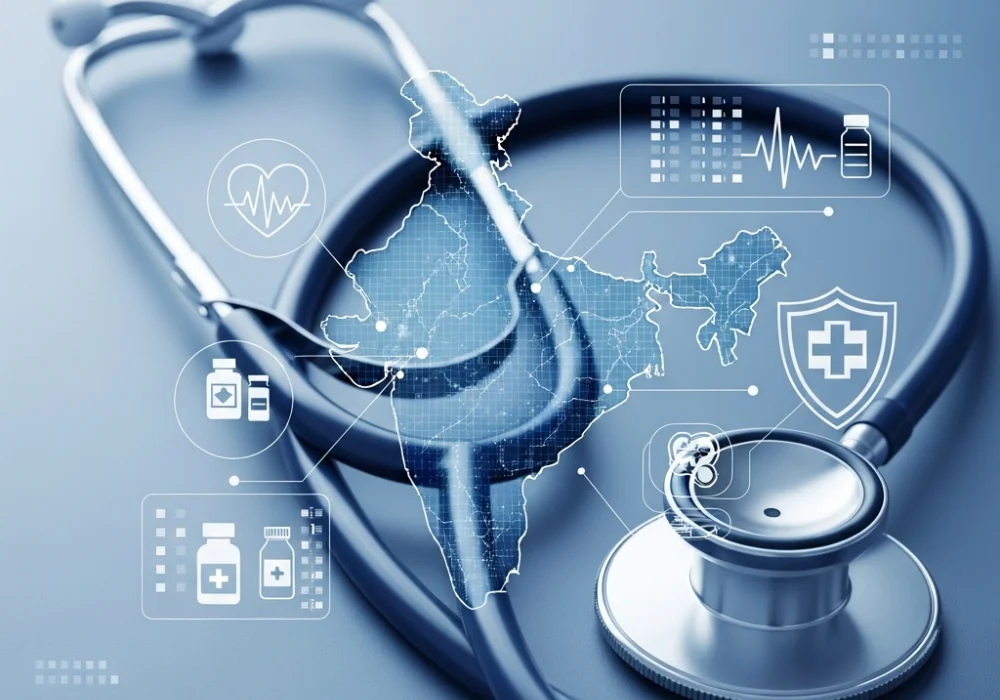
Introduction: The Pulse of India’s Healthcare Evolution
India’s healthcare industry has emerged as one of the largest sectors in terms of both revenue and employment. For aspirants of UPSC, SSC, and state PSCs, understanding the nuances of this sector is critical, as it intersects with social justice, economics, and technological innovation. The industry comprises hospitals, medical devices, clinical trials, outsourcing, telemedicine, medical tourism, health insurance, and pharmaceuticals. In recent years, India has transitioned from a focus solely on curative care to a more holistic approach encompassing preventive and primary healthcare.
💡 Why is this topic important for Exams?
Healthcare is a recurring theme in General Studies Paper II (Social Justice/Governance) and Paper III (Economy/Science & Tech) of the UPSC Mains. It also features heavily in Prelims under government schemes and economic indicators. Key themes include the ‘Right to Health’, public spending as a percentage of GDP, and the ‘Pharmacy of the World’ tag.
Market Size and Economic Significance
The Indian healthcare market is growing at a CAGR of about 22% since 2016. It is expected to reach $372 billion by the end of 2024. Factors driving this growth include rising incomes, greater health awareness, lifestyle diseases, and increasing access to insurance. India is also a global leader in the pharmaceutical sector, being the largest provider of generic drugs globally, fulfilling 20% of the total global demand by volume. The industry is categorized into the public and private sectors. While the public sector focuses on secondary and tertiary care in urban areas and basic healthcare in rural areas, the private sector provides the majority of secondary, tertiary, and quaternary care institutions.
India’s competitive advantage lies in its large pool of well-trained medical professionals and significantly lower costs of treatment compared to developed nations. For instance, the cost of heart surgery in India is roughly one-tenth of that in the United States, which fuels the booming medical tourism sector, currently growing at 18% annually.
Government Interventions: Ayushman Bharat & Beyond
The Government of India has launched several flagship schemes to achieve Universal Health Coverage (UHC). The most prominent is Ayushman Bharat, launched in 2018. It has two main pillars:
- Health and Wellness Centres (HWCs): Transforming existing sub-centres to provide Comprehensive Primary Health Care (CPHC) including maternal and child health services and non-communicable diseases.
- Pradhan Mantri Jan Arogya Yojana (PM-JAY): The world’s largest fully government-funded health insurance scheme, providing a cover of ₹5 lakh per family per year for secondary and tertiary care hospitalization to over 12 crore poor families.
Furthermore, the Ayushman Bharat Digital Mission (ABDM) aims to develop the backbone necessary to support the integrated digital health infrastructure of the country. It bridges the gap between different stakeholders of the healthcare ecosystem through digital highways.
💡 Pro-Tip: Public Health Expenditure
According to the Economic Survey, India’s public healthcare spending has risen but remains around 2.1% of GDP. The National Health Policy (NHP) 2017 targets increasing this to 2.5% of GDP by 2025. Mentioning these specific targets in your answers adds significant value.
Pharmaceuticals and Medical Devices
India is often called the “Pharmacy of the World.” The Indian pharmaceutical industry is the 3rd largest by volume and 14th largest by value globally. To reduce dependence on imports, particularly Active Pharmaceutical Ingredients (APIs) from China, the government introduced the Production Linked Incentive (PLI) Scheme for Pharmaceuticals and Bulk Drugs. This is a critical step toward ‘Atmanirbhar Bharat’ (Self-reliant India).
The Medical Devices sector is also a ‘sunrise sector.’ Currently, India imports nearly 70-80% of its medical devices. To counter this, the National Medical Device Policy 2023 was approved to facilitate an orderly growth of the sector and meet the public health objectives of equity, affordability, and quality.
Challenges in the Indian Healthcare Sector
Despite significant progress, challenges remain. The primary issue is the Rural-Urban Divide; 75% of healthcare infrastructure is concentrated in urban areas where only 27% of the population resides. Other challenges include:
- Shortage of Manpower: India faces a shortage of doctors and nurses. The WHO recommends a 1:1000 doctor-to-population ratio; India has reached this on paper (including AYUSH doctors), but specialized care in rural areas is still lacking.
- High Out-of-Pocket Expenditure (OOPE): Even with insurance, a significant portion of the population pays from their savings, pushing millions into poverty every year.
- R&D Gaps: While India excels in generic manufacturing, it lags in the discovery of new molecular entities and high-end medical technology.
Future Outlook: Telemedicine and AI
Telemedicine and Digital Health are the next frontiers. The eSanjeevani platform has facilitated millions of teleconsultations, proving that technology can bridge the geographical gap in healthcare access. Artificial Intelligence (AI) is being integrated for early diagnosis of diseases like cancer and tuberculosis, especially in resource-constrained settings. The National Health Stack (NHS) is being built to provide a digital framework for these innovations to scale.
🧠 Interactive Mock Quiz: Healthcare Industry
Q1. What is the target public healthcare spending as a percentage of GDP according to the National Health Policy 2017?
- A) 1.5%
- B) 2.5%
- C) 5.0%
- D) 3.5%
✅ Click to Reveal Answer & Deep Explanation
Correct Answer: B) 2.5%
The National Health Policy (NHP) 2017 set a target to increase the government’s health expenditure from the then-current levels to 2.5% of the GDP by 2025. This is intended to reduce out-of-pocket expenses and improve the quality of public health services. Options A, C, and D are incorrect as they do not match the specific policy target mentioned in official government documents.
Q2. Which scheme is known as the ‘world’s largest government-funded health insurance scheme’?
- A) PM Suraksha Bima Yojana
- B) PM Jan Dhan Yojana
- C) Ayushman Bharat PM-JAY
- D) Rashtriya Swasthya Bima Yojana
✅ Click to Reveal Answer & Deep Explanation
Correct Answer: C) Ayushman Bharat PM-JAY
The Pradhan Mantri Jan Arogya Yojana (PM-JAY) provides a health cover of Rs. 5 lakh per family per year for secondary and tertiary care. It targets over 12 crore poor and vulnerable families. PM Suraksha Bima Yojana (Option A) is an accident insurance scheme, while PM Jan Dhan Yojana (Option B) is for financial inclusion. RSBY (Option D) was the predecessor to PM-JAY.
Q3. What is the rank of India in the global pharmaceutical market by volume?
- A) 1st
- B) 3rd
- C) 14th
- D) 10th
✅ Click to Reveal Answer & Deep Explanation
Correct Answer: B) 3rd
India ranks 3rd in the world in pharmaceutical production by volume and 14th by value. This discrepancy exists because India produces a massive quantity of low-cost generic drugs. Option C (14th) refers to the value rank, while Option B (3rd) is the volume rank, which was asked in the question.
Q4. The ‘eSanjeevani’ platform is associated with which facet of healthcare?
- A) Organ Donation
- B) Telemedicine
- C) Medical Waste Management
- D) Vaccine Cold Chain
✅ Click to Reveal Answer & Deep Explanation
Correct Answer: B) Telemedicine
eSanjeevani is a doctor-to-doctor (eSanjeevani AB-HWC) and doctor-to-patient (eSanjeevaniOPD) teleconsultation system. It was launched to provide remote healthcare services, ensuring that patients in rural areas can consult specialists without traveling. This was particularly vital during the COVID-19 pandemic.
Q5. What percentage of medical devices in India are currently imported?
- A) 20-30%
- B) 40-50%
- C) 70-80%
- D) 95-100%
✅ Click to Reveal Answer & Deep Explanation
Correct Answer: C) 70-80%
Despite having a strong pharmaceutical base, India significantly lags in medical device manufacturing, importing roughly 70-80% of its requirements, especially high-end equipment like MRIs and CT scanners. The government is trying to reduce this through PLI schemes for medical devices.
Q6. Which mission aims to develop an integrated digital health infrastructure across India?
- A) Digital India Mission
- B) Ayushman Bharat Digital Mission (ABDM)
- C) National Health Mission
- D) PM Swasthya Suraksha Yojana
✅ Click to Reveal Answer & Deep Explanation
Correct Answer: B) Ayushman Bharat Digital Mission (ABDM)
ABDM aims to create a seamless digital ecosystem for healthcare. Key components include a Health ID (ABHA) for every citizen, a Healthcare Professionals Registry (HPR), and Health Facility Registries (HFR). While Option A is a broader umbrella, ABDM is specific to the health sector.
Q7. What is the doctor-to-population ratio recommended by the World Health Organization (WHO)?
- A) 1:500
- B) 1:1000
- C) 1:2000
- D) 1:100
✅ Click to Reveal Answer & Deep Explanation
Correct Answer: B) 1:1000
The WHO recommends a minimum of 1 doctor for every 1000 people. While India has officially achieved a ratio of 1:834 (by including AYUSH practitioners), the availability of allopathic doctors in rural public health centers remains a critical concern for policymakers.
Q8. Which state in India is often cited for having the highest health indices, comparable to developed nations?
- A) Maharashtra
- B) Kerala
- C) Tamil Nadu
- D) Punjab
✅ Click to Reveal Answer & Deep Explanation
Correct Answer: B) Kerala
Kerala consistently tops the NITI Aayog’s Health Index. Its robust primary healthcare system, high literacy rates, and focus on decentralization (Panchayati Raj) in health management are key reasons for its success in maternal and infant mortality rates.
Q9. The PLI Scheme for pharmaceuticals specifically focuses on increasing the domestic production of:
- A) Ayurvedic Herbs
- B) Active Pharmaceutical Ingredients (APIs)
- C) Hospital Furniture
- D) Surgical Masks
✅ Click to Reveal Answer & Deep Explanation
Correct Answer: B) Active Pharmaceutical Ingredients (APIs)
APIs are the raw materials needed to manufacture finished drugs. India currently relies heavily on China for these. The PLI (Production Linked Incentive) scheme provides financial incentives to domestic manufacturers to produce these critical ingredients locally, ensuring supply chain security.
Q10. What is the main objective of the PM Swasthya Suraksha Yojana (PMSSY)?
- A) Free distribution of medicines
- B) Correcting regional imbalances in tertiary healthcare
- C) Providing sanitation facilities in hospitals
- D) Enhancing nurse training modules
✅ Click to Reveal Answer & Deep Explanation
Correct Answer: B) Correcting regional imbalances in tertiary healthcare
PMSSY was launched with the dual objective of correcting regional imbalances in the availability of affordable tertiary healthcare services and augmenting facilities for quality medical education in the country through the setting up of AIIMS-like institutions and upgrading government medical colleges.
Need Help with Your Preparation?
Our experts are available to provide you with free mentorship, detailed study materials, and mock tests to help you crack your dream competitive exam.
💬 Chat with our Experts on WhatsApp (+91 9526806124)




