
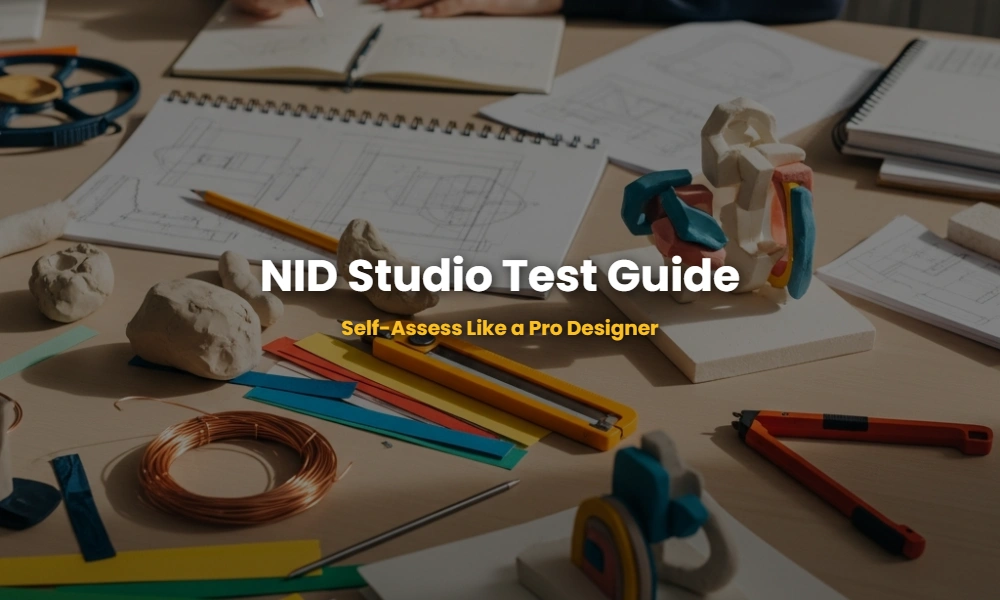
Evaluating your NID Studio Test mock exercises at home requires a rigorous, objective approach based on five core design pillars: material handling, structural integrity, conceptual innovation, aesthetic finish, and time management. To effectively self-assess, you must distance yourself from your creation and use a quantitative rubric that mimics the high standards of the National Institute of Design examiners.
🚀 Key Takeaways
- Understand that material manipulation is more important than the final beauty of the model.
- Use a 10-point scale for objective self-grading across different categories.
- Prioritize utility and function over purely decorative elements.
- Always perform a ‘Shake Test’ to check the structural stability of your 3D models.
- Analyze if your design logic solves the problem stated in the prompt effectively.
Table of Contents
Is Your NID Studio Test Practice Wasted?
Most aspirants fail the NID Studio Test because they focus on making ‘pretty’ things rather than demonstrating ‘design thinking’ and material intelligence. At home, you must assess whether your mock exercises show a deep understanding of the medium you are using, whether it is clay, wire, or paper. If your model falls apart or lacks a clear conceptual story, your practice is indeed ineffective for the high standards of NID entrance exam strategy.
To stop wasting time, start by recording your entire process. The Studio Test isn’t just about the end result; it is about the economy of movement and the efficiency of your material usage. Ask yourself: Did I use the minimum amount of adhesive? Did I maximize the properties of the material? For instance, if you are working with wire, did you leverage its tensile strength or just bend it randomly? These are the questions that separate toppers from the rest.
💡 Click to Reveal the ‘White Space’ Secret
Designers value the use of negative space. When self-assessing, check if your model or doodle is too cluttered. A clean, minimalist approach often scores higher as it shows confidence and clarity of thought.
The Secret Checklist: Is Your 3D Model Passing?
A passing 3D model in an NID Studio Test mock must stand independently, satisfy the prompt’s functional requirements, and exhibit clean joints and edges. If your model relies on excessive tape or glue to stay upright, it fails the structural integrity test. Professional evaluation involves checking if the model looks the same from all 360-degree angles, showing consistent effort and detail.
When evaluating at home, look for these three ‘S’ factors: Stability, Symmetry, and Storytelling. Does the model wobble when you blow on it? (Stability). If the design requires balance, is it perfectly aligned? (Symmetry). Does the form immediately communicate what it is supposed to be? (Storytelling). If you have to explain your model for someone to understand it, the design has failed its primary goal. You should also ensure you are following professional design sketching tips before you even touch the materials.
The Home Evaluation Rubric
Assign yourself scores out of 10 for each of the following:
- Interpretation of Brief: Did you strictly follow the constraints?
- Innovation: Is your idea different from the first 5 things that came to mind?
- Material Handling: Did you respect the material (e.g., no unnecessary folding of paper)?
- Craftsmanship: Are there visible glue marks or messy cuts?
- Stability: Is the structure rigid and purposeful?
Why Your Material Handling Logic is Probably Wrong?
Material logic in the NID context means using a material’s inherent properties to solve a problem—such as using the flexibility of wire for hinges or the rigidity of cardboard for load-bearing. Most students treat all materials as ‘building blocks,’ which is a fundamental error. Self-assessment must focus on whether you exploited the material’s unique characteristics to achieve your design goal.
For example, if you are given a sheet of aluminum, did you just wrap it around something, or did you explore scoring, folding, and creating textures? The examiner looks for a ‘dialogue’ between the maker and the material. At home, analyze your scraps. If you have more waste than used material, your material planning is poor. A design-thinking approach minimizes waste while maximizing impact. This level of detail is crucial for your NID portfolio guide development as well.
Doodling Disasters: Are You Ignoring Marking Schemes?
Doodling and visualization exercises in the NID Studio Test are evaluated based on observational depth, line quality, and the ability to convey motion or emotion through static lines. It is not about being a ‘fine artist’ but about being a ‘visual communicator.’ Self-assess by checking if your sketches demonstrate perspective, proportion, and a clear focal point that draws the eye.
Common disasters include using ‘hairy’ or shaky lines instead of confident, single-stroke lines. When reviewing your mocks at home, place your sketches across the room. If the main idea is still visible and clear from 5 feet away, your visual hierarchy is correct. If it looks like a mess of gray scribbles, you need to work on your tonal contrast and line weight. Remember, the examiner only spends a few seconds on each sheet—your sketch must ‘pop’ instantly.
💡 Pro Tip: The Mirror Test
Hold your drawing up to a mirror. Any errors in proportion or perspective that your brain ‘fixed’ while drawing will immediately become obvious in the reflection. This is a secret trick used by professional animators and designers.
NID Evaluation Metrics Comparison Table
Use this table to objectively compare your current mock performance against the expected ‘Topper’ standards at NID.
| Feature | Average Performance | Topper Standard |
|---|---|---|
| Material Usage | Uses material as a substitute for something else. | Exploits inherent properties (texture, strength). |
| Finish/Neatness | Visible adhesive, rough edges, smudges. | Surgical precision, invisible joints. |
| Concept | Literal interpretation of the prompt. | Metaphorical and abstract problem solving. |
| Time Management | Rushes the last 20% of the work. | Consistent quality from start to finish. |
Insider Examiner Evaluation Hacks
Examiners at NID often look for ‘The Unexpected Detail’—a small touch that shows you were thinking about the user experience. When self-assessing your home mocks, check if you have included ergonomic considerations or sensory details that make the design more human-centric. Did you consider how a person would hold the object? Did you think about the safety of the edges?
Another high-level evaluation technique is the ‘Concept Write-up’. In the actual test, you are often asked to write a brief explanation. Evaluate your own write-up: Is it filled with buzzwords, or does it actually explain your design choices? If your write-up doesn’t match the physical model, your score will drop significantly. Self-assessment is about brutal honesty. If you wouldn’t buy your product in a store, why would an examiner give it a seat at NID?
Commonly Asked Questions (FAQ)
How do I simulate the NID Studio Test environment at home?
Set a strict timer for 3 hours, use a limited set of materials (only what is in your mock kit), and work on a small, cluttered desk to mimic the actual exam hall pressure.
What is the most important criteria in NID Studio Test evaluation?
Material handling and conceptual innovation carry the most weight. Your ability to think ‘out of the box’ while respecting the constraints of the physical medium is key.
Should I focus more on the model or the sketch?
Both are vital, but the 3D model usually carries higher marks in the Studio Test phase as it demonstrates tactile skills and spatial reasoning that sketches cannot.
Need Personalized Feedback on Your Mocks?
Don’t leave your design future to chance. Get your mock exercises reviewed by NID alumni and expert mentors today!
💬 Chat with our Experts on WhatsApp (+91 9526806124)




