
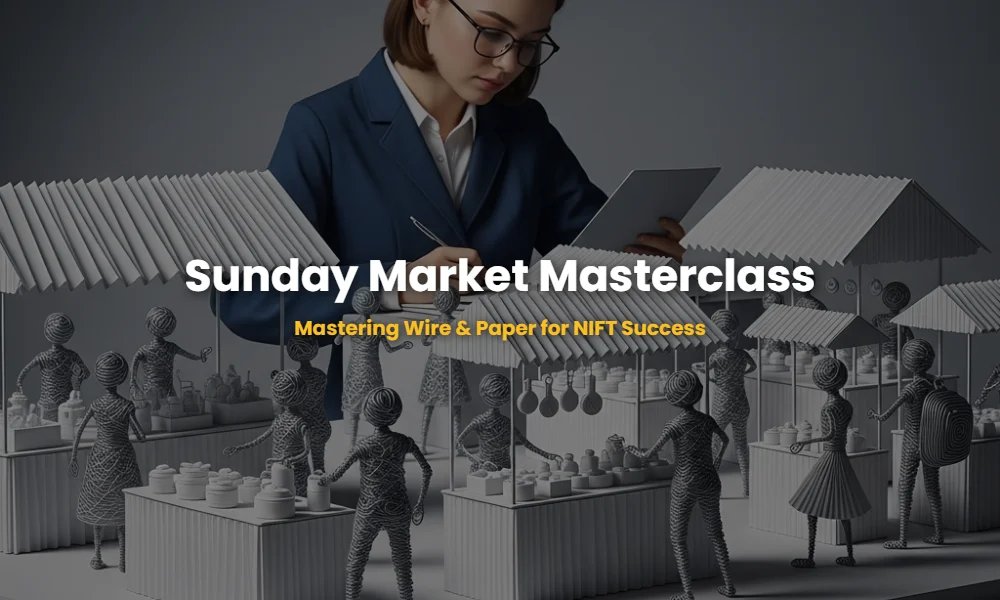
As a senior member of the NIFT Admission Panel, I have witnessed thousands of students struggle with the infamous 3D modeling round. The Chaos of a Sunday Market is a classic prompt designed to test your spatial intelligence and material handling. Most aspirants fail because they try to be literal. To score an A+, you must transcend the physical and model the energy of the market using just wire and paper.
🚀 Key Takeaways
- Master abstract storytelling over literal representation.
- Learn the ‘Skeleton-Skin’ technique for wire and paper.
- Understand the 5 core Evaluation Criteria examiners look for.
- Discover how to write a Concept Note that seals the deal.
Table of Contents
Is Your Sunday Market Concept Too Boring?
To win the NIFT Situation Test, your Sunday Market concept must focus on dynamic movement and sensory overload rather than static stalls. Examiners look for how you translate the noise, the crowds, and the overlapping layers of a bazaar into a cohesive 3D composition using structural hierarchy.
When you think of a Sunday Market, don’t just build a table with fruit. Build the rhythm. Use your wire to create the sweeping paths of the crowd and your paper to create the ‘visual noise’ of hanging fabrics, discarded boxes, and fluttering awnings.
💡 Pro-Tip: The ‘Vortex’ Concept
Instead of a grid layout, arrange your elements in a spiral or vortex shape. This subconsciously signals ‘chaos’ and ‘energy’ to the examiner, showing high-level design thinking.
The Wire Hacks You’re Ignoring?
The secret to using wire in the Situation Test is to treat it as a 3D drawing tool that provides structural integrity while representing movement. You must master twisting, coiling, and looping to create the ‘skeleton’ of your market stalls and the gestural forms of the crowd.
Wire is often the most underutilized material. In a Sunday Market model, use thin wire to represent the overhead power lines or the tangled structure of a makeshift roof. Use thicker wire loops to signify the bustling movement of people. Remember, a clean joint is the difference between a mess and a masterpiece. Use advanced bending techniques to avoid messy glue blobs.
The Paper Manipulation Tricks You Can’t Skip?
Paper manipulation in the Chaos of a Sunday Market requires textural variety such as pleating, quilling, and crumpling to represent different market elements. By changing the surface quality of the paper, you represent different materials like cloth, metal, or organic produce without needing extra props.
Consider these techniques:
- Pleating: For the corrugated metal sheets of stalls.
- Quilling: For the organic shapes of fruits and vegetables.
- Crumpling: To show the ‘chaos’ of discarded bags or weathered textures.
- Layering: To create depth and the feeling of a crowded space.
Always ensure your paper elements are securely attached to your wire skeleton. This shows the examiner you understand material synergy.
The Secret Evaluation Rubric Revealed?
The NIFT Situation Test evaluation is based on a strict 5-point rubric including innovation, material handling, aesthetic appeal, neatness, and conceptual clarity. To score high, your model must remain stable (not falling apart) while pushing the boundaries of the prompt’s interpretation.
| Criteria | What We Look For | Weightage |
|---|---|---|
| Material Handling | Minimal glue marks, sturdy wire joints, innovative paper folds. | 30% |
| Conceptualization | Does it represent ‘Chaos’ or just a ‘Market’? | 25% |
| Aesthetic Appeal | Composition balance and visual flow. | 20% |
| Write-up | Clarity of thought and design vocabulary. | 15% |
| Innovation | Unique use of wire/paper (e.g., weaving wire into paper). | 10% |
Is Your Write-up Killing Your Score?
A winning Concept Note for the Sunday Market must explain your design metaphors and how you used specific techniques to represent chaos. It shouldn’t just describe what you built; it must explain why you built it that way using professional design terminology.
For example, instead of saying “I made wire people,” say “I utilized wire gestures to represent the kinetic energy and overlapping paths of urban shoppers.” This shows creative maturity. Use keywords like ‘juxtaposition’, ‘hierarchy’, and ‘spatial fluidity’.
💡 Click to Reveal the Secret Sentence
Always include this: “My model explores the intersection of commerce and chaos through the tension between structural wire elements and organic paper forms.”
Need Direct Guidance from NIFT Alumni?
Don’t leave your fashion dreams to chance. Get personalized feedback on your models and concept notes today!
💬 Chat with our Experts on WhatsApp (+91 9526806124)




