
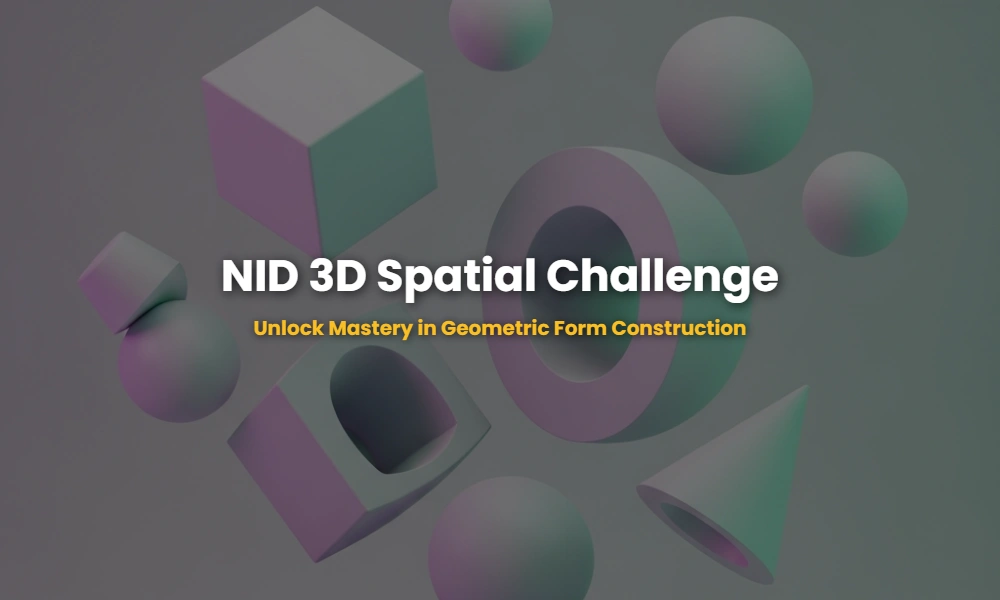
Mastering Spatial Visualization 3D Form NID is often the single most significant factor that separates the top 1% of rankers from the thousands of aspirants who fail the Design Aptitude Test (DAT) every year. This cognitive skill isn’t just about drawing; it is about the mental capacity to manipulate complex geometric entities in your mind’s eye before your pencil even touches the paper. The NID examiners are not just looking for artists; they are hunting for designers who can see through solid matter, predict the outcome of interpenetrating solids, and accurately render sectional views that most people cannot even imagine.
Is Spatial Visualization the Make-or-Break Factor?
Spatial visualization for NID is the fundamental ability to mentally rotate, flip, and transform three-dimensional objects within a two-dimensional space. It involves understanding orthographic projections, isometric perspectives, and the structural logic of complex forms. Candidates who master this skill can solve design problems faster and with significantly higher accuracy during the high-pressure NID exam preparation phase.
🚀 Key Takeaways:
- Mental Rotation is the foundation of all spatial design tasks.
- Sectional views require an understanding of internal voids and thicknesses.
- Nets of solids (unfolding 3D to 2D) are frequent high-weightage questions.
- Interpenetration of solids tests your logic of spatial volume.
Are You Falling for the Isometric View Trap?
The isometric trap in design exams occurs when a student fails to distinguish between what is visible and what is mathematically present in a 3D form. Often, NID questions present a ‘hidden’ side of a block that changes the entire sectional view or volume calculation. To avoid this, you must develop a systematic approach to counting surfaces and identifying shared edges between primitives like cylinders, cones, and spheres.
If you don’t master the art of ‘Mental Slicing,’ you will likely lose at least 15-20 marks in the Design Aptitude Test. This technique involves envisioning a plane cutting through a solid at various angles—horizontal, vertical, or oblique—and predicting the resulting 2D shape. For example, a cylinder cut at an angle doesn’t produce a circle, but an ellipse. Ignoring these geometric nuances is a recipe for failure.
Interactive Spatial Challenge: 12 Cards to Mastery
Hover over each card below to test your spatial reasoning logic. Can you predict the answer before the card flips?
The Pro Guide to Visualizing Complex Solids
To excel in 3D form construction, you must apply the ‘Subtraction Method.’ Instead of trying to build a complex form from scratch, imagine a large block of clay and visualize cutting away the unnecessary parts. This is how expert designers approach sectional views—they see the negative space as clearly as the positive mass. Using mock tests specifically focused on spatial rotation can increase your speed by 40%.
| Visual Concept | Standard Approach | Expert NID Hack |
|---|---|---|
| Sectional View | Drawing the outline | Mental ‘Slicing’ and shading voids |
| Form Rotation | Rotating the whole object | Tracking a single ‘Anchor Vertex’ |
| Net Unfolding | Counting every face | Identifying ‘Opposite Pair’ faces |
💡 Pro-Tip: The ‘Ghost Outline’ Technique
When drawing a sectional view, always draw the original full object in light pencil first. This ‘ghost outline’ helps you maintain the correct proportions and perspective while you darken the actual cut surface. This prevents the common error of shrinking the object during the slicing process.
The Questions That Stop Most Aspirants Cold
How many sectional views do I need to master?
You should master the basic three: Horizontal (Plan), Vertical (Sectional Elevation), and Cross-sectional. However, NID often asks for oblique sections (angled), which test your understanding of ellipses and truncated polygons.
Is mental rotation a talent or a learned skill?
While some have a natural affinity, mental rotation is a plastic cognitive skill that improves with specific training. Consistent practice with isometric-to-orthographic conversion is the most effective way to improve this ‘talent’.
Which geometric solids are most common in NID?
Prisms, pyramids, cones, and cylinders are the ‘Big Four’. Lately, NID has been combining these into ‘Boolean’ objects—where one solid is subtracted from or added to another, creating complex voids.
Don’t let Spatial Visualization be the reason you miss your NID seat. Mastery comes with the right guidance and relentless practice of 3D logic.
💬 Chat with our Experts on WhatsApp (+91 9526806124)




