
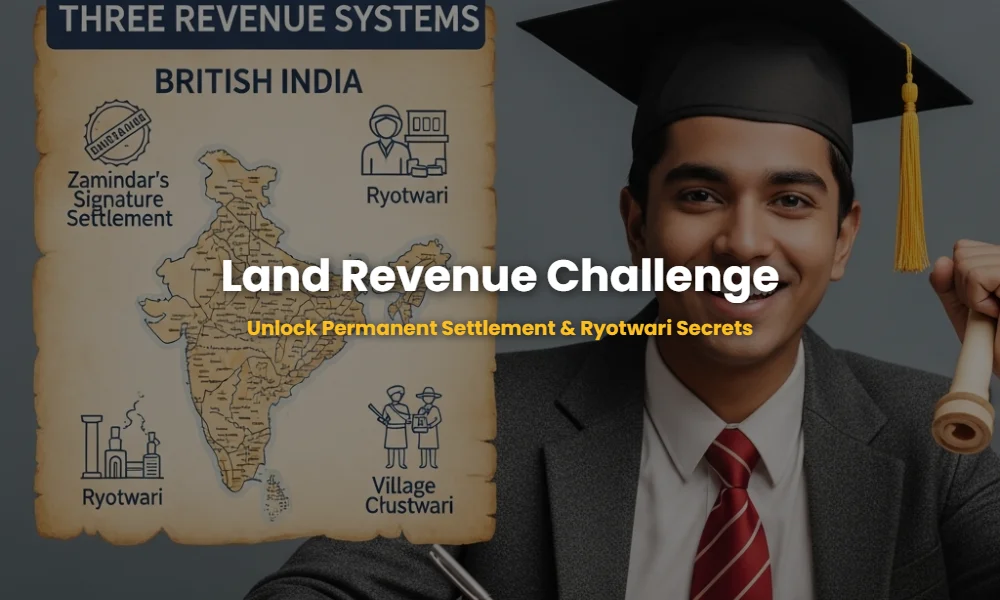
Can You Master British Land Revenue Systems?
The British East India Company didn’t just rule with the sword; they ruled with the pen and tax ledger. For any serious SSC CGL or CHSL aspirant, the complex web of the Permanent Settlement, Ryotwari, and Mahalwari systems is a high-yield topic that often determines the difference between a selection and a rejection. In this deep-dive, we break down the secret mechanics of how the British extracted wealth from Indian soil and provide you with interactive tools to memorize these facts forever.
🚀 Key Takeaways
- ✅ Permanent Settlement: Introduced by Lord Cornwallis in 1793 (Bengal).
- ✅ Ryotwari System: Introduced by Thomas Munro in 1820 (Madras).
- ✅ Mahalwari System: Introduced by Holt Mackenzie in 1822 (North-West India).
- ✅ Sunset Law: The brutal clause that stripped Zamindars of their land.
- ✅ Ryots vs. Mahals: Understanding the basic unit of revenue collection.
Why Do Most Students Fail Permanent Settlement Questions?
The Permanent Settlement (1793) was a landmark land revenue system introduced by Lord Cornwallis in Bengal, Bihar, and Odisha. It fixed the land revenue demand permanently, recognizing Zamindars as the owners of the land as long as they paid a fixed share (10/11th) to the British state.
Many aspirants overlook the Sunset Law, which was the British mechanism of ensuring punctuality. If a Zamindar failed to pay the revenue by sunset on the specified date, their estate was auctioned off. This led to the rise of absent landlords and increased exploitation of the actual tillers of the land. It is crucial to understand that while it gave the Company a fixed income, it crippled the agricultural economy in the long run. To understand the broader context, you should also study the economic impact of British rule.
💡 Pro-Tip: The Zamindar’s Role
The Zamindar was merely a tax collector before 1793. Cornwallis converted them into ‘Landowners’ to create a loyal class of supporters for the British Raj. This is a common trick question in SSC CGL Tier-II.
Is the Ryotwari System Actually Direct Empowerment?
The Ryotwari system, introduced by Thomas Munro and Alexander Read in 1820, was implemented primarily in the Madras and Bombay Presidencies. It established a direct settlement between the government and the ‘Ryots’ (cultivators), theoretically removing the middleman (Zamindar).
Despite the lack of middlemen, the system was far from peasant-friendly. The revenue rates were excessively high, often reaching 50-60% of the produce. This forced peasants to borrow money from local moneylenders, leading to widespread rural indebtedness. In the SSC exam, you must remember that the state became the ‘Supreme Landlord’ under this system. For a comparative view, check out our guide on colonial administration in India.
💡 Pro-Tip: Why South India?
The British opted for Ryotwari in the South because there were no large-scale traditional Zamindars like those in Bengal. They wanted to avoid creating a new landed aristocracy where none existed.
The Mahalwari Trap: What You Are Missing?
The Mahalwari system was introduced by Holt Mackenzie in 1822 and later refined under Lord William Bentinck. It was applied in the North-Western Provinces, Punjab, and parts of Central India. The basic unit of revenue assessment was the ‘Mahal’ (the entire village or estate).
In this system, the revenue was not fixed permanently but revised periodically. The responsibility for paying the revenue rested with the village community, usually represented by the headman or Lambardar. This system combined elements of both Zamindari and Ryotwari but was equally oppressive due to the collective nature of the tax burden. If one farmer failed, the whole village suffered. This is a key area for SSC history notes preparation.
The Secret Cheat Sheet: Comparing the Big Three
Use this table to visualize the differences that the SSC examiners love to test. This is your ultimate revision tool before the exam.
| Feature | Permanent Settlement | Ryotwari | Mahalwari |
|---|---|---|---|
| Introduced By | Lord Cornwallis | Thomas Munro | Holt Mackenzie |
| Year | 1793 | 1820 | 1822 |
| Region | Bengal, Bihar, Odisha | Madras, Bombay | NWFP, Punjab, UP |
| Revenue Unit | Zamindar (Owner) | Ryot (Individual) | Mahal (Village) |
Interactive 3D Flashcard Challenge
Hover over the cards below to test your memory! Can you get all 12 right?
Mastering the History Curve: Expert Strategies
History isn’t just about dates; it is about the ‘Why’. For SSC exams, examiners often frame questions on the socio-economic impacts. Why did the British prefer different systems in different regions? Understanding this helps in eliminiting options during the exam. Also, always keep a look out for previous year questions on these topics.
❓ Which system was the most widespread?
The Ryotwari system covered about 51% of British-occupied territory in India, making it the most geographically extensive land revenue system.
❓ Did Permanent Settlement benefit the Company?
In the short term, yes, because it guaranteed revenue. In the long term, no, because they could not increase taxes even if agricultural productivity increased.
Ready to Ace the SSC Exam?
Don’t leave your selection to chance. Get personalized guidance and high-quality mock tests today!
💬 Chat with our Experts on WhatsApp (+91 9526806124)




