
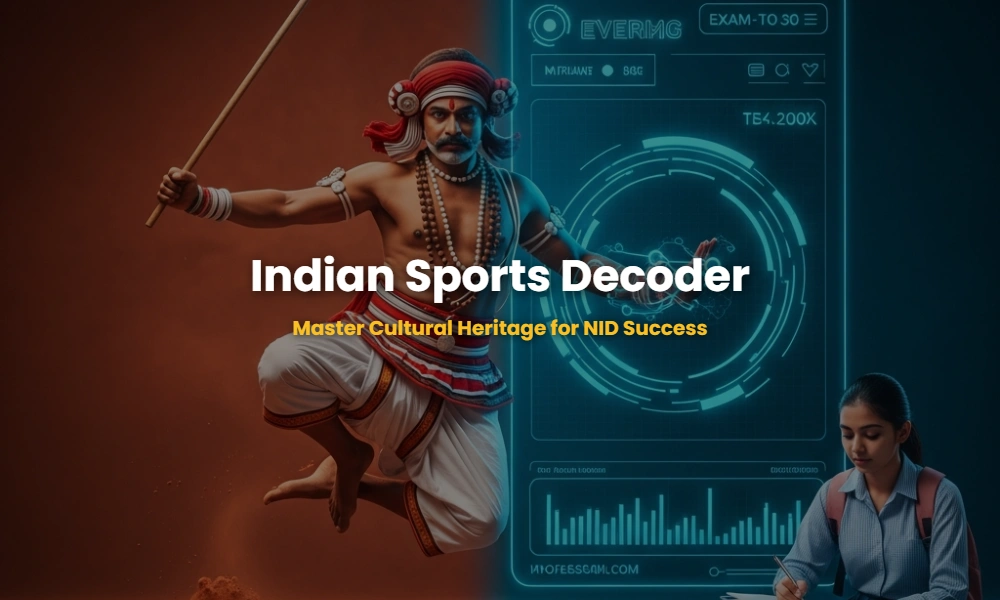
Cracking the National Institute of Design (NID) entrance exam requires more than just sketching skills; it demands a deep-rooted understanding of Indian heritage. One of the most recurring yet misunderstood themes is the History and cultural significance of traditional Indian sports. From the fluid geometry of Kalaripayattu to the rhythmic intensity of Vallam Kali, these sports are goldmines for visual communication and product design questions.
🚀 Key Takeaways
- Understand why NID focuses on indigenous sports for socio-cultural evaluation.
- Learn to translate kinetic energy from sports into static visual media.
- Master the ’30-Second Ninja Shortcuts’ to solve complex visual analysis questions.
- Analyze the evolution of sports branding from rural roots to Pro Kabaddi aesthetics.
The Secret Weapon: Why NID Obsesses Over Traditional Sports
NID uses traditional Indian sports to test an aspirant’s ability to observe movement, cultural context, and the integration of community values into design. By analyzing sports like Mallakhamb or Kho-Kho, the examiner evaluates if you can identify human ergonomics and social dynamics within a uniquely Indian framework.
Traditional sports are not just games; they are living repositories of visual vocabulary. For instance, the circular motion in Kushti or the linear speed of a Kabaddi raid offers distinct compositional elements. If you fail to recognize the visual hierarchy inherent in these traditional arenas, you miss out on scoring high in the Studio Test and the DAT Mains. These sports represent a synergy between the physical body and the environment, a core tenet of design thinking.
The Visual Media Trap: How Modern Design Reimagines Ancient Games
Modern visual media has revolutionized traditional sports by applying contemporary graphic design, high-contrast cinematography, and gamification to ancient practices. This intersection is where NID often frames its most challenging ‘Representation’ questions, asking students to bridge the gap between ‘The Old’ and ‘The New’.
Look at the Pro Kabaddi League (PKL). It took a dusty, rural sport and transformed it into a neon-lit, high-octane visual spectacle. The use of dynamic typography, player silhouettes, and bold color palettes (like the Jaipur Pink Panthers) is a masterclass in rebranding. In modern visual media, traditional sports are no longer just ‘folk’; they are ‘lifestyle brands’. When analyzing modern media representation, focus on how camera angles in animation (like the fight sequences in Baahubali inspired by Kalaripayattu) emphasize the ‘heroic’ scale of the athlete.
5 Lethal Practice Questions (The Decoder)
These simulated questions are designed to mimic the complexity of NID’s Previous Year Questions (PYQs). Don’t just answer; decode the intent.
💡 Click to Reveal Ninja Solution
Focus on the tapered ends. The ‘Ninja Shortcut’ is to treat the Gilli as a dual-cone. Its rotation creates a stable flight path. In your sketch, use ‘motion lines’ commonly used in comic book art to depict speed.
💡 Click to Reveal Ninja Solution
The vertical pole is your ‘line’. The human body is the ‘circle’ or arc. Place the circle at the top-left of the line to show balance. Remember: Minimalism = Less is More.
💡 Click to Reveal Ninja Solution
Panel 1: Village meeting. Panel 2: Carving the boat together. Panel 3: 100 oarsmen in sync. Panel 4: Shared celebration. Use a consistent ‘horizon line’ to maintain visual flow.
💡 Click to Reveal Ninja Solution
Earth tones: Terracotta Red (for the Akhada mud), Deep Brown, and Saffron. These colors evoke grit, tradition, and discipline. Avoid neon colors as they clash with the ‘earthy’ heritage.
💡 Click to Reveal Ninja Solution
AR can project ‘Raid paths’ or ‘Breath timers’ (since Kabaddi is about holding breath) directly onto the court for the viewer. This is a classic UX design principle of real-time data visualization.
The 30-Second Ninja Shortcuts for NID Visuals
In the high-pressure environment of the NID exam, you don’t have time to overthink. Use these shortcuts to instantly improve your representation of traditional sports.
- The ‘Center of Gravity’ Rule: For sports like Mallakhamb or Kushti, always identify the ‘weight point’ first. If the weight is off-balance, your sketch will look amateur.
- The ‘Line of Action’: Draw a single curved line from the head to the toe of the athlete. This ‘S’ or ‘C’ curve creates instant dynamism in your representation.
- Texture Mapping: If the sport is rural (like Kambala), use cross-hatching to represent ‘dirt’ and ‘sweat’. If it’s modernized, use clean gradients.
- Silhouetting: If you can’t draw the face, draw the silhouette. A strong silhouette of a Kalaripayattu leap is more recognizable than a detailed, poorly proportioned face.
Struggling with Cultural Representation?
Our mentors specialize in decoding the intricate relationship between Indian heritage and NID’s evolving exam patterns. Don’t leave your preparation to chance.
💬 Chat with our Experts on WhatsApp (+91 9526806124)




