
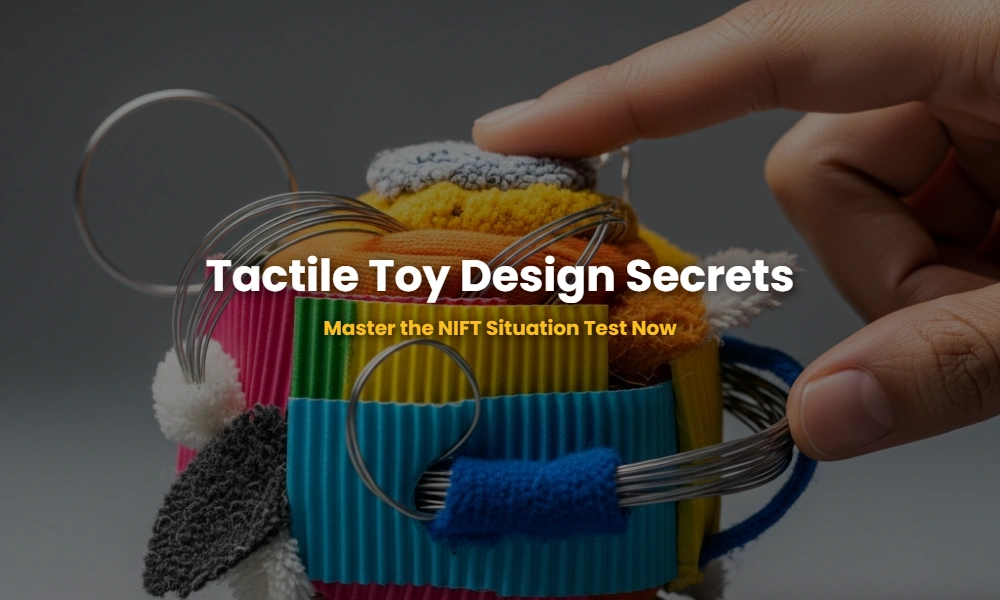
The NIFT Situation Test: Designing a Tactile Educational Toy for Visually Impaired Children
Designing for inclusivity is not just a trend; it is the ultimate test of a designer’s empathy and technical prowess. In the NIFT Situation Test, the tactile educational toy prompt is a high-stakes challenge that separates the visionaries from the mere model-makers. If you aren’t thinking about haptic feedback, material semantics, and cognitive mapping, you are already behind.
🚀 Key Takeaways
- ✅ Haptic Differentiation: Using distinct textures to represent different information categories.
- ✅ Material Intelligence: How to use mixed media like wire, clay, and fabric to simulate real-world physics.
- ✅ User-Centric Design: Designing specifically for the ‘hand-eye’ coordination of the visually impaired.
- ✅ Structural Integrity: Ensuring your 3D model doesn’t collapse under the pressure of examination.
The Psychological Secret to Winning the Tactile Toy Challenge?
A successful tactile educational toy relies on sensory translation, where visual data is converted into physical patterns that the brain can decode through touch. To win the NIFT Situation Test, your model must demonstrate a high degree of empathy, ensuring that every texture choice has a functional purpose rather than being purely decorative.
As an examiner, I look for cognitive affordance. Does the child know where to start touching the toy? Is there a tactile ‘landing strip’? Using sensory design principles, you must create a hierarchy of information. For instance, rough textures might signify boundaries, while soft textures signify interactive ‘hotspots’.
Is the Mixed Media Trap Killing Your Score?
In the Situation Test, mixed media doesn’t mean ‘throwing everything at the wall.’ It means selecting materials like cardboard, sandpaper, wire, and thread to create a tactile vocabulary that a visually impaired child can intuitively understand without sight.
Many students make the mistake of using too much glue, which ruins the texture. If you are building a 3D model for the Situation Test, remember that the examiners will touch your model. If it feels sticky or sharp in an unintended way, you lose points on ‘Finish and Material Handling’.
💡 Examiner’s Secret: The ‘Blindfold Test’
We often close our eyes and touch your model. If we cannot identify the core concept of your toy through touch alone, your design has failed the inclusivity criteria. Always test your own model with your eyes closed during the last 15 minutes.
Prompts You Cannot Afford to Ignore for Creative Brainstorming
To generate a 10/10 idea for a tactile educational toy, use these high-level prompts to guide your design process. Each prompt focuses on a different aspect of inclusive education tools.
- The Topographical Alphabet: Can you design a toy where letters are not just 3D shapes, but represent the sound they make through texture? (e.g., ‘S’ feels like a smooth snake, ‘B’ feels like bumpy bubbles).
- The Rhythm Weaver: A toy that teaches math through physical patterns. Using beads and wires, can you create a system where the child ‘feels’ addition and subtraction?
- The Texture Map: A globe or map for a visually impaired child where water is smooth plastic, mountains are crinkled paper, and forests are soft felt.
- The Emotion Slider: A tool that uses different temperatures (simulated by material properties like metal vs. wood) to help children identify and communicate feelings.
What the Panelists Are Really Marking You On
We use a comprehensive 5-point rubric to evaluate your tactile toy. Most students focus on ‘Aesthetics’, but that only accounts for 15% of the total score. The real weightage lies in innovation and empathy.
| Criterion | Weightage | Panelist Secret Advice |
|---|---|---|
| Empathy & Utility | 35% | Does it actually work for a blind child? |
| Material Manipulation | 25% | Clean joints and zero visible glue marks. |
| Innovation | 20% | Avoid clichés like simple blocks. Think systems. |
| Write-up Clarity | 20% | Explain the ‘Why’ behind every material used. |
The Ultimate Write-up Template for 100% Score
Your write-up is the voice of your model. Without it, the examiner might miss your genius. Follow this structure to ensure you leave no room for doubt.
- Concept Name: Give it a punchy, professional name (e.g., ‘The Haptic Harmonizer’).
- User Persona: Define the age group and specific need of the child.
- Tactile Legend: List each material and what it represents (e.g., ‘Sandpaper = Warning/Stop’).
- Educational Value: State exactly what skill the toy teaches (Logic, Language, or Motor Skills).
❓ Can I use color in a toy for the visually impaired?
Yes! Many visually impaired children have ‘low vision’ rather than total blindness. Using high-contrast colors (yellow on black) shows you understand the full spectrum of visual impairment. It adds another layer of utility to your model.
Ready to Crack the NIFT Situation Test?
Don’t leave your design career to chance. Get personalized feedback on your models and professional guidance from former NIFTians.
💬 Chat with our Experts on WhatsApp (+91 9526806124)




