
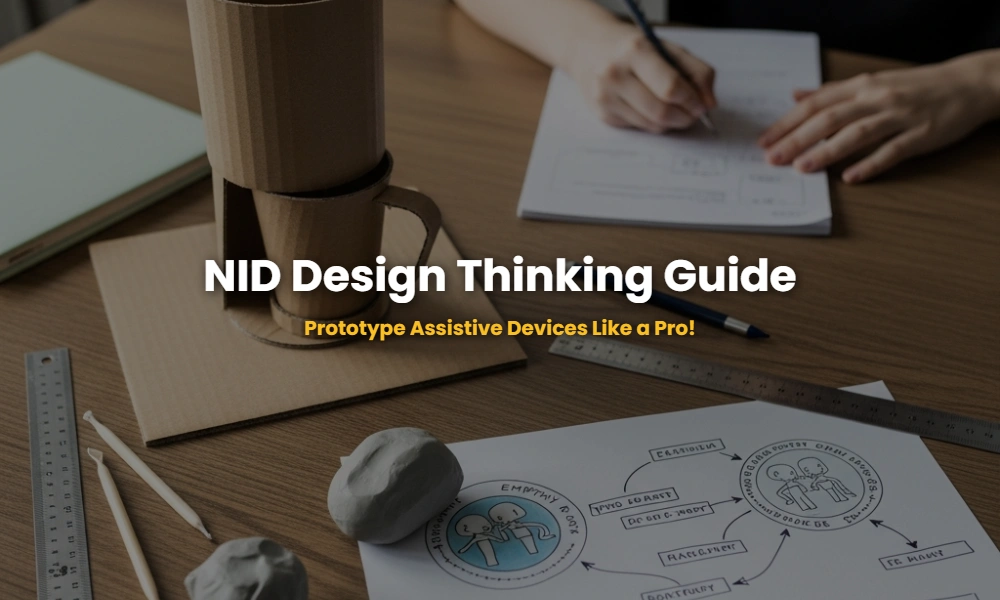
The NID (National Institute of Design) DAT Mains is not just a test of your sketching skills; it is a rigorous evaluation of your ability to think, empathize, and build solutions for real-world problems. Among the most challenging tasks is the creation of assistive devices for people with disabilities using simple materials like card-paper and clay. This process requires a deep dive into design thinking, a methodology that separates the toppers from the average candidates.
🚀 Key Takeaways
- ✅ Empathy is King: Understand the user’s pain points before touching the clay.
- ✅ Material Synergy: Use card-paper for structural rigidity and clay for ergonomic detailing.
- ✅ The 5-Step Loop: Empathize, Define, Ideate, Prototype, and Test.
- ✅ Accessibility First: Focus on Universal Design principles to ensure inclusivity.
- ✅ Time Management: Learn to build high-fidelity models in under 90 minutes.
Table of Contents
The Sneaky Empathy Secrets NID Toppers Use
Design thinking for NID starts with extreme empathy. It is the practice of stepping into the shoes of a person with a disability—be it visual impairment, motor dysfunction, or hearing loss—to identify the invisible barriers they face daily. Without empathy, your model is just a piece of art; with it, it becomes a life-changing solution.
To win the NID Studio Test, you must create a “User Persona.” Imagine ‘Arjun,’ a 70-year-old with arthritis who struggles to hold a toothbrush. Your design isn’t just a “cool toothbrush”; it’s a grip-enhanced, lightweight assistive tool tailored specifically for his restricted finger movement. This level of detail shows the examiner that you are a problem solver, not just a model maker.
💡 Click to Reveal: The Empathy Map Hack
Always draw a quick 2-minute empathy map on your rough sheet. Divide it into: Says, Thinks, Does, and Feels. This visual guide ensures your prototype remains user-centric throughout the exam.
Card-Paper vs. Clay: The Ultimate Prototyping Duel
In NID, materials are your vocabulary. Card-paper and clay are the most frequently provided materials because they represent the two pillars of industrial design: structure and form. Knowing when to use which is the difference between a flimsy mess and a professional prototype.
Use card-paper for creating the internal skeleton or “chassis” of your device. It provides the strength and geometric precision needed for mechanical parts. Clay, on the other hand, is the soul of ergonomics. Use it for parts that come into contact with the human body—like handles, buttons, or supports—as it can be molded to fit the contours of a hand or limb perfectly.
| Feature | Card-Paper (Structure) | Clay (Ergonomics) |
|---|---|---|
| Best For | Flat surfaces, hinges, boxes | Curved grips, textures, weight |
| Strength | High (if folded correctly) | Low (needs internal support) |
| Precision | Mathematical/Geometric | Organic/Human-centric |
Top Assistive Device Concepts You Can Build
Choosing the right concept is vital. You want to pick a problem that is complex enough to showcase your skills but simple enough to build within the time limit. For the Design Aptitude Test, think of daily chores that become hurdles for the disabled.
- The Tactile Navigation Tool: A wearable device using clay for textured patterns that help visually impaired users distinguish between different rooms or objects.
- Adaptive Kitchenware: A card-paper knife guide with a clay-molded handle that allows people with tremors to chop vegetables safely.
- One-Handed Zip-Assistant: A simple mechanical lever made of card-paper that helps hemiplegia patients zip up their jackets.
- Auditory Visualizer: A clay housing for a hypothetical sensor that converts sound into vibrations for the hearing impaired.
The NID Workflow: From Paper to Final Model
A professional workflow prevents panic. NID examiners look for a systematic approach, often observing how you organize your workstation and manage your time. Follow this 4-step actionable list to ensure a polished final product.
- Rapid Ideation (10 mins): Sketch 3 quick variations of your device. Do not overthink; choose the most functional one.
- The Skeleton Build (30 mins): Use card-paper to create the base. Use techniques like scoring (lightly cutting the top layer) to get crisp 90-degree folds without breaking the paper.
- The Ergonomic Layer (30 mins): Apply clay to the interaction points. Ensure the clay is smoothed out and does not look like a messy lump. Pro Tip: Use a little water to finish the clay surface for a professional sheen.
- The Presentation (10 mins): Clean up your edges. If there is glue residue, remove it. A clean model conveys a clear mind.
💡 Click to Reveal: The Stability Secret
Clay is heavy. If your paper structure is collapsing under the weight of the clay, insert a rolled-up paper “pillar” inside the structure to act as a support beam.
Are You Making These Deadly Prototyping Mistakes?
Many brilliant students fail the NID DAT Mains because they focus on aesthetics over utility. Avoid these common pitfalls to keep your score high. Remember, the examiner cares more about *why* you made a choice than how pretty it looks.
One common mistake is overusing adhesive. Too much glue makes the card-paper soggy and weak. Instead, use mechanical joins like slits and tabs. Another error is neglecting the “testing” phase of design thinking. In your write-up, always mention how you *would* test this device with real users to iterate further.
Crucial FAQs for NID Aspirants
How important is the write-up in NID?
It is critical. The write-up explains your design thinking process. It should include your user persona, the problem identified, and why your material choices (paper/clay) solve that problem.
Can I use extra materials like pins or string?
Only if they are provided in the kit. NID is very strict about material usage. Using outside materials can lead to disqualification.
What if my clay model falls apart?
Don’t panic. Use card-paper scraps to create internal scaffolding. This is a great way to show creative problem solving during the exam.
Ready to Crack the NID Studio Test?
Get personalized coaching and mock tests from the experts who have guided thousands to their dream design careers!
💬 Chat with our Experts on WhatsApp (+91 9526806124)




