
Decoding Delhi’s Sky-High Ambition
Welcome, aspiring civil servants and competitive exam candidates, to a crucial discussion on a cutting-edge environmental solution garnering significant attention: cloud seeding. In the face of unprecedented air pollution, especially in the National Capital Region, India is exploring innovative approaches. Delhi, in collaboration with the Indian Institute of Technology (IIT) Kanpur, recently initiated trials for artificial rain through cloud seeding – a topic highly relevant for your General Studies papers, Current Affairs, and Environmental Science sections. Let’s demystify this complex process and understand its implications. Our kerala psc preparation guide is your first step towards success in state exams.
The Urgent Call for Intervention: Delhi’s Air Pollution Crisis
For years, Delhi has grappled with alarming levels of air pollution, particularly during the winter months. A dense blanket of smog often chokes the city, severely impacting public health, visibility, and overall quality of life. Traditional measures, while important, have often fallen short in providing immediate relief. It is this dire situation, the persistent ‘hazardous’ air quality index readings, that has compelled authorities to seek out emergency interventions. The collaboration between the Delhi government and IIT Kanpur to conduct cloud seeding trials represents a desperate, yet scientifically backed, attempt to wash away the pollutants from the atmosphere and offer a temporary respite to the city’s residents. This move underscores the severity of the environmental challenge facing one of the world’s largest metropolises.
Understanding Cloud Seeding: The Science of Making it Rain
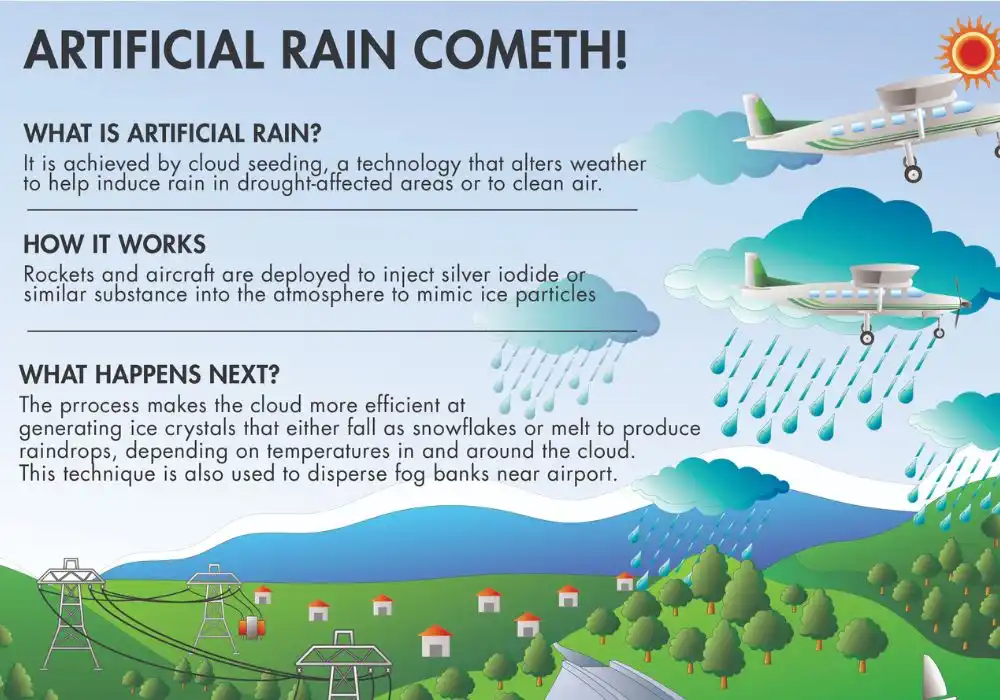
At its core, cloud seeding is a weather modification technique that aims to increase precipitation (rain or snow) from clouds. The fundamental principle revolves around introducing tiny particles into clouds, which then act as “ice nuclei” or “condensation nuclei.” Think of it as providing a microscopic scaffold for water droplets to form around.
How it Works: Suitable clouds already contain supercooled water droplets – water that remains liquid even below freezing point. When seeding agents are dispersed into these clouds, these agents provide surfaces for the supercooled water droplets to freeze onto, or for existing water vapor to condense around. Once these ice crystals or water droplets grow large enough, they become too heavy to remain suspended in the cloud and fall as precipitation.
The “How”: Mechanisms and Materials of Artificial Rain
The process of cloud seeding involves several key steps and materials. Firstly, identifying the right kind of clouds is crucial; not all clouds are suitable for seeding. The target clouds must contain sufficient moisture and be at the right temperature range. Once identified, seeding agents are introduced into these clouds.
Common Seeding Agents: The most widely used substances are silver iodide, a compound whose crystalline structure is very similar to that of ice, making it an excellent ice nucleator. Other agents include dry ice (solid carbon dioxide), which cools the air dramatically, causing water droplets to freeze instantly, and sometimes even hygroscopic salts like calcium chloride, which attract water vapor.
Delivery Methods: These agents can be dispersed using various methods. Aircraft, typically specialized planes, are often used to fly through clouds and release flares containing silver iodide or spray dry ice. Ground-based generators, which burn a solution containing silver iodide, can release the particles into the updrafts that carry them into the clouds. In some cases, rockets are also employed to deliver seeding agents into specific cloud formations. The selection of method depends on the cloud type, atmospheric conditions, and the specific objectives of the seeding operation.
Potential Benefits: Beyond Just Clearing the Smog
While Delhi’s immediate objective for cloud seeding is to mitigate severe air pollution, the technique holds broader potential benefits. Primarily, increased precipitation can help in agricultural areas facing drought, boosting crop yields and replenishing water reservoirs. It can also aid in suppressing wildfires by dampening vegetation. In the context of pollution, artificial rain can “wash down” particulate matter and other pollutants from the atmosphere, significantly improving air quality for a temporary period. This cleansing effect can bring immediate relief to urban populations suffering from respiratory ailments due to heavy smog. Moreover, in regions dependent on snowpack for water supply, cloud seeding can enhance snow accumulation, ensuring water availability during drier months.
The Other Side of the Cloud: Risks, Limitations, and Ethical Dilemmas
Despite its potential, cloud seeding is not without its controversies and challenges. One of the primary concerns is its environmental impact. While silver iodide is generally considered non-toxic in the minute quantities used, long-term or widespread seeding could lead to accumulation, though studies have largely shown minimal ecological risk. More significant is the ethical debate: altering natural weather patterns raises questions about “weather ownership” and potential downstream effects. If one region artificially induces rain, could it be “stealing” moisture from a neighboring region that would have received it naturally?
Effectiveness and Cost: A major limitation is the variable and often difficult-to-prove effectiveness. The natural variability of weather makes it challenging to definitively attribute increased precipitation solely to seeding, as opposed to natural processes. Furthermore, cloud seeding operations are expensive, requiring specialized aircraft, equipment, and expert personnel. The high cost coupled with uncertain outcomes makes it a significant investment. There are also concerns about unintended consequences, such as localized flooding if too much rain is induced, or its inability to work if suitable clouds are not present, which is often the case during severe pollution episodes that coincide with dry atmospheric conditions. Cloud seeding is also not a permanent solution to pollution; it offers temporary relief without addressing the root causes of emissions.
A Global Perspective: Where Else is Artificial Rain Being Tried?
Cloud seeding is not a new concept and has been experimented with and implemented in various parts of the world for decades. Countries like China, Russia, the United States, and the United Arab Emirates have invested heavily in weather modification programs. China, for instance, famously used cloud seeding to ensure clear skies for the 2008 Beijing Olympics and continues to employ it for agricultural purposes and to combat droughts. The UAE frequently uses cloud seeding to enhance rainfall in its arid climate to augment freshwater supplies. In the US, states like California and Idaho have used it to increase snowpack in mountains, thereby boosting water resources for irrigation and hydroelectric power generation. These global examples provide both a testament to its potential and a cautionary tale regarding its complexities and the varying degrees of success achieved.
India’s Initiative: The IIT Kanpur and Delhi Partnership
India has explored cloud seeding sporadically in the past, primarily for drought mitigation. However, the recent initiative in Delhi, partnering with IIT Kanpur, marks a significant, high-profile effort specifically targeting air pollution. IIT Kanpur, known for its advanced research in atmospheric sciences, has been at the forefront of developing the technology and understanding the meteorological conditions required for successful seeding in the Indian context. This partnership brings scientific rigor and expertise to the trial, aiming to establish clear protocols and assess the efficacy of artificial rain in India’s unique atmospheric conditions. The objective is to gather data and understand if this emergency measure can be a viable part of a multi-pronged strategy to combat pollution, even if for short-term relief.
The Road Ahead: Is Cloud Seeding a Real Solution?
While the prospect of artificially clearing polluted skies is appealing, it is crucial to view cloud seeding as one tool in a larger environmental toolkit, not a “silver bullet.” It offers temporary symptomatic relief for pollution and can supplement water resources, but it does not address the fundamental causes of air pollution, such as vehicular emissions, industrial discharge, and stubble burning. For long-term sustainable solutions, comprehensive policies focusing on emission control, renewable energy adoption, public transportation enhancement, and waste management are indispensable. Cloud seeding trials in Delhi are an important scientific experiment to understand its potential and limitations in a critical urban scenario, providing valuable insights for future environmental management strategies.
Why This Matters for Your Competitive Exams
For aspirants preparing for UPSC, SSC, PSC, and other government examinations, understanding cloud seeding is paramount. This topic can appear in various forms: as a factual question in Current Affairs, a concept in Environmental Science or Geography, or as part of an essay or descriptive answer on climate change and pollution mitigation strategies. Questions might cover the science behind it, its benefits and drawbacks, global examples, the specific initiative in India, and its role as a sustainable solution. A comprehensive grasp of this subject demonstrates your awareness of contemporary environmental challenges and technological interventions. Myentrance exam preparation portal is your one-stop solution for all competitive exams.
Frequently Asked Questions (FAQs)
1. What specific chemicals or substances are primarily used for cloud seeding in trials like Delhi’s?
The most common and effective substance used in cloud seeding operations, including those being trialled in Delhi, is silver iodide (AgI) due to its crystal structure being remarkably similar to that of ice, allowing it to act as an efficient ice nucleating agent in supercooled clouds. Other agents like dry ice (solid carbon dioxide) and hygroscopic salts can also be used.
2. Is cloud seeding a safe environmental practice, and are there any long-term ecological concerns?
Numerous studies have been conducted on the environmental safety of cloud seeding. While minute quantities of silver iodide are dispersed, most research indicates that the concentrations are too low to pose significant environmental or human health risks, and silver iodide does not accumulate extensively in the environment. However, the ethical implications of altering natural weather patterns remain a topic of discussion among environmentalists.
3. How effective is cloud seeding in consistently increasing rainfall or reducing pollution?
The effectiveness of cloud seeding is a complex and often debated topic. While scientific evidence suggests it can increase precipitation by 5-15% under ideal conditions, consistently proving its efficacy and attributing specific rainfall increases solely to seeding is challenging due to the natural variability of weather. Its effectiveness in reducing pollution is generally temporary, as it only “washes down” pollutants without addressing their continuous emission.
4. Has cloud seeding been attempted in India before, or is Delhi’s trial a first-of-its-kind initiative?
India has experimented with cloud seeding on a limited basis in the past, primarily in states like Maharashtra and Karnataka for drought mitigation. However, the Delhi trial, specifically targeting severe air pollution with the involvement of IIT Kanpur, is a significant and high-profile initiative focused on urban environmental crisis management, representing a renewed and focused effort in this domain.
5. Why is cloud seeding considered an “emergency measure” rather than a permanent solution for air pollution?
Cloud seeding is an emergency measure because it offers only temporary relief by physically removing pollutants from the atmosphere through rain. It does not address the root causes of pollution, such as vehicular emissions, industrial activities, and agricultural burning. A sustainable and permanent solution requires comprehensive policy changes, stricter emission controls, and a shift towards cleaner energy sources and practices.





