
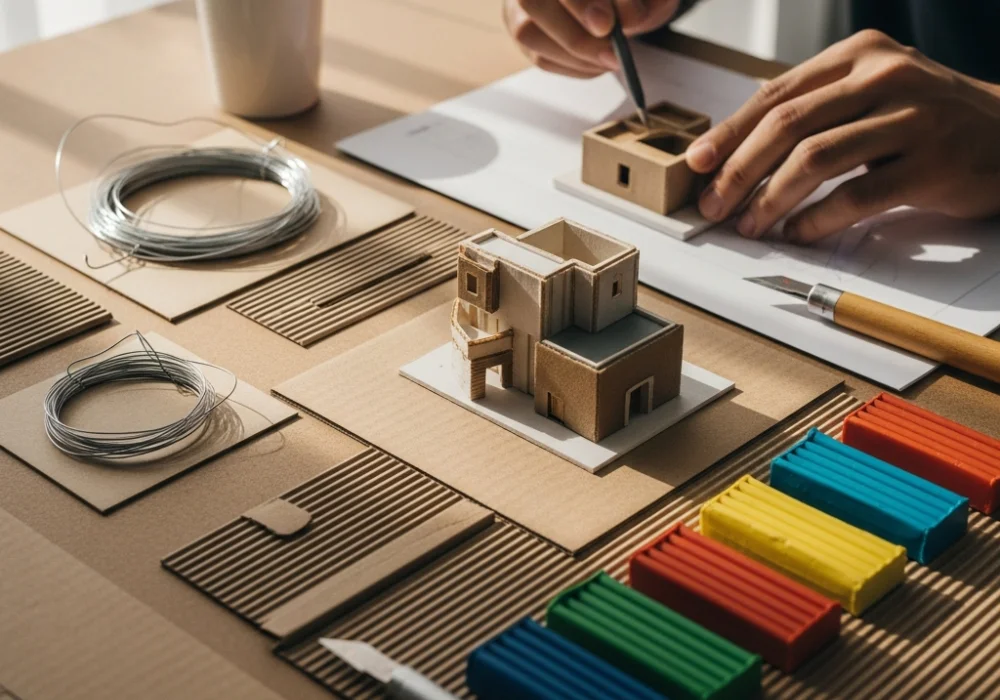
Introduction: Stepping into the 3D World
So, you have cleared the initial hurdles of the NIFT entrance exam! Congratulations. But before you can walk through those prestigious campus gates, there is one final, hands-on challenge: the NIFT Situational Test. For many aspirants, this is the most nerve-wracking stage. Why? Because it moves beyond the comfort of a 2D sketchpad and asks you to think, build, and narrate in three dimensions.
Mastering material handling isn’t just about making something that looks ‘pretty.’ It is about innovation, structural integrity, and material exploration. In this comprehensive guide, we will dive deep into the strategies that separate a mediocre model from a topper’s masterpiece. Whether you are working with wire, clay, or simple corrugated sheets, your ability to manipulate these mediums will define your success.
Table of Contents
- Understanding the NIFT Situational Test
- Deep Dive: Common Materials and Their Uses
- The Art of Joinery: Building Strong Models
- What Do the Evaluators Actually Look For?
- Writing the Perfect Concept Note
- Material Comparison Quick-View
- The Importance of Mock Tests at MyEntrance.in
- Quick Knowledge Check
- Frequently Asked Questions
Understanding the NIFT Situational Test
The Situational Test is a practical exam designed to test your spatial awareness, creative ability, and material handling skills. You are typically given a set of materials and a theme (e.g., ‘A workspace for a futuristic doctor’ or ‘A child’s dream park’). You have exactly three hours to create a 3D model and write a detailed concept note explaining your thought process.
The Psychological Shift
Many students make the mistake of thinking like a sculptor. In the NIFT context, you must think like a designer. A sculptor creates form for beauty; a designer creates form for function and meaning. Every fold, cut, and joint in your model should have a purpose. Remember, you cannot use any external tools or materials—only those provided in the kit.
Deep Dive: Common Materials and Their Uses
In the latest pattern of the NIFT Situational Test, you will encounter various materials. Knowing how to handle each one is critical.
1. Corrugated Sheet (Cardboard)
This is your primary structural material. It provides strength and volume.
- Technique: Scoring. Never cut through the cardboard if you want a clean fold. Use your cutter to lightly slice the top layer, allowing it to bend smoothly.
- Pro-Tip: Use the internal ‘flutes’ of the sheet to insert wires or straws for extra stability.
💡 Click to Reveal: The ‘Cylindrical’ Secret
To create a perfect curve with thick cardboard, roll it against the edge of a table or use a pen to break the internal fibers. This prevents the cardboard from cracking and gives you a smooth, professional cylinder.
2. Wire (Copper or Aluminum)
Wire is excellent for adding linearity and movement to your model. It can represent cables, structural supports, or abstract flows of energy.
- Technique: Spiraling and Netting. Instead of just using a single strand, try twisting two wires together for added strength and visual texture.
3. Clay (Modeling Clay)
Clay is the only material that allows for organic, fluid shapes. However, it can be heavy and messy.
- Technique: Pinching and Coiling. Avoid using large chunks of clay as they may cause your model to collapse. Use clay as a ‘connector’ or for small, detailed focal points.
The Art of Joinery: Building Strong Models
One of the biggest reasons models fail is poor joinery. If your model collapses while the invigilator is moving it, you lose significant marks. Here are the professional ways to join materials:
- Slit-and-Lock: Cut a small slit in two pieces of cardboard and slide them into each other. This is much stronger than using just glue.
- Flaps and Tabs: When building a box or a 3D shape, always leave 1cm ‘flaps’ to apply adhesive. Never try to glue two raw edges together.
- Wire Anchoring: Poke a small hole in your base board and loop the wire through it. Secure it with a small piece of tape on the underside.
Common Joinery Mistakes
Avoid excessive use of tape. If the tape is visible and messy, it shows a lack of technical finesse. Use Fevicol or glue drops sparingly and wait for them to set. Patience is a design tool!
What Do the Evaluators Actually Look For?
NIFT doesn’t just want a pretty model. They grade you on a multi-dimensional scale. Here is a breakdown of the scoring metrics:
| Parameter | What it Means | How to Score High |
|---|---|---|
| Concept Innovation | Originality of the idea. | Avoid clichés. Think of a unique angle for the theme. |
| Material Manipulation | How well you used the materials. | Show variety. Use at least 4-5 different materials from the kit. |
| Structural Stability | The sturdiness of the model. | Ensure the model doesn’t wobble or lean. |
| Aesthetic Appeal | Visual balance and finish. | Keep it clean. No visible glue marks or rough edges. |
Writing the Perfect Concept Note
The Concept Note is as important as the model itself. If the examiner cannot understand your model, they cannot grade it fairly. Your note should be a bridge between your 3D creation and your 2D thoughts.
Structure of a Winning Note:
- The Hook: Start with a strong title for your creation.
- The Inspiration: Explain what triggered your idea (nature, architecture, emotions).
- Material Choice: Explain why you chose specific materials. (e.g., “I used the rigid corrugated sheet to represent the strength of a skyscraper and the thin wire to show the connectivity of the internet.”)
- User Experience: Mention how the user would interact with your design.
💡 Click to Reveal: The Secret Language of Design
Use keywords like ‘ergonomic’, ‘sustainable’, ‘minimalist’, and ‘dynamic’ in your concept note. This shows the evaluators that you are already thinking like a professional designer.
The Importance of Mock Tests at MyEntrance.in
Reading about material handling is one thing; doing it under a 3-hour clock is another. This is where practice becomes your greatest ally. At myentrance.in, we provide specialized resources and mock prompts that mimic the latest pattern of NIFT Situational Tests.
By practicing with our mock tests, you learn:
- Time Management: How to allocate time between brainstorming (15 mins), building (2 hours), and writing (45 mins).
- Resourcefulness: Learning how to create complex shapes with limited materials.
- Self-Evaluation: Comparing your work against topper samples to see where you can improve.
Visit myentrance.in today to explore our exclusive design entrance material and take your first step toward NIFT success!
Quick Knowledge Check
Test your understanding of the NIFT Situational Test concepts below!
1. What is the most effective way to create a clean fold in a corrugated sheet?
Reveal Answer
Scoring: Lightly cutting the top layer without going all the way through.
2. Why should you avoid using too much clay in a tall model?
Reveal Answer
Clay is heavy and can cause the model to become top-heavy and collapse due to gravity.
3. How long is the NIFT Situational Test typically?
Reveal Answer
3 Hours (inclusive of model making and the concept note).
Frequently Asked Questions
Q1: Can I bring my own colors or glitter to the exam?
No. You are strictly forbidden from using any external materials. You must only use the kit provided by NIFT. Using external items can lead to disqualification.
Q2: Is the concept note marked separately?
Yes, the concept note carries significant weight. It is assessed for clarity, English proficiency, and how well it justifies your 3D model.
Q3: What if my model breaks at the end?
Try to leave 10-15 minutes at the end for ‘QC’ (Quality Check). Use this time to reinforce weak joints. If it breaks, try to subtly fix it with the remaining tape or wire.
Q4: How important is neatness?
Extremely important. Neatness reflects your precision as a future designer. Avoid messy glue webs and ragged edges.
Need Personalized Guidance for Design Exams?
Our experts at MyEntrance are ready to help you crack the upcoming exams with specialized mock tests and 1-on-1 feedback.
💬 Chat with our Experts on WhatsApp (+91 9526806124)




