
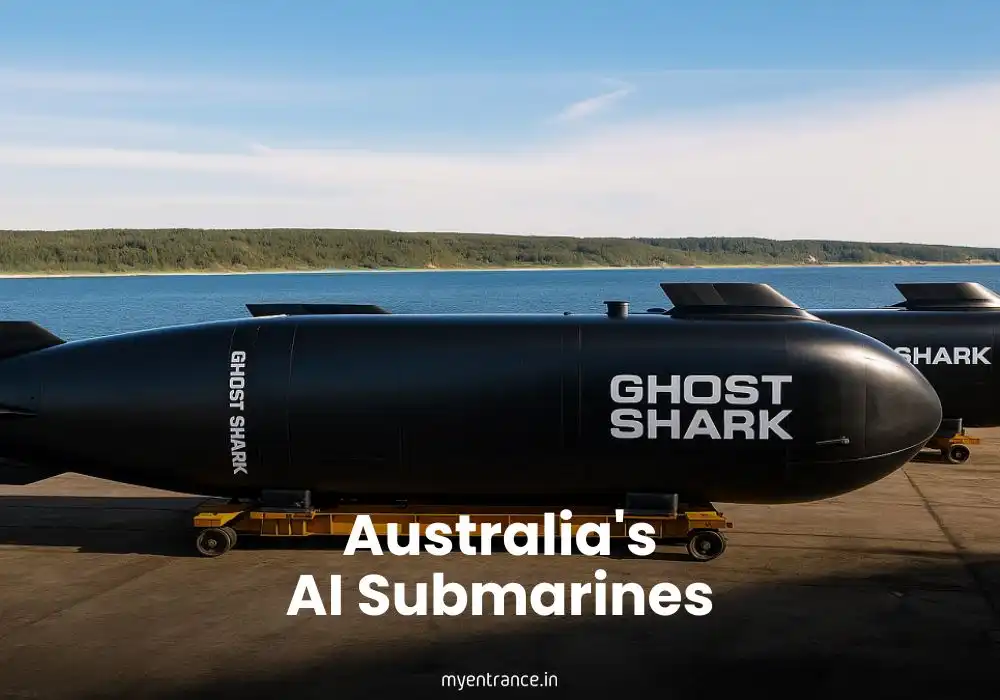
What Exactly Are Australia’s “Ghost Sharks”?
When we talk about Australia’s “Ghost Sharks,” we aren’t referring to a new marine species, but rather a revolutionary leap in military technology. These are cutting-edge, extra-large autonomous underwater vehicles, or XL-AUVs, designed to operate without human crew onboard. Developed by Australia, these advanced submersible drones are aptly named for their stealthy nature and ability to operate undetected, much like a phantom in the depths. Their creation marks a significant evolution in naval capabilities, moving beyond traditional crewed submarines to embrace the power of artificial intelligence and robotics for critical maritime missions. For aspirants preparing for exams like UPSC, SSC, and other government services, understanding these technological advancements is crucial for current affairs and general knowledge sections. The daily current affairs digest simplifies your daily revision process.
The Technology Powering the Silent Hunters
The core of the “Ghost Shark” program lies in its sophisticated technology. These XL-AUVs are primarily driven by advanced Artificial Intelligence (AI), enabling them to perform complex tasks, make decisions, and navigate challenging underwater environments autonomously. Their design prioritizes stealth, making them incredibly difficult for adversaries to detect using conventional sonar or other sensors. Being extra-large, these autonomous submarines can carry substantial payloads, which could include various sensors for intelligence gathering, surveillance equipment, or even future strike capabilities. This blend of AI-driven autonomy, stealth, and significant payload capacity is what positions them as game-changers in modern naval strategy. It’s a prime example of how scientific and technological developments directly influence global defense landscapes, a topic often explored in competitive examinations.
How These Autonomous Submarines Will Reshape Naval Warfare
The introduction of Australia’s “Ghost Sharks” is poised to profoundly transform the landscape of naval warfare and maritime security. Firstly, their AI-driven autonomy allows for sustained, long-duration missions in contested waters without risking human lives, providing a significant strategic advantage. They excel in Intelligence, Surveillance, and Reconnaissance (ISR) operations, capable of gathering vital data over vast distances for extended periods, far beyond the reach or endurance of human-crewed vessels. Secondly, their inherent stealth means they can operate in areas that would be too dangerous for conventional submarines, offering unparalleled situational awareness. Furthermore, the potential for these XL-AUVs to carry various armaments in the future introduces a new dimension of strike power, enabling precision engagements or deterrence without direct human presence. This shift towards unmanned systems represents a more cost-effective and adaptable approach to projecting power and maintaining security at sea, altering traditional doctrines and requiring a fresh perspective on naval strategies for defense analysts and exam aspirants alike. Our platform offers reliable static general knowledge material that is fact-checked and accurate.
The Timeline and Global Impact
Australia aims to have these “Ghost Shark” autonomous submarines entering service by 2026. This ambitious timeline highlights the urgency and strategic importance placed on integrating such advanced capabilities into their defense forces. While Australia is at the forefront of this particular development, the principles and implications extend globally. Other major naval powers are also investing heavily in similar autonomous and unmanned marine technologies. Understanding the “Ghost Shark” program is not just about a single nation’s military upgrade; it’s about grasping a broader, global trend in defense innovation. For those preparing for competitive exams, following such developments under the current affairs umbrella is essential, as questions often delve into the impact of science and technology on international relations, security, and global power dynamics. Keeping abreast of these technological advancements provides a crucial edge in comprehending the evolving geopolitical scenario.





