
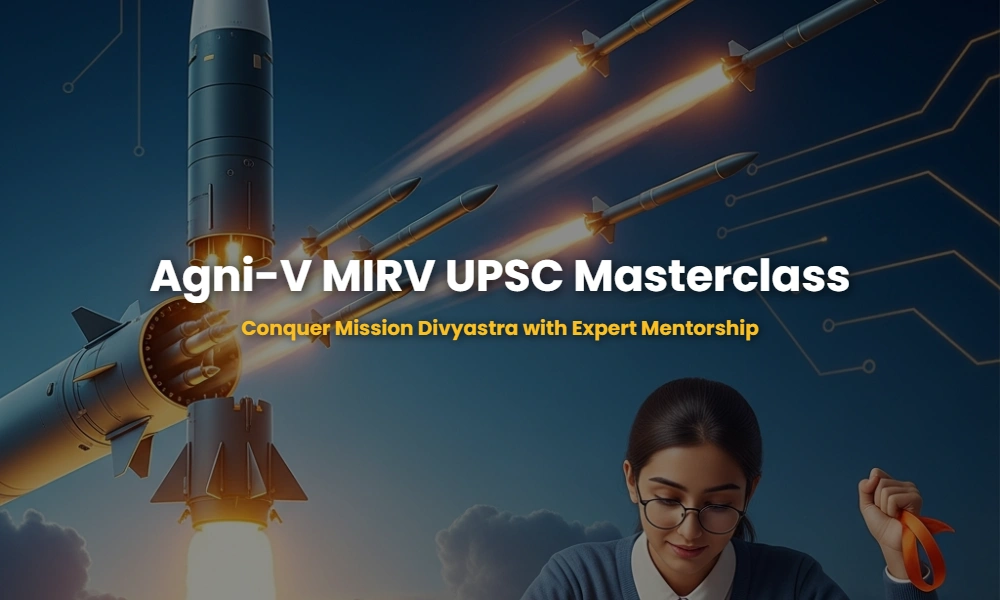
The Strategic Leap: Agni-V MIRV and Mission Divyastra
Mission Divyastra represents India’s successful integration of Multiple Independently Targetable Re-entry Vehicle (MIRV) technology into the Agni-V missile. This milestone enhances India’s nuclear deterrence by allowing a single missile to strike multiple targets across vast geographical areas, effectively penetrating complex missile defense systems.
Listen, Exam Warrior. I know the weight you carry. The endless cycle of current affairs, the technical jargon of defense technology, and the constant fear of missing out on a crucial detail. Mission Divyastra isn’t just another news headline; it is a fundamental shift in India’s strategic posture. To master this for the UPSC, you must look beyond the range of 5,000 km. You need to understand the physics of re-entry, the miniaturization of warheads, and the geopolitical message India is sending to the world. Don’t let the complexity overwhelm you. Break it down, analyze the ‘Why’, and remember: every hour of focused study is a step closer to LBSNAA.
Decoding MIRV Technology for UPSC Aspirants
MIRV technology involves equipping a single ballistic missile with several warheads, each capable of being directed to a separate target. Unlike conventional missiles, MIRV-enabled Agni-V releases these warheads at different trajectories, making interception by enemy anti-ballistic missile (ABM) systems statistically improbable and strategically difficult.
For the UPSC Science and Tech section, focus on these three pillars of MIRV:
- Precision Miniaturization: India had to master the art of creating smaller nuclear warheads that fit within a single payload fairing without losing yield.
- The ‘Bus’ (Post-Boost Vehicle): Think of this as a space taxi. After the main rocket stages fall away, this ‘bus’ maneuvers in space, releasing warheads sequentially.
- Guidance Systems: Each warhead requires independent guidance, navigation, and control (GNC) to ensure terminal accuracy over thousands of kilometers.
—— Click to Reveal: The Geopolitical Impact ——
By achieving MIRV capability, India joins an elite club (USA, Russia, China, France, UK). It shifts the balance of power in Asia, providing a ‘credible minimum deterrent’ that can bypass the sophisticated missile shields being developed by adversaries. This reinforces India’s ‘No First Use’ policy by ensuring a devastating second-strike capability.
Technical Specifications vs. Global Peers
The Agni-V is a three-stage solid-fueled Intercontinental Ballistic Missile (ICBM) with a range exceeding 5,000 km. Its MIRV integration under Mission Divyastra places it in direct competition with China’s DF-41 and the US Minuteman III, significantly enhancing India’s survivability in a nuclear conflict scenario.
| Feature | Agni-V (MIRV) | DF-41 (China) | Minuteman III (USA) |
|---|---|---|---|
| Range | 5,000+ KM | 12,000 – 15,000 KM | 13,000 KM |
| Propulsion | 3-Stage Solid Fuel | 3-Stage Solid Fuel | 3-Stage Solid Fuel |
| Warhead Type | MIRV (Multiple) | MIRV (Up to 10) | MIRV (1-3) |
| Launch Mode | Road/Rail Mobile | Road/Rail Mobile | Silo-based |
UPSC Mock Quiz: Mission Divyastra
Test your precision, Exam Warrior. These questions are designed to mimic the complexity and depth of the UPSC Prelims.
Q1. What is the primary technological advancement tested in ‘Mission Divyastra’?
Q2. Which of the following best describes the ‘Post-Boost Vehicle’ (PBV) in MIRV technology?
Q3. Agni-V is a canister-based missile. What is the primary advantage of this feature?
Q4. Which organization led the development of Agni-V’s MIRV technology?
Q5. Strategic Significance: How does MIRV strengthen India’s ‘No First Use’ (NFU) policy?
Q6. What is the approximate range of the Agni-V missile?
Q7. Which fuel type is primarily used in the Agni-V missile?
Q8. Mission Divyastra places India in the group of nations having MIRV tech. Which country is NOT in this group?
Q9. What is ‘Counter-Force’ and ‘Counter-Value’ targeting in the context of MIRV?
Q10. How does the induction of Agni-V MIRV complete India’s Nuclear Triad?
Aspirant Empathy: The Mentor’s Secret Sauce
I see you, Warrior. You’ve been staring at the same page for forty-five minutes. Your eyes are burning, your tea is cold, and that voice in your head is whispering that everyone else knows more than you. Stop. Take a breath.
UPSC is not about being a human encyclopedia; it’s about Analytical Endurance. You don’t need to memorize the chemical composition of the solid fuel. You need to understand why India chose solid fuel over liquid (it’s for mobility and readiness). Focus on the ‘why’ and the ‘how’.
☕ Mentor’s Hack: The 20-Minute Defense Drill
Instead of reading a 50-page PDF on missiles, draw a single-page mind map. Center: Agni-V MIRV. Branches: 1. Tech Specs 2. Mission Divyastra 3. Geopolitical Impact 4. Comparison. Look at it for 5 minutes before bed. Science and Tech is about visualization, not just rote learning.





