
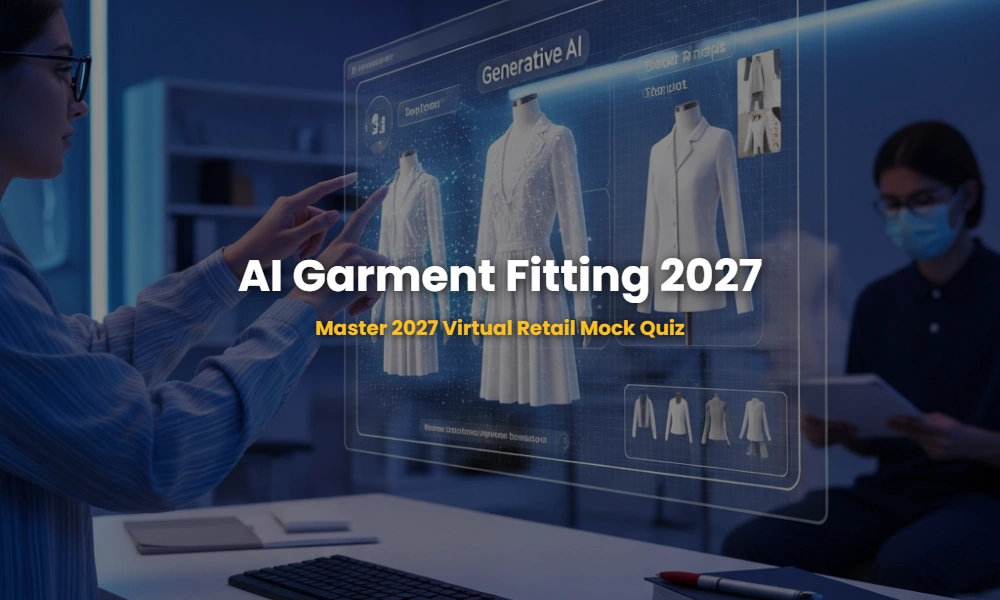
Is Generative AI the Death of Traditional Prototyping?
The fashion industry is hurtling toward a 2027 reality where physical samples are nearly extinct. For NIFT aspirants, understanding the intersection of Generative AI, rapid prototyping, and virtual garment fitting is no longer just an elective—it is the survival kit for the modern GAT and CAT papers. This comprehensive guide and mock quiz explore how AI-driven design synthesis is collapsing the supply chain from months to minutes.
The Secret Roadmap to 2027 Retail Mastery
🚀 Key Takeaways You Cannot Ignore
- Instant Prototyping: Generative AI reduces prototyping time by 90% through text-to-3D garment synthesis.
- Neural Try-Ons: 2027 retail will feature ‘Neural Radiance Fields’ (NeRFs) for photorealistic virtual fitting.
- Sustainability: Virtual sampling eliminates physical waste, a core metric in modern NIFT design evaluation.
- Hyper-Personalization: AI-driven fitting rooms will predict size accuracy with 99.8% precision using biometric data.
The Sneaky Death of Traditional Physical Samples
By 2027, Generative AI will have rendered physical prototyping secondary to digital synthesis. In current retail, brands produce 4-6 physical samples per garment. However, design automation tools now allow for ‘Zero-Sampling’ workflows. This shift uses Latent Diffusion Models to generate thousands of textile variations in seconds, allowing designers to select final candidates before a single thread is cut.
💡 Insider Tip: Why Examiners Love GenAI
Examiners are looking for students who understand that Generative AI isn’t just about ‘making pictures.’ It is about material science simulation. Mentioning ‘Drape Simulation’ and ‘Stress Mapping’ in your answers will show a high level of apparel technology expertise.
Are You Ready for the Virtual Fitting Room Takeover?
Virtual garment fitting in 2027 will go beyond simple 2D overlays to include Physics-Aware Generative Fitting. This technology uses AI to predict exactly how a fabric (like silk vs. denim) will move against a specific body type. This level of realism is what will drive the ‘Digital Twin’ economy, where consumers own a virtual version of every item in their closet.
The NIFT 2027 Mock Challenge: Don’t Fail This!
Q1. What is the primary role of Generative Adversarial Networks (GANs) in 2027 rapid prototyping?
Q2. Which technology enables ‘Neural Try-Ons’ to adapt to different body shapes in real-time?
Q3. How does Generative AI impact the ‘Sampling Waste’ in the 2027 fashion cycle?
Q4. In 2027, ‘Zero-Shot Learning’ in AI fitting helps to:
Q5. ‘Latent Diffusion Models’ are primarily used for which prototyping task?
Q6. What is the main advantage of ‘Digital Twins’ in 2027 retail?
Q7. Which AI concept allows for the automated generation of technical specification sheets (Tech Packs)?
Q8. Virtual fitting reduces retail ‘Return Rates’. By how much is GenAI predicted to lower this in 2027?
Q9. What is ‘Physics-Aware’ AI in the context of garment simulation?
Q10. In 2027, ‘Co-Creative’ AI means:
Why Traditional NIFT Preparation is No Longer Enough
Most NIFT coaching institutes focus on history. But the 2027 exam will prioritize future-tech literacy. You need to understand how Generative AI integrates with the Metaverse fashion landscape. This involves understanding decentralized design and how rapid prototyping facilitates ‘On-Demand Manufacturing’.
🔍 Click to Reveal Examiner’s Secret Checklist
If asked about AI in your interview (Situation Test), always mention: 1. Ethical Data Sourcing, 2. Generative Inclusivity (fitting all bodies), and 3. Computational Creativity.
The Final Verdict on 2027 Prototyping
Generative AI is not a threat; it is an evolution. By 2027, the retail floor will be a blend of high-speed virtual prototyping and precision-guided robotic assembly. Mastering these concepts today is the only way to secure a top rank in the NIFT entrance exam.





