
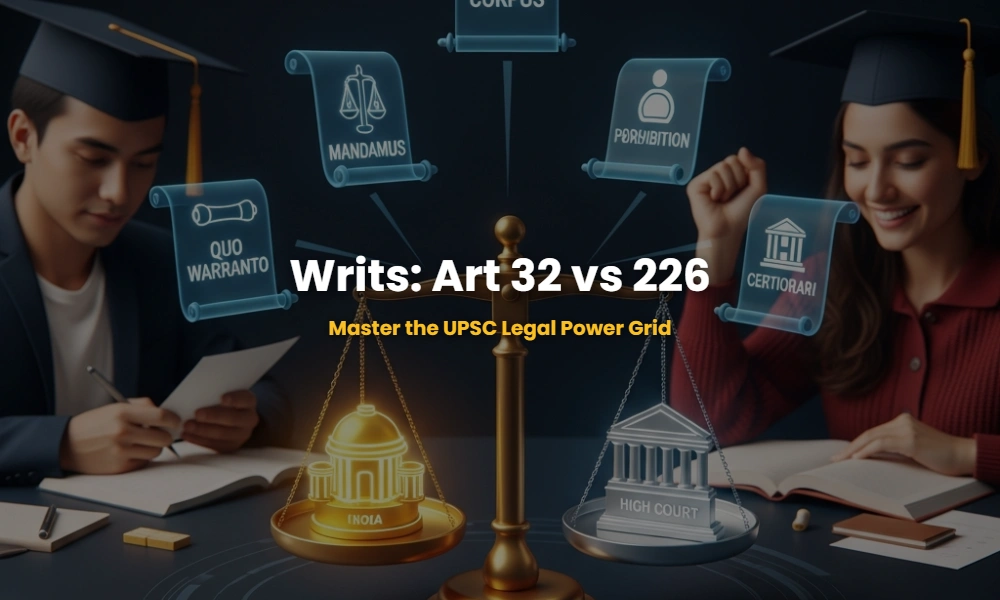
The Ultimate Visual Guide to Five Writs
Is your UPSC preparation missing this critical distinction between Art 32 and Art 226?
🚀 Key Takeaways: What You Must Master Today
- ✅ Article 32: Only for Fundamental Rights (Narrower Scope).
- ✅ Article 226: For FRs + Legal Rights (Broader Scope).
- ✅ Discretionary Power: High Courts can refuse; Supreme Court cannot.
- ✅ Territoriality: SC is Pan-India; HC is State-specific.
The Lethal Mistake in Comparing Art 32 and 226?
Is the High Court’s writ power wider than the Supreme Court’s? Yes. While the Supreme Court can only issue writs for Fundamental Rights under Article 32, High Courts can issue them for both Fundamental Rights and any other legal rights under Article 226, giving them broader jurisdiction. This nuance is where 90% of UPSC aspirants lose marks. Article 32 is itself a Fundamental Right, meaning the Supreme Court is the ‘guarantor and protector’ of your rights. Conversely, Article 226 is a constitutional power granted to High Courts, making it discretionary. An aspirant must understand that while the SC has a narrower subject-matter reach, its territorial reach spans the entire nation, whereas the HC is limited by state boundaries. This interplay of Judicial Review power is central to the Indian Constitution’s basic structure as established in the L. Chandra Kumar case (1997).
1. Habeas Corpus: “To Have the Body”
The Definitive Rule: Habeas Corpus is a prerogative writ issued by the court to a person who has detained another person, to produce the body of the latter before it. It is the most powerful tool against arbitrary detention.
This writ is applicable against both public authorities and private individuals. However, it cannot be issued if the detention is lawful, for contempt of court, or outside the court’s jurisdiction. In the context of the UPSC Polity Syllabus, always remember the ADM Jabalpur case vs. the post-Emergency correction in the 44th Amendment.
2. Mandamus: “We Command”
The Definitive Rule: Mandamus is a command issued by a court to a public official, public body, lower court, tribunal, or government asking them to perform an official duty they have failed or refused to perform.
It acts as a wake-up call for administrative lethargy. It ensures that the rule of law is maintained by forcing authorities to act within their statutory obligations. For UPSC, note that Mandamus cannot be used to enforce departmental instructions that lack statutory force.
Why Prohibition vs Certiorari Confuses Every Topper?
How do you distinguish between ‘Prevention’ and ‘Cure’ in Indian Law? Prohibition is issued by a higher court to a lower court or tribunal to prevent it from exceeding its jurisdiction (Prevention). Certiorari is issued to squash the order of a lower court after the judgment is delivered (Cure).
Prohibition can only be issued against judicial and quasi-judicial authorities. Certiorari, however, has evolved. Since the 1991 Supreme Court ruling, Certiorari can even be issued against administrative authorities that affect the rights of individuals. This distinction is a favorite for UPSC Prelims. While Prohibition stops a trial mid-way because of a lack of jurisdiction, Certiorari effectively ‘deletes’ an unconstitutional or illegal verdict already in the books. Both are essential for maintaining the hierarchy of the judiciary and preventing legal overreach by local tribunals or special courts.
💡 Click to Reveal the Secret Mnemonic
Remember: Prohibition = Prevent (During trial). Certiorari = Cure/Cancel (After trial). Use this to never mix them up in the exam hall!
Quo-Warranto: Is the Official Sitting Legally?
What is the legal authority of a person holding a public office? Quo-Warranto is issued to inquire into the legality of the claim of a person to a public office. It prevents illegal usurpation of public office by an individual.
Unlike other writs (except Habeas Corpus), any interested person, and not necessarily the aggrieved person, can seek this writ. This is a massive point of law for UPSC Mains. To issue this writ, the office must be public, created by a statute or the Constitution, and must be of a substantive nature. It cannot be issued against ministerial offices or private offices. This ensures that the executive does not appoint ‘favorites’ to constitutional posts without meeting the requisite eligibility criteria defined by law.
The Sneaky New Exam Pattern Changes You Cannot Afford to Ignore
How does the examiner test the ‘Extraordinary Jurisdiction’ of High Courts? The recent trend in UPSC shows a shift toward ‘Statement-Based Questions’ regarding the discretionary nature of Article 226. You must know that while the Supreme Court cannot refuse to entertain a petition under Article 32 (because the right to move the SC is itself a Fundamental Right), a High Court can refuse to exercise its writ jurisdiction if an alternative remedy is available to the petitioner. This nuance separates the rankers from the rest. Furthermore, with the rise of Digital Governance, the application of Mandamus against tech-driven public service delivery is a hot topic for current affairs integration in your GS Paper 2 answers.
Commonly Asked Questions (FAQs)
Can Article 32 be suspended?
Yes, Article 32 can be suspended during a National Emergency as per Article 359, except for the rights guaranteed under Articles 20 and 21.
Who is called the ‘Protector’ of the Constitution?
The Supreme Court of India is designated as the guarantor and protector of Fundamental Rights under the constitutional scheme.
Ready to Ace your UPSC Polity?
Join thousands of aspirants mastering the Constitution with our expert-led modules.
💬 Chat with our Experts on WhatsApp (+91 9526806124)




