
Master Garment Construction Terminology in Minutes?
Every year, thousands of NIFT aspirants lose marks not because of a lack of creativity, but due to a failure to grasp the technical terminology of garment construction. To the untrained eye, a ‘seam’ is just a line; to a future fashion designer, it is the structural backbone of a garment that dictates drape, durability, and aesthetic value. If you cannot distinguish between a bias cut and a grain line, you are effectively flying blind in the General Ability Test (GAT).
🚀 Key Takeaways
- ✅ Master the hierarchy of sewing tools from shears to seam rippers.
- ✅ Understand the critical difference between grain lines and bias cuts.
- ✅ Learn the industrial names for standard finishing techniques.
- ✅ Decode the ‘Examiner’s Language’ used in NIFT GAT papers.
- ✅ Gain 10 competitive points with our high-difficulty mock quiz.
The Secret Blueprint of Fashion Success
The Sneaky New Tool Names You Cannot Ignore
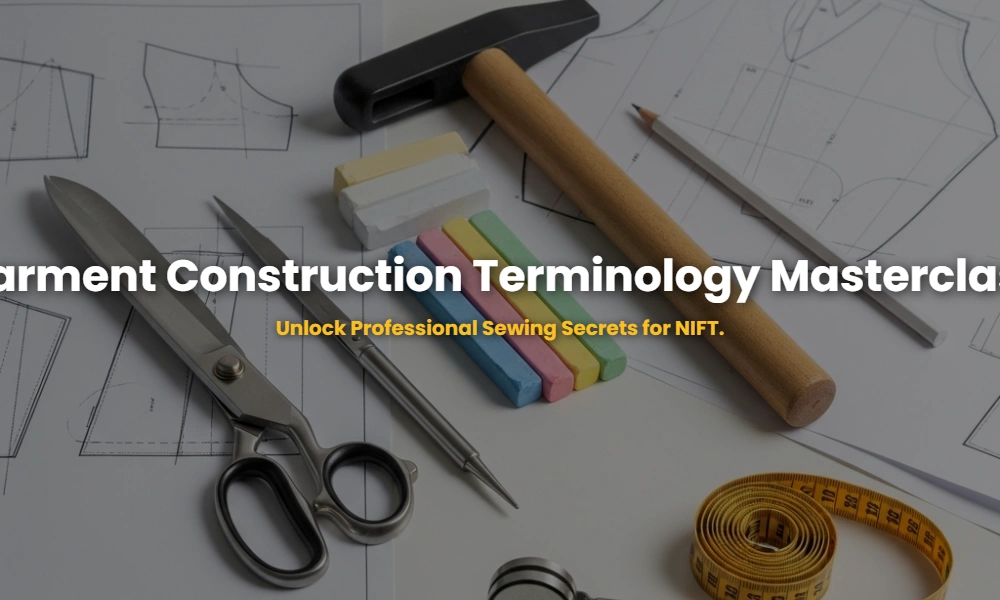
Sewing tools are more than just ‘needles and thread.’ The NIFT GAT often tests your knowledge of specialized equipment such as Pinking Shears, Tailor’s Ham, and Tracing Wheels. These tools have specific functions that prevent fabric fraying, allow for curved pressing, or transfer pattern markings without damaging the textile.
Using the wrong tool can ruin a high-quality fabric. For example, using regular paper scissors on silk will dull the blades and crush the fibers, leading to jagged edges. Expert designers utilize pattern drafting tools like the French Curve to achieve the perfect armhole contour—a detail frequently questioned in NIFT creative ability tests.
| Tool Name | Technical Function | Key Feature |
|---|---|---|
| Pinking Shears | Zig-zag edge cutting | Prevents fraying on raw edges |
| Tailor’s Ham | Pressing curved surfaces | Firmly stuffed, egg-shaped |
| Awl | Piercing small holes | Used for marking eyelets/buttons |
| L-Square | Drafting 90-degree angles | Essential for grain line alignment |
The NIFT Mock Challenge: Test Your Knowledge
Ready to see if you have what it takes? This mock quiz features questions designed with the same complexity as the NIFT original papers. Don’t peek at the answers until you’ve tried them all!
Q1. Which term describes the finished edge of the fabric that prevents it from unraveling during manufacturing?
Q2. What is the technical name for the triangular fold of fabric used to provide shape to a garment at the bust or waist?
Q3. Which tool is used specifically to transfer pattern markings like notches or darts onto fabric?
Q4. A ‘French Seam’ is most suitable for which type of fabric?
Q5. Which term refers to the extra fabric allowed beyond the stitching line to prevent the garment from pulling apart?
Q6. What is ‘Basting’ in garment construction?
Q7. A ‘Bobbin’ is used in which part of the sewing machine?
Q8. Which term describes a narrow, decorative strip of fabric cut on the bias?
Q9. What is the main purpose of ‘Interfacing’?
Q10. Which tool is essential for accurately measuring a client’s body for tailoring?
Why Expert Guidance is Your Secret Weapon
Passing the NIFT entrance isn’t just about drawing well; it’s about having the academic authority to answer technical GAT questions with 100% accuracy. Thousands of students study the same material, but those who understand the Latent Semantic Indexing (LSI) of the industry—the specialized jargon and technical nuances—are the ones who make it to the top campuses in Delhi and Mumbai.
By mastering construction basics, you demonstrate to the admissions committee that you possess a professional mindset. This knowledge is equally valuable for the Situation Test, where you must manipulate materials to create stable structures under pressure.
Still confused about construction?
Don’t leave your fashion dreams to chance. Get expert guidance and customized mock tests today.
💬 Chat with our Experts on WhatsApp (+91 9526806124)




