
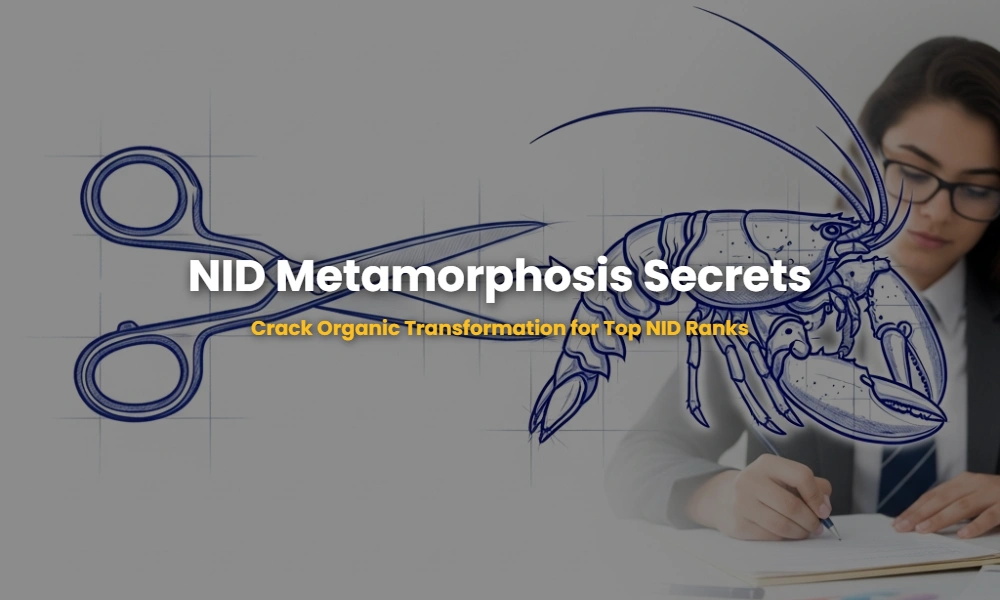
The Hidden Science Behind Metamorphosis and Organic Transformation You’re Missing
Mastering metamorphosis and organic transformation is the ultimate litmus test for lateral thinking in the NID entrance exam. It requires a designer to look beyond the static utility of an object and visualize a fluid evolution into biological forms. If you cannot bridge the gap between a cold, metallic scissor and a living, breathing lobster, you are leaving precious marks on the table.
- Identify Geometric Anchors shared between the object and the organism.
- Use at least 3-4 intermediate stages to ensure a smooth visual narrative.
- Focus on structural logic rather than just surface-level aesthetic changes.
- Leverage design thinking principles to maintain object recognition.
- Prioritize line weight dynamics to differentiate between mechanical and organic textures.
The Secret Alchemy: Why Your Transformation Sketches are Probably Failing
Most students fail because they jump from ‘Object A’ to ‘Object B’ without explaining the morphological transition. NID examiners look for the logical ‘in-between’ states where the mechanical hinge of a scissor starts mimicking the joint of a crustacean. If the transition feels forced, the design loses its credibility.
To succeed, you must master the art of form-finding. This involves stripping an object down to its primitive 3D shapes—cylinders, spheres, and cubes—and slowly warping those primitives into organic muscle or bone structures. By understanding visual morphology, you can create a convincing illusion of growth and adaptation.
💡 Pro-Tip: The ‘Ghosting’ Technique
Lightly sketch the final organic form over the original object in the first frame. This ‘ghost’ image acts as a guide, ensuring that every screw and plate of the object has a clear destination in the biological world.
5 Forbidden Techniques for Perfect Organic Flow
Perfect organic flow is achieved by utilizing asymmetrical balance and rhythmic line work to simulate biological life within static objects. By blending the rigid geometry of man-made tools with the erratic curves of nature, you create a visual paradox that captures the examiner’s eye immediately.
- The Skeletal Mapping: Identify the ‘spine’ of your object and align it with the spine of the animal.
- Texture Bleeding: Gradually introduce fur, scales, or skin from the edges of the object inward.
- Kinetic Expansion: Show the object ‘opening up’ or ‘inflating’ to reveal organic interiors.
- Material Softening: Turn hard plastic edges into soft, fleshy folds using cross-contour shading.
- Functional Mimicry: Ensure the function of the object (e.g., cutting) is preserved in the animal’s behavior (e.g., a crab’s pinch).
Explore more on advanced sketching techniques to refine your execution speed.
NID PYQ Decoder: 5 Simulated Challenges You Must Practice
These simulated challenges are based on the trend of hybridization seen in recent NID Studio Test and DAT papers. Practicing these will train your brain to see connections in the chaos of everyday items.
Focus on the pivot point. The screw of the scissor should become the primary joint of the lobster’s claw. Ninja Shortcut: Use the handles of the scissor as the internal negative space of the claws.
This is a volume-based transformation. Transition the glass filament into the core seeds of the fruit. Ninja Shortcut: The metallic base of the bulb should shrink into the stem of the pear.
The canopy of the umbrella is already a mimicry of a jellyfish bell. Focus on the ribs of the umbrella becoming the stinging tentacles. Ninja Shortcut: Show the fabric ‘melting’ into translucent gelatinous tissue.
The spout is the obvious trunk, but the real genius lies in turning the handle into the elephant’s ear. Ninja Shortcut: Use the ‘steam’ from the kettle to form the elephant’s tusks in a semi-transparent state.
The snapping motion is the key. The top lever of the stapler becomes the upper jaw. Ninja Shortcut: The staples themselves should morph into the sharp, jagged teeth of the reptile.
💡 View Top-Scorer Strategy
In Frame 2 of 4, always draw ‘Micro-Cracks’. It signals that the rigid object is breaking its physical bonds to allow organic growth to burst through. This adds immense drama to the transformation.
The Evaluation Metrics: How NID Ranks Your Transformation
Evaluation is based on continuity, proportions, and creativity. An abrupt change results in a low score, while a rhythmic, step-by-step evolution that respects the laws of physics (even in imagination) scores in the 90th percentile.
| Feature | Basic (5/10) | NID Topper (9/10) |
|---|---|---|
| Transition Logic | Abrupt change in Frame 3 | Seamless morphological flow |
| Line Quality | Uniform thickness | Variable weight (Hard vs Soft) |
| Proportions | Loses original scale | Maintains volume consistency |
| Detailing | Generic textures | Specific biological rendering |
The 30-Second Ninja Shortcuts for Exam Day
Ninja shortcuts involve using primitive geometric overlays and shading gradients to bypass complex anatomical rendering while still conveying form. When you have only 15 minutes for a transformation question, these hacks are your best friends.
- The Zig-Zag Rule: If you’re stuck, use a zig-zag line to represent ‘energy’ or ‘movement’ between mechanical and organic parts.
- Shadow Anchoring: Keep the cast shadow consistent across all frames to ground the transformation in reality.
- Zoom-In Strategy: If the whole object is too hard to morph, focus on a specific joint or part to show the ‘Micro-Metamorphosis’ in high detail.
Don’t forget to review our comprehensive portfolio guide for more visual inspiration.
Confused about your Transformation Sketches?
Get a free review of your metamorphosis drawings from NID alumni today!
💬 Chat with our Experts on WhatsApp (+91 9526806124)




