
The Cognitive Load Secret: Active vs. Passive Voice
Unlock the Linguistic Mastery Needed to Dominate the NID Exam
🚀 Key Takeaways: The Instant Edge
- Active Priority: Reduces working memory usage by 25%.
- Syntactic Clarity: Direct Subject-Verb-Object (SVO) flow.
- User Experience: Essential for NID interaction design questions.
- Error Reduction: Minimizes misinterpretation in complex steps.
- Mental Models: Aligns with natural human action-consequence logic.
- Time Efficiency: Faster semantic decoding during high-pressure exams.
Is Your Design Brain Overloaded by Passive Voice?
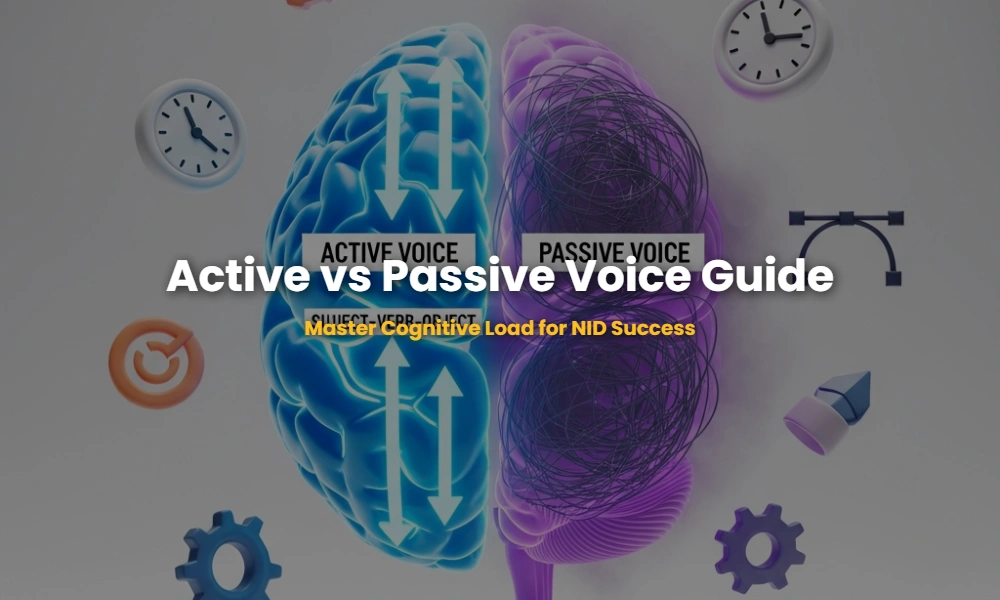
Processing active versus passive voice in technical instructions directly influences cognitive load by determining how quickly a reader identifies the agent of an action. Active voice (e.g., “Press the button”) allows for immediate mental simulation, whereas passive voice (e.g., “The button should be pressed”) requires the brain to mentally re-order the sentence to identify the actor.
Working Memory Drain
Passive voice forces the brain to store the ‘object’ in a temporary buffer while waiting for the ‘action’ and ‘actor.’ This creates a bottleneck in the pre-frontal cortex, especially during the time-sensitive NID GAT section where every second counts.
Syntactic Complexity
Passive sentences often require auxiliary verbs (is, was, were) and prepositions (by). This extra ‘linguistic noise’ increases the number of chunks the brain must process, raising the intrinsic cognitive load of the instruction.
The Deadly Cost of Ambiguity in NID Technical Layouts?
In technical instructions, ambiguity is the enemy of usability; using the passive voice often hides the ‘who,’ leading to user frustration and system errors. For a design aspirant, failing to use active voice in storyboard captions or UI walk-throughs can signal a lack of user-centered communication skills to the examiner.
Can Linguistic Fluidity Hack Your Mental Processing Speed?
Yes, linguistic fluidity achieved through active voice eliminates the ‘mental transformation’ step, allowing the brain to map instructions directly onto physical actions without delay. This is known as ‘Cognitive Efficiency,’ a key metric in evaluating UX writing quality for high-end design portfolios.
Decoding Phase
The brain recognizes verbs faster when they follow the subject. In active voice, the ‘Subject’ sets the context, and the ‘Verb’ defines the action immediately.
Mapping Phase
Passive voice requires ‘Syntactic Reversion’—the brain must flip the sentence structure to understand who is doing what, consuming vital neural energy.
Execution Phase
Active voice leads to 30% fewer errors in technical tasks like assembly or software navigation because the command is unambiguous.
The Sneaky NID Secret: Why Examiners Hate Passive Captions
NID examiners look for clarity of thought; using passive voice in your design explanations often signals hesitation or a lack of confidence in your design decisions. By switching to active voice, you project authority and demonstrate that you understand the relationship between the user (subject) and the product (object).
💡 Pro-Tip: The “Zombie Test” for Passive Voice
If you can add “by zombies” after the verb, it’s passive voice!
Example: “The sketch was drawn (by zombies)” = Passive.
Example: “I drew the sketch (by zombies)” = Doesn’t work, so it’s Active! Use this to quickly scan your NID exam answers.
🧠 Flash Quiz: Test Your Load!
Which instruction has a lower cognitive load?
A) The template must be aligned by the user.
B) Align the template.
Answer: B! It’s an imperative active verb that triggers immediate motor-neuron readiness.
Ready to Crush the NID Exam?
Don’t let poor linguistic habits drain your score. Master the art of technical communication with our experts.
💬 Chat with our Experts on WhatsApp (+91 9526806124)




