
📌 Quick Navigation
The Deadly Secret Behind Low NIFT CAT Scores!
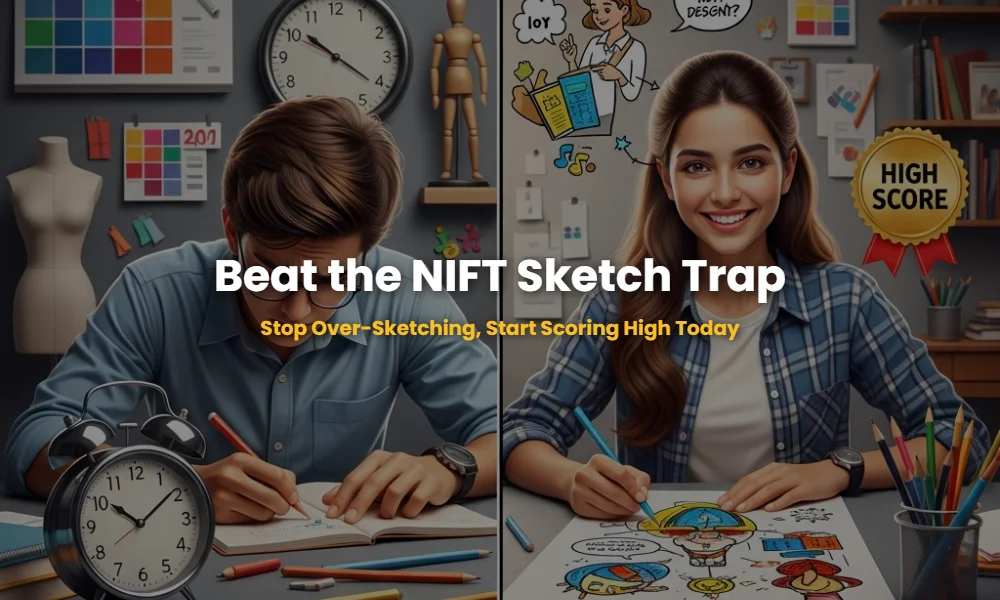
The NIFT Creative Ability Test (CAT) is not an art competition; it is a design aptitude evaluation. Most students enter the hall with a psychological obsession with ‘the perfect drawing,’ often spending 45 minutes on a single eye or a texture while the clock ticks away. This is the Perfect Sketch Trap—a psychological barrier where the fear of an imperfect line sabotages your ability to communicate a brilliant design concept. To succeed, you must shift your focus from being a ‘fine artist’ to being a ‘visual communicator.’
🚀 Key Takeaways
- Ideation and original concepts carry 60-70% of the weightage.
- Proportion and perspective are more critical than intricate shading.
- Completion of all questions is non-negotiable for a top rank.
- The eraser is your worst enemy in the exam hall.
Is Your Shading Robbing You of NIFT Marks?
Winning the NIFT CAT requires prioritizing conceptual depth over hyper-realistic rendering. A high-scoring sheet features a unique interpretation of the prompt, clear composition, and functional design. Evaluators look for ‘out-of-the-box’ thinking rather than how well you can mimic a photograph, which is a common mistake among untrained candidates.
Understanding the NIFT CAT syllabus is only half the battle. The other half is the internal struggle against perfectionism. When you spend too much time on aesthetics, you lose the opportunity to showcase your design thinking skills, which are the primary metrics for selection.
| Evaluation Criteria | The ‘Perfect’ Sketcher | The Smart Designer |
|---|---|---|
| Ideation | Cliché / Common | Unique & Contextual |
| Composition | Focus on 1 corner | Balanced & Dynamic |
| Line Quality | Over-rubbed, messy | Confident, single strokes |
| Completion | Usually Incomplete | 100% Finished |
The ’30-60-10′ Rule You Can’t Afford to Ignore!
The 30-60-10 rule is a strategic time-allocation framework where you spend 30% of your time brainstorming, 60% on sketching/coloring, and 10% on final detailing. This prevents the psychological trap of rushing the idea to start drawing immediately, which often results in a beautiful but mindless illustration that fails the prompt.
Many students skip the brainstorming phase, leading to ‘creative block’ halfway through the drawing. By dedicating the first 10-12 minutes to rough thumbnails, you solidify your vision, reducing the need for erasures later. To master this, you should practice with a NIFT sample paper under strict timed conditions to build muscle memory and mental speed.
💡 Pro-Tip: The ‘No-Eraser’ Drill
Try practicing your sketches with a pen or a very dark pencil that cannot be fully erased. This forces your brain to commit to lines and plan ahead, effectively curing the habit of ‘sketch-rub-repeat’ that kills time during the NIFT CAT exam.
Why Your Brain Freezes Under CAT Pressure?
Psychological paralysis in the NIFT CAT occurs when the ‘Critical Brain’ (the part that judges quality) takes over the ‘Creative Brain’ (the part that generates ideas). To overcome this, you must treat the paper as a conversation with the examiner. Focus on clarity of thought—if you can explain your concept in three lines of text, your drawing should visually mirror that simplicity without unnecessary clutter.
The fear of making a mistake is the primary cause of the ‘Perfect Sketch Trap’. Designers realize that every ‘mistake’ is simply a redirection. In the CAT, if a line goes wrong, incorporate it into the texture or the background. Never stop to obsess over a minor flaw. The examiner is looking for your potential to learn design, not your current status as a master artist. Remember, NIFT is looking for thinkers who can draw, not cameras that can sketch.
The Hierarchy of NIFT CAT Evaluation:
- Concept/Idea: Is it original or copied from Pinterest?
- Composition: Is the space used effectively?
- Color Theory: Do the colors evoke the right emotion?
- Detailing: Is the finish clean and professional?
NIFT CAT Mastery: Critical FAQs
❓ Is shading mandatory in NIFT CAT?
No, shading is not mandatory unless specifically asked. However, basic light and shadow help in defining forms and depth. Over-shading often makes the sheet look messy and consumes too much time.
❓ Can I use a scale or ruler?
While not explicitly banned, using a ruler for everything makes your drawing look rigid and ‘un-artistic’. Freehand drawing is highly preferred by NIFT evaluators as it shows confidence and control.
❓ What if I don’t finish the last question?
Incomplete questions are a major red flag. It’s better to have four ‘good’ sketches than three ‘perfect’ ones and one empty box. Speed and completion are critical for ranking.
Struggling with NIFT CAT Preparation?
Don’t let the psychological trap hold you back from your dream campus! Get personalized feedback on your sketches and exclusive shortcut techniques from NIFT Alumni.
💬 Chat with our Experts on WhatsApp (+91 9526806124)




