
Can Historical Design Evolution Crack Your NID Exam?
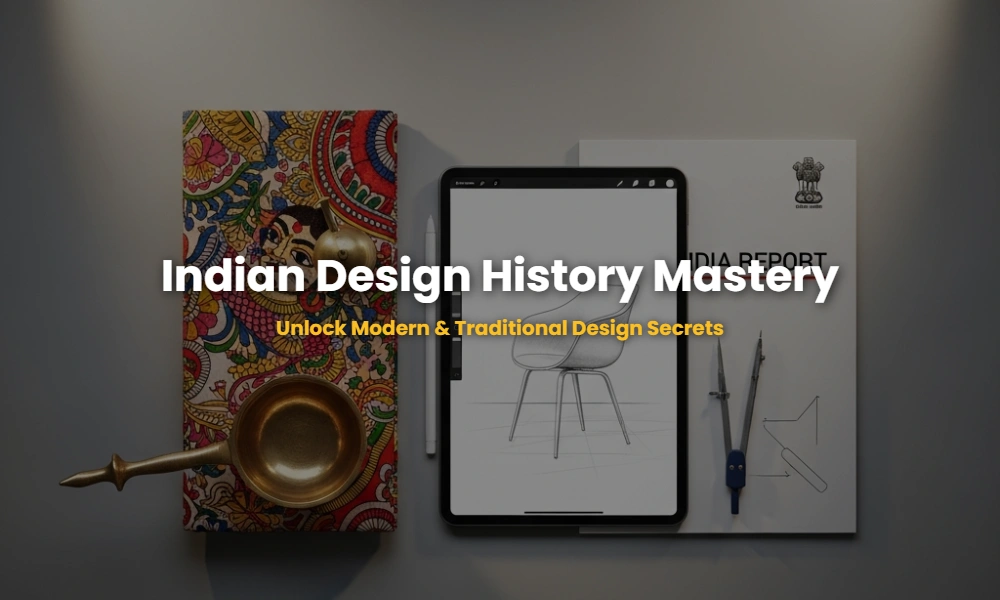
The National Institute of Design (NID) doesn’t just test your sketching; it tests your understanding of India’s aesthetic DNA. If you don’t grasp how Historical Design Evolution transitioned from temple carvings to sustainable tech, you are leaving 20% of your GAT marks on the table. This guide is your secret weapon to mastering the contributions of Modern Indian Designers and Traditional Craft Movements.
🚀 Key Takeaways
- ✅ The India Report (1958): The foundational document that birthed NID.
- ✅ Craft Movements: How the Swadeshi movement influenced modern product design.
- ✅ Legendary Figures: Why Dashrath Patel and Pupul Jayakar are exam favorites.
- ✅ Sustainability: The link between traditional ‘Jugaad’ and contemporary design thinking.
The Secret Roadmap You Need
The 12-Card Evolution Challenge: Can You Score 12/12?
Hover or Tap the cards below to reveal the secret history every NID topper knows.
Are You Sleeping on These Modern Indian Design Legends?
Modern Indian Designers are not just creators; they are storytellers who use history as their ink. From the minimalist product designs of industrial pioneers to the avant-garde fashion of Sabyasachi, the core philosophy remains: Respect the past, design for the future.
Take Satyendra Pakhalé, for instance. His work is a masterclass in how to take a ‘Traditional Craft Movement’—like the Bell Metal casting of Central India—and turn it into a globally recognized luxury product. This ability to synthesize Ethos and Technology is exactly what NID examiners look for in your portfolio and studio tests. If you can explain the ‘Why’ behind a material choice, you are already ahead of 90% of applicants.
💡 Pro-Tip: The ‘Material Evolution’ Hack
When sketching for NID, try to incorporate one traditional element (like a pattern or joint) into a modern object (like a drone or a smartphone). It shows the examiner you understand Historical Design Evolution.
Traditional vs. Modern: The Fatal Mistakes Students Make
Understanding the difference between raw craft and designed products is the key to winning Google’s ‘Position Zero’ in your mind. Traditional design was often communal and iterative, while Modern design is often individualistic and solution-driven. However, in India, these two worlds frequently collide.
The Sneaky Examiner Tips You Cannot Afford to Ignore
Historical Design Evolution questions in the NID DAT (Design Aptitude Test) often focus on ‘Cultural Context’. The examiner wants to see if you know why a certain chair was designed in 1960s India versus 1960s Europe. The answer always lies in the availability of materials and the socio-economic goal of the era.
Don’t just memorize names; understand the movements. The Bauhaus influence on Indian design led to the rejection of unnecessary ornamentation in favor of clean lines, which we see in the early NID identity and projects. Focus on how the ‘India Report’ emphasized using the ‘eyes of the village’ alongside the ‘tools of the city’.
❓ Quick Quiz: Who is the ‘Father of Indian Industrial Design’?
While many contribute, Gajanan Upadhyay is often cited for his pioneering work in furniture design and establishing the wood workshop at NID. His ‘Low-cost furniture’ series remains a benchmark.
Still Confused About Design History?
Don’t let the vastness of Indian design history overwhelm you. Our experts can help you decode the patterns and movements that actually matter for NID 2024-25.
💬 Chat with our Experts on WhatsApp (+91 9526806124)




