
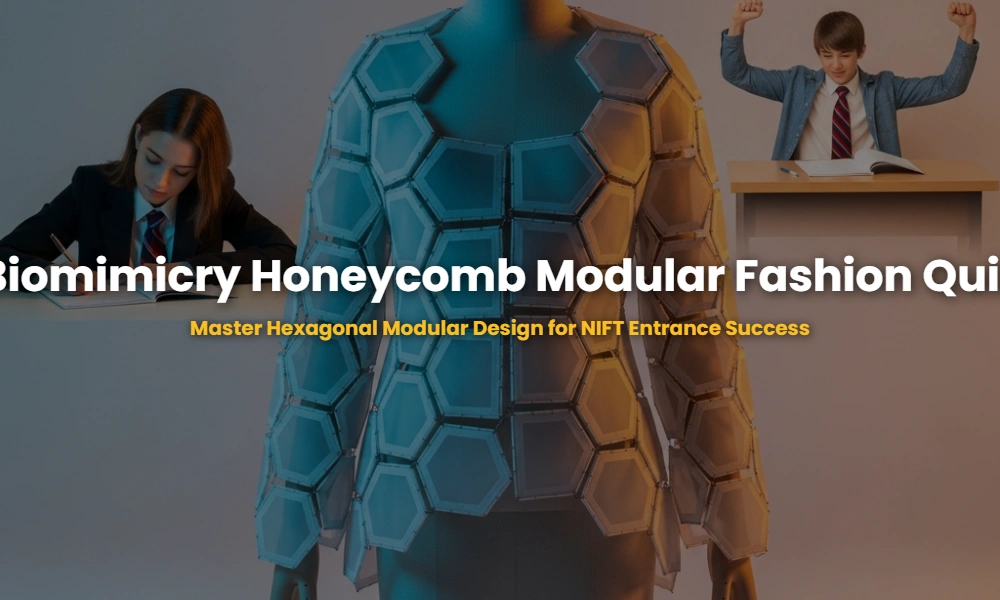
The Secret Geometry of Honeycombs: Why Top NIFT Rankers are Obsessed with Biomimicry
Applying the geometric hexagon structure of honeycombs to modular garment construction involves using nature’s most efficient tiling system to create interlocking fabric components. This biomimetic approach ensures maximum material utility, reduces textile waste to near zero, and allows for infinite customization without traditional seams, a topic now essential for NIFT CAT and GAT.
🚀 Key Takeaways
- Understanding tessellation and its role in zero-waste design.
- The mathematical efficiency of the 120-degree hexagonal interior angle.
- How biomimicry bridges the gap between biological systems and textile engineering.
- Applying modularity to create adaptable, circular fashion ecosystems.
The Sneaky Geometric Secrets of Honeycombs You Cannot Afford to Ignore
Hexagonal structures in nature, particularly in honeycombs, represent the peak of structural efficiency by providing the largest volume for the least amount of material. In fashion design, this translates to minimizing fabric consumption while maximizing surface area coverage, making it a cornerstone of geometric pattern making for innovative designers.
When we look at the honeycomb through the lens of biomimicry, we observe that the hexagon is the only shape that balances structural integrity with 360-degree tiling potential. Unlike circles, hexagons leave no gaps; unlike triangles or squares, they provide a more fluid, organic silhouette that mimics the curves of the human body more effectively when translated into three dimensions. This is why NIFT examiners are increasingly focusing on how students can adapt biological structures to solve modern textile problems.
💡 Pro Tip: The 120-Degree Rule
In a perfect hexagonal grid, three hexagons meet at a single vertex, each contributing 120 degrees to complete the 360-degree circle. This distribution of stress is why honeycomb structures are exceptionally strong yet lightweight in modular fashion.
The Fatal Mistake Aspirants Make with Modular Garment Construction
Modular garment construction using hexagonal units requires a deep understanding of interlocking mechanisms rather than traditional stitching methods. Many students fail to realize that the strength of a modular garment lies in the tension and friction of the joints, not just the aesthetic placement of the shapes on a dress form.
By integrating modularity, designers can create ‘living’ garments that evolve. If one hexagonal module is damaged, it can be replaced without discarding the entire garment. This is the essence of circularity in sustainable textile innovation. Below is a comparison of how the hexagon outperforms other shapes in modular design:
| Feature | Square Unit | Triangle Unit | Hexagon Unit |
|---|---|---|---|
| Tessellation | Basic | Complex | Optimized |
| Flexibility | Rigid | High | Superior (Multi-directional) |
| Visual Appeal | Grid-like | Sharp/Edgy | Organic/Fluid |
Exclusive Mock Quiz: Can You Handle These 10 Hexagonal Design Challenges?
This quiz tests your ability to apply biological principles to technical design, a skill that separates average candidates from top-tier NIFT material. If you can score 8/10, you are well-prepared for the most difficult NIFT CAT preparation tips and questions.
Q1. Why is the hexagon considered the most efficient shape for modular construction in biomimicry?
Q2. In the context of NIFT design theory, what is ‘Tessellation’?
Q3. Who is the author of ‘Biomimicry: Innovation Inspired by Nature’, a core text for design aspirants?
Q4. Which mechanical property is enhanced by using a honeycomb structure in modular textiles?
Q5. How does modular hexagonal construction support the ‘Circular Economy’ in fashion?
Q6. What is the sum of internal angles in a regular hexagon?
Q7. Which of these is a major challenge in creating interlocking modular fashion?
Q8. Biomimicry level 1 is mimicking form. What is level 3?
Q9. Which designer is famous for his work with the ‘A-POC’ (A Piece of Cloth) system, which relates to modularity?
Q10. How does a hexagonal grid help in zero-waste pattern cutting?
Expert NIFT Examiner Tips to Ace Biomimicry Questions
To score high in the NIFT Creative Ability Test (CAT), you must demonstrate the ability to observe natural systems and translate their mechanics into wearable solutions. Don’t just draw a hexagon; explain its purpose.
When answering a design prompt based on biomimicry, focus on the ‘Why’ before the ‘How’. Explain that you chose the honeycomb structure for its structural strength or its ability to allow for flat-packed modular assembly. This shows the examiner that you understand NIFT design theory at a deeper, functional level rather than just a decorative one.
💡 Advanced Concept: Voronoi vs. Hexagonal Grids
While regular hexagons are standard in honeycombs, ‘Voronoi patterns’ are a related biomimetic concept seen in dragonfly wings. Using Voronoi structures in modular design allows for variation in module size while maintaining structural connectivity, perfect for organic garment draping.
Ready to Crack NIFT with Expert Mentorship?
Don’t leave your fashion dreams to chance. Get personalized guidance, mock tests, and insider tips from top NIFT alumni today!
💬 Chat with our Experts on WhatsApp (+91 9526806124)




