
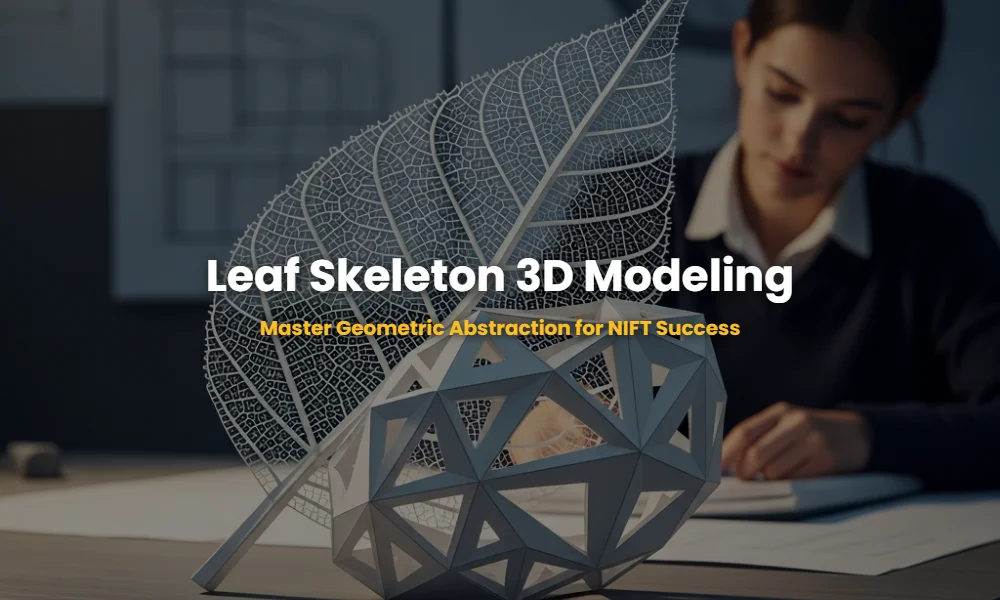
The Design Secret: Why Abstracting the Skeletal Structure of a Leaf into a 3D Structural Model is Your Golden Ticket
Abstracting the skeletal structure of a leaf into a 3D structural model involves identifying the core structural logic of a leaf—its venation, midrib, and margins—and translating these organic lines into rigid, three-dimensional geometric prisms to maintain structural integrity and aesthetic balance. This process is a cornerstone of the NIFT Studio Test, testing your ability to simplify complexity without losing essence.
🚀 Key Takeaways
- Identify the Midrib as the primary load-bearing axis.
- Use Triangular Prisms for maximum rigidity and stability.
- Abstract Venation Patterns (Pinnate vs. Palmate) into secondary geometric supports.
- Ensure Joinery is clean and structurally sound at all intersections.
The Sneaky Reason You Might Fail the Skeletal Abstraction Challenge (And How to Fix It!)
Aspirants fail when they attempt to mimic the leaf visually rather than structurally; the key is to interpret the leaf’s ‘skeleton’ as an architectural framework composed of prisms that support their own weight. Instead of flat surfaces, focus on the volume created by the cross-sections of the midrib and veins.
Understanding geometric abstraction techniques is vital. For instance, a curved midrib should not be a single bent prism, but a series of interconnected straight prisms that create a faceted curve. This demonstrates your understanding of 3D construction over simple crafting.
💡 Pro-Tip: The ‘V-Fold’ Secret
When using paper or thin sheets to create prisms, use a ‘V’ or ‘U’ fold pattern. This creates immediate structural rigidity. A flat sheet fails under its own weight, but a prism formed from that same sheet can support significant loads.
The Forbidden Knowledge of Prism Construction: Mastering Organic Abstraction
The transition from a 2D leaf image to a 3D structural model requires a deep dive into the properties of geometric prisms. A prism, by definition, has a constant cross-section. By varying the scale of these cross-sections—specifically making them thinner at the leaf tip—you can emulate the natural tapering found in biological skeletons.
In the context of biomimicry in design, the structural efficiency of a leaf’s skeleton is unparalleled. To replicate this, your model must handle tension and compression. Triangular prisms are the ‘gold standard’ here because they do not deform under shear stress, unlike rectangular ones.
The Structural Matrix: Choosing the Right Prism for Your Model
Choosing the wrong prism cross-section for a primary vein can lead to a collapsed model and a failed exam score. Use the table below to decide which geometry fits each part of the leaf’s anatomy.
| Prism Type | Anatomical Equivalent | Structural Strength | Complexity to Build |
|---|---|---|---|
| Triangular | Midrib / Primary Veins | Very High | Medium |
| Rectangular | Secondary Venation | Moderate | Low |
| Hexagonal | Complex Nodes/Hubs | Extremely High | High |
The Ultimate 3D Skeletal Abstraction Quiz: Only for Top 1% Aspirants
Test your conceptual understanding of structural modeling with these challenging MCQs designed by NIFT experts. Use these to master 3D composition principles.
Q1. When abstracting a Pinnate leaf, which part of the prism model should have the largest cross-sectional area to ensure structural stability?
Q2. Why is a triangular prism preferred over a rectangular prism for the structural frame of a leaf abstraction?
Q3. To represent ‘Reticulate Venation’ in a 3D model using prisms, what approach is most effective?
Q4. What does the ‘tapering’ of prisms from the center to the periphery in a leaf model signify?
Q5. Which joinery technique is best for connecting two triangular prisms at an angle in a skeletal model?
Q6. How do you ensure a 3D model of a large Monstera leaf remains stable using only thin paper prisms?
Q7. What is the main challenge of abstracting a ‘Palmate’ venation into 3D?
Q8. In a 3D structural model, what does ‘Negative Space’ represent in the context of a leaf skeleton?
Q9. Which prism cross-section is most ‘efficient’ (highest strength-to-weight ratio) for a long, straight vein?
Q10. How do you communicate ‘vitality’ or ‘life’ in a static geometric prism model of a leaf?
The Final Verdict: Dominating the NIFT Studio Test
Mastering the abstraction of organic forms into geometric structures is not just an art; it is an engineering feat. By focusing on the structural logic of the leaf and utilizing the inherent strength of prisms, you demonstrate the analytical and creative thinking that NIFT examiners crave. Remember, your goal is not to build a leaf, but to build the idea of a leaf’s strength.
For further practice, try building models of abstracting other natural forms like shells or insect wings using similar principles. Consistency in prism execution will set you apart from the thousands who use simple sticks or flat cutouts.
Confused about 3D Construction?
Our NIFT experts are available 24/7 to review your mock models and provide feedback on your abstraction techniques.
💬 Chat with our Experts on WhatsApp (+91 9526806124)




