
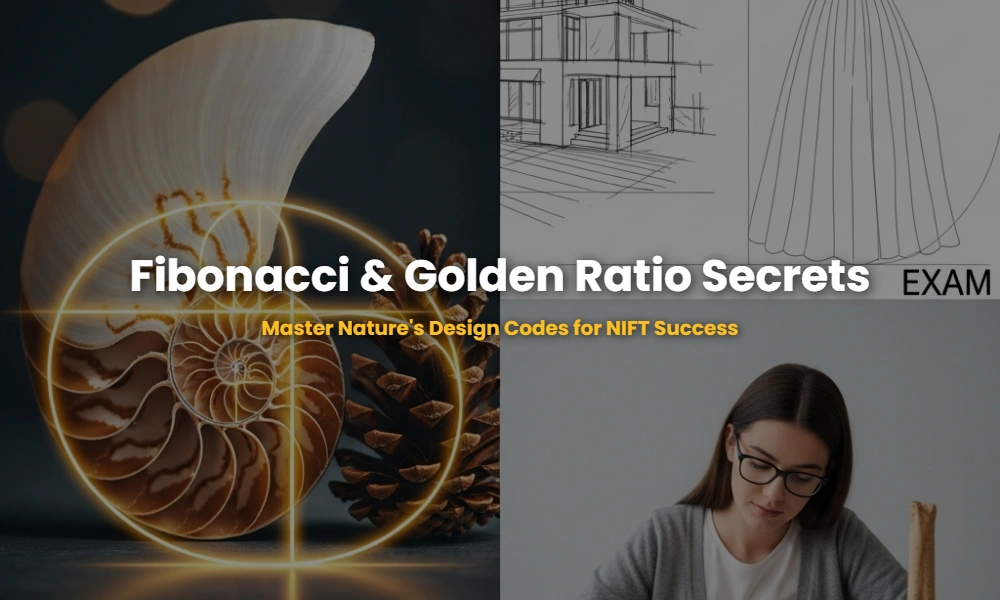
The Design Code: Mastering Fibonacci & the Golden Ratio in Nature
For a NIFT aspirant, understanding the Analysis of Fibonacci sequences and the Golden Ratio in natural spiral structures like shells and pinecones is not just an academic exercise—it is a mandatory skill for the Creative Ability Test (CAT) and General Ability Test (GAT). Examiners frequently look for these underlying mathematical rhythms in your compositions and natural sketching. If you fail to grasp how nature organizes growth through the Golden Section (Phi), your designs may appear aesthetically “off” compared to top-ranking students.
🚀 Key Takeaways
- Understand the recursive nature of the Fibonacci Sequence (1, 1, 2, 3, 5, 8…).
- Learn why the Golden Ratio (1.618) is the limit of Fibonacci ratios.
- Identify Phyllotaxis in pinecones and the Logarithmic Spiral in nautilus shells.
- Master the application of these principles in NIFT design portfolios.
Can You Afford to Miss These Hidden Fibonacci Patterns in Your NIFT Portfolio?
The Fibonacci sequence is a series of numbers where each number is the sum of the two preceding ones, creating a growth pattern that optimizes space and energy. In design exams, utilizing these proportions ensures that your visual hierarchies are naturally balanced and harmonious to the human eye.
Ignoring these patterns means missing the “Divine Proportion” that has guided artists from Leonardo da Vinci to modern luxury fashion brands. When you sketch a flower or a pinecone, the number of spirals usually corresponds to Fibonacci numbers (like 5, 8, 13, or 21). This isn’t random; it’s nature’s way of packing seeds or petals most efficiently without crowding. For students preparing for NIFT GAT syllabus topics, this mathematical logic is a frequent source of tricky questions.
💡 Pro-Tip: The NIFT Examiner’s Perspective
When asked to draw an organic structure, always try to incorporate a sense of radial symmetry based on the Golden Spiral. It demonstrates a sophisticated understanding of form and structure that sets you apart from amateur sketchers.
The Golden Ratio Secret: Why Top Designers Obsess Over Pinecones and Shells
The Golden Ratio (represented by the Greek letter Phi, ≈ 1.618) is the mathematical limit of the ratio of consecutive Fibonacci numbers. In nature, it manifests as the most efficient growth constant, allowing organisms like pinecones to pack maximum seeds in minimum surface area.
Why does this matter for your exam? Because the Golden Ratio is synonymous with aesthetic perfection. Whether you are analyzing a Nautilus shell or the layout of a fashion editorial, the 1:1.618 ratio creates a focal point that the human brain is evolutionarily wired to find pleasing. In the NIFT entrance exam strategy, applying Phi to your layout design or logo creation can drastically improve your CAT scores.
| Natural Structure | Mathematical Pattern | Design Application |
|---|---|---|
| Pinecone Seeds | Opposing Fibonacci Spirals | Efficient Texture Packing |
| Nautilus Shell | Logarithmic (Golden) Spiral | Curvilinear Proportion |
| Sunflower Heads | Phyllotaxis (Phi) | Radial Symmetry Hierarchy |
Stop Designing Blindly: How Logarithmic Spirals Change Everything
A logarithmic spiral is a self-similar curve where the distances between the turnings increase in geometric progression, often tied to the Golden Ratio. Unlike an Archimedean spiral, it maintains its shape as it grows, making it nature’s preferred blueprint for shells and galaxies.
In design, this concept allows for “Equiangular” growth. If you understand how a shell grows without changing its shape, you can create modular designs in fashion that are scalable and structurally sound. To truly excel, one must study color theory and composition alongside these geometric truths to build a cohesive visual narrative.
The Ultimate Mock Quiz: Test Your Mastery Before the Exam Day
Think you’ve mastered the Analysis of Fibonacci sequences and the Golden Ratio in natural spiral structures like shells and pinecones? These 10 NIFT-level questions will separate the toppers from the rest.
Q1. In a standard pinecone, the clockwise and counter-clockwise spirals are almost always what?
Q2. What is the approximate value of the Golden Ratio (Phi)?
Q3. Which type of spiral is found in a Nautilus shell, where it maintains its shape as it grows?
Q4. What is the term for the arrangement of leaves or seeds around a stem/axis based on Fibonacci?
Q5. If a designer uses the Golden Ratio for a rectangle’s width (w=10cm), what would be the height (h)?
Q6. In a Fibonacci sequence, which number follows 21 and 34?
Q7. The angle used in phyllotaxis to minimize leaf overlap is approximately how many degrees?
Q8. Which artist famously used the Golden Ratio in the ‘Vitruvian Man’?
Q9. In a pinecone, if you count 21 spirals in one direction, what is the most likely number of spirals in the other?
Q10. What is a ‘Golden Spiral’ based on?
Insider Examiner FAQs
How does Fibonacci help in CAT (Creative Ability Test)?
It helps you divide your drawing space effectively. Using a 1:1.6 proportion for your main character or product in a scene creates instant visual balance that is pleasing to evaluators.
Is it necessary to use a ruler for Golden Ratio in exams?
No! NIFT is about observation. You should be able to estimate the ratio 2:3 or 3:5 (Fibonacci approximations) by eye. Mastery comes with practicing sketching natural forms.
Confused about Golden Ratios or Design Prep?
Get personalized guidance from NIFT alumni and industry experts today!
💬 Chat with our Experts on WhatsApp (+91 9526806124)




