
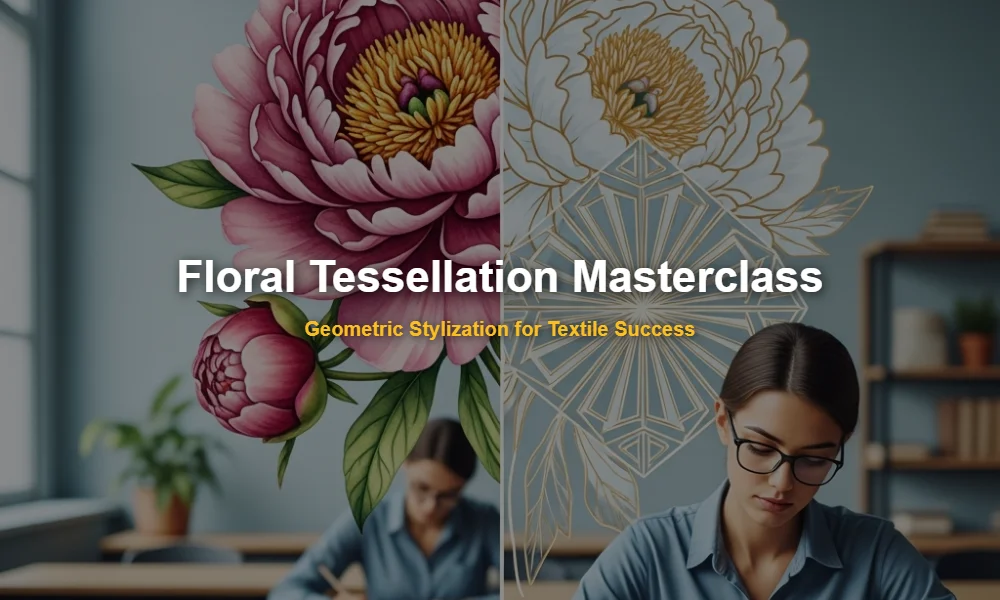
How can you master stylizing organic floral motifs into repeating geometric tessellations for textile prints?
Every year, thousands of NIFT aspirants struggle with the complex transition from drawing a realistic flower to creating a sophisticated, industry-standard textile repeat. Stylizing organic floral motifs into repeating geometric tessellations is not just about drawing; it is a mathematical and artistic dance of symmetry, abstraction, and spatial reasoning. In the competitive landscape of the NIFT CAT (Creative Ability Test), the ability to deconstruct nature and reconstruct it into a seamless geometric grid is the hallmark of a top-ranker.
- Master the distinction between motif simplification and complete abstraction.
- Understand the 17 Wallpaper Groups used in professional textile tessellation.
- Learn the ‘M.C. Escher’ technique of subtraction and addition for seamless repeats.
- Discover why geometric grids are the backbone of high-end industrial textile manufacturing.
The Secret Blueprint: Table of Contents
The Hidden Trap Aspirants Fall Into When Designing Floral Patterns
The biggest mistake in stylizing organic floral motifs into repeating geometric tessellations is maintaining too much realism, which creates ‘cluttered’ intersections and breaks the visual flow of the tessellation. To succeed, you must strip the flower to its geometric essence—circles, triangles, or polygons—while maintaining its botanical identity.
When you transition from an organic form to a geometric abstraction, you are essentially creating a ‘Repeat Unit’. This unit must interact with its neighbors perfectly. In textile design, particularly for block printing or rotary screen printing, the motif must fit within a specific grid. If the lines are too organic, the ‘seams’ of the repeat will be visible, a cardinal sin in professional fabric design.
💡 Examiner’s Insider Tip: The ‘Squint Test’
Squint your eyes at your design. If you can clearly see the boundaries of the square or rectangle you drew in, your tessellation has failed. The geometric floral motifs should flow so seamlessly that the underlying grid is invisible to the untrained eye.
Why Your Geometric Tessellations Look Cluttered—And How to Fix It Instantly
Geometric tessellations for textile prints require an understanding of ‘Symmetry Operations’: translation, rotation, reflection, and glide reflection. Without these, your floral stylization will look like a simple sticker repeat rather than a sophisticated textile composition.
| Tessellation Type | Symmetry Used | Floral Application |
|---|---|---|
| Regular | Translation | Identical stylized petals repeating on a square grid. |
| Semi-Regular | Rotation | Two different floral motifs meeting at vertex points. |
| Escher-Style | Glide Reflection | Irregular floral shapes interlocking like a puzzle. |
In a high-quality textile print design, the ‘Negative Space’ (the area between motifs) must be as geometric and intentional as the ‘Positive Space’ (the floral motif itself). This is the secret to achieving balance.
The Forbidden Math of NIFT: Can You Solve the Symmetry Riddle?
Designing for NIFT requires moving beyond the simple ‘Square Repeat’ and mastering ‘Half-Drop’ and ‘Brick’ repeats. By stylizing organic floral motifs into these grids, you create a more dynamic movement across the fabric, making the design appear more expensive and professional.
When stylizing, use the Law of Simplification. If a rose has 20 petals, your stylized version should have 5 or 6 geometric shapes that suggest a rose. This motif stylization process allows the motif to be rotated and reflected without losing its visual impact.
💡 Click to Reveal the Secret of Islamic Florals
Islamic floral art (Arabesque) is the pinnacle of this technique. They use a ‘Geometric Underlying Grid’ (like a 10-pointed star) and weave organic vines through it. For NIFT, try drawing your geometric grid first, then fit your stylized flowers into the intersections.
Ultimate NIFT Mock Quiz: Stylization & Tessellations
Q1. In a ‘Regular Tessellation’ of stylized florals, which three geometric polygons are the only ones capable of tiling a plane perfectly without gaps?
Q2. Which ‘Symmetry Operation’ involves sliding a motif along a line and then reflecting it over that same line?
Q3. When stylizing a motif for a ‘Half-Drop’ repeat, the second column of motifs is shifted vertically by what fraction of the repeat height?
Q4. What is the main objective of ‘Abstracting’ an organic floral motif for a tessellation?
Q5. In textile design, what does the term ‘Rapport’ refer to?
Q6. M.C. Escher is famous for creating ‘Interlocking Tessellations’. What is the ‘Area Preservation’ rule in his technique?
Q7. Why is ‘Radial Symmetry’ commonly used for stylizing flowers like Dahlias or Sunflowers in geometric prints?
Q8. Which of these is a ‘Non-Periodic’ tessellation, often used for modern, non-repeating stylized floral textures?
Q9. In stylization, the term ‘Geometric Distillation’ means:
Q10. What is the main advantage of using a ‘Hexagonal Grid’ over a ‘Square Grid’ for floral stylization?
Still confused about tessellations?
Our experts help NIFT aspirants master complex design concepts daily.
💬 Chat with our Experts on WhatsApp (+91 9526806124)




