
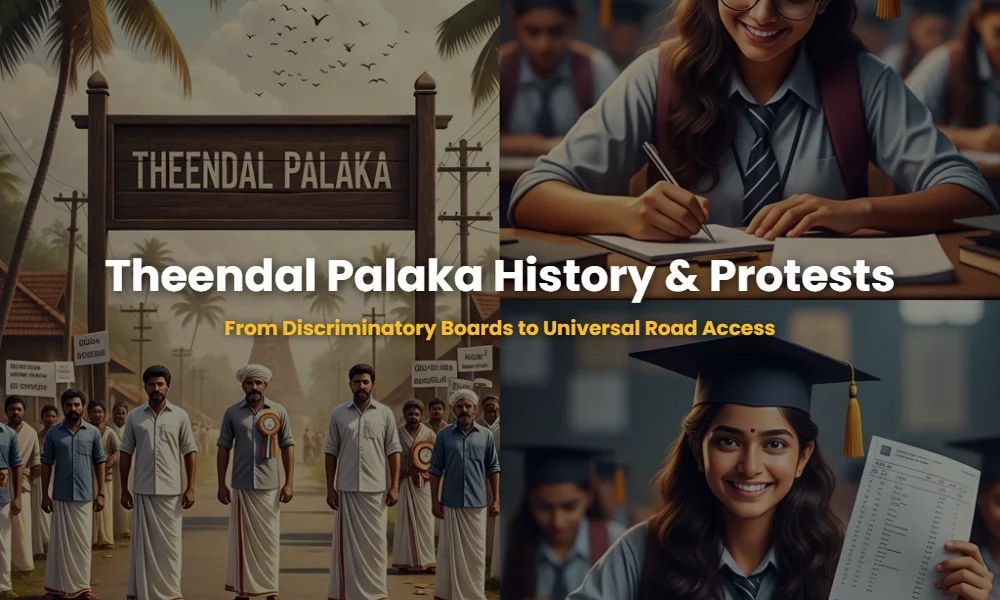
The Notorious Theendal Palaka & The Great Protest Movements
A Definitive Visual Guide for Kerala PSC Aspirants
🚀 Key Takeaways You Must Memorize Right Now!
- ✅ Theendal Palaka were physical boards marking distances where lower castes were forbidden.
- ✅ The Vaikom Satyagraha (1924) was the first major movement against these road restrictions.
- ✅ T.K. Madhavan was the mastermind who brought the issue to national attention via the INC.
- ✅ The Savarna Jatha led by Mannathu Padmanabhan proved high-caste support for the movement.
- ✅ Final Success: Roads were opened to all in Vaikom by 1925, setting a precedent for India.
Why Were These Cruel Boards Placed on Public Roads?
The implementation of Theendal Palaka (Untouchability Boards) on public roads surrounding temples was a physical manifestation of the caste system in early 20th-century Kerala. These boards marked a specific boundary beyond which members of the Ezhava, Pulaya, and other marginalized communities were legally and socially prohibited from walking, even if the roads were maintained by public taxes.
🚫 The Distance Rule
Caste discrimination was measured in feet. Ezhavas had to stay 16 feet away, while Pulayas were forced to stay 64 feet away from ‘high caste’ individuals. The boards made these invisible rules visible and enforceable by law.
🏛️ The Legal Backbone
Shockingly, these boards weren’t just social customs; they were often backed by the princely state of Travancore’s administration, making the struggle a fight against both religious orthodoxy and state policy.
To understand the depth of this struggle, one must look at the Kerala Renaissance history which identifies these boards as the primary target of early civil rights activists.
The Forbidden Zones: Which Specific Locations Faced This Tyranny?
Theendal Palaka were most prominently placed on the four roads encircling major temples like the Vaikom Mahadeva Temple. These roads served as vital public thoroughfares, yet thousands were forced to take long detours through muddy fields because of their caste, leading to extreme economic and physical hardship.
| Location | Target of Protest | Significance |
|---|---|---|
| Vaikom | Temple Road Access | The epicenter of the first organized anti-untouchability movement in India. |
| Guruvayur | Temple Entry & Road Access | Followed the Vaikom model to demand complete temple entry rights. |
| Kalpathi | Agraharam Access | Protested against restrictions in the Brahmin settlements of Palakkad. |
| Suchindram | Temple Road Access | A crucial Satyagraha in southern Travancore against untouchability. |
💡 Pro-Tip for PSC: What was the ‘Theendal Kuzhi’?
While the Theendal Palaka was the board, the ‘Theendal Kuzhi’ (Untouchability Pit) was a literal pit or marked spot on the ground where lower castes had to deposit their tax money or goods to avoid ‘polluting’ the officials by proximity. It highlights the extreme dehumanization of the era.
How Did the Vaikom Satyagraha Smash the Theendal Palaka System?
The Vaikom Satyagraha (1924-1925) was the most decisive blow against the Theendal Palaka. It began on March 30, 1924, when K.P. Kesava Menon, T.K. Madhavan, and Bahuleyan walked toward the prohibited boards, courting arrest and igniting a movement that would last 604 days and capture the world’s attention.
If you are preparing for the Vaikom Satyagraha detailed syllabus, you must note that the movement ended only after the intervention of the Maharani of Travancore and Mahatma Gandhi’s personal visit.
Did You Know These Lesser-Known Facts About the Protest Leaders?
The movement to tear down the Theendal Palaka was led by a diverse coalition of visionary leaders. Their collective efforts ensured that the ‘Kerala Model’ of social reform became a blueprint for the rest of India. These figures are high-priority for any Kerala PSC question paper.
T.K. Madhavan
Known as the ‘Soul of Vaikom Satyagraha’. He was the first to visualize the protest and used his newspaper ‘Desabhimani’ to mobilize the masses against the untouchability boards.
K. Kelappan
Often called ‘Kerala Gandhi’. He played a pivotal role in Vaikom and later led the Guruvayur Satyagraha, continuing the fight against caste barriers.
George Joseph
A Christian leader who actively participated in the Vaikom Satyagraha, demonstrating that the fight against the boards was a secular struggle for human rights.
🔍 Click to Reveal: Who was the first Satyagrahi arrested at Vaikom?
The first batch of Satyagrahis to be arrested were Kunnappally Achutha Menon (Nair), Bahuleyan (Ezhava), and Venniyil Govinda Panicker (Nair). This diverse group was intentionally chosen to challenge the notion that caste was a private religious matter.
The Ultimate Victory: When Did the Boards Finally Come Down?
The victory at Vaikom was the beginning of the end for the Theendal Palaka system. Following the 1925 agreement, three out of the four roads surrounding the Vaikom temple were opened to all castes. This paved the way for the historic Temple Entry Proclamation of 1936, which legally abolished untouchability in Travancore temples.
Social Progress: 100% Achieved (The Path to Equality)
📉 Why this matters for your Rank:
PSC examiners frequently ask about the sequence of events. Remember: Theendal Palaka Protests -> Vaikom Satyagraha (1924) -> Savarna Jatha -> Road Opening (1925) -> Temple Entry Proclamation (1936). Skipping these details could cost you a crucial mark in the Kerala Administrative Service (KAS) or Degree Level exams.
Frequently Asked Questions for Kerala PSC
❓ What was the main demand of the Vaikom Satyagraha?
The primary demand was the right for all people, regardless of caste, to use the public roads leading to the Vaikom Mahadeva Temple, which were blocked by Theendal Palaka.
❓ Who suggested the idea of the Savarna Jatha?
The Savarna Jatha was suggested by Mahatma Gandhi to demonstrate that the upper castes also supported the removal of the untouchability boards.
❓ Which newspaper was most instrumental in the movement?
T.K. Madhavan’s ‘Desabhimani’ and the ‘Mitavadi’ were crucial in highlighting the atrocities of the Theendal Palaka to the public.





