
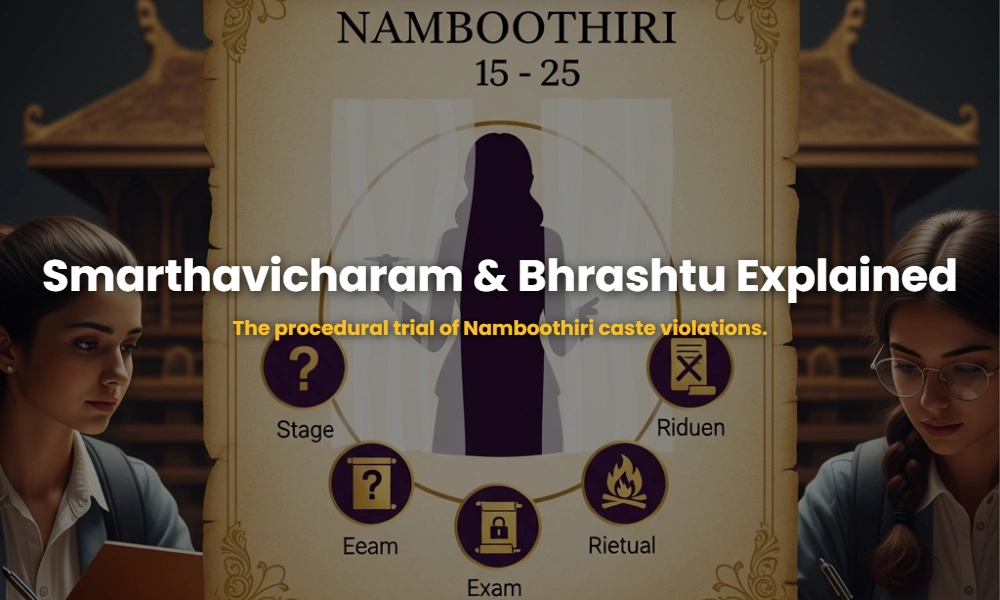
The Dark Legal History: Decoding Smarthavicharam & Bhrashtu
To master the Kerala PSC history segment, one must comprehend the intricate social fabric of the Namboothiri community. Kerala social reforms were born out of the struggle against practices like Smarthavicharam. This article breaks down the brutal efficiency of this ritualistic trial and the resulting Bhrashtu (excommunication).
- The 5 distinct stages of the Smarthavicharam trial.
- The legal authority of the Smarthan (the presiding judge).
- The social death sentence known as Bhrashtu.
- The historic case of Kurinjedathu Thathri.
The Forbidden Ritual: What Exactly was Smarthavicharam?
Smarthavicharam was a traditional ritualistic trial conducted by the Namboothiri community in Kerala to investigate allegations of sexual misconduct, particularly against women (Antharjanams). It was presided over by a Smarthan (an expert in Smritis) to determine the purity of the accused through rigorous questioning and evidence gathering before a final verdict.
Understanding this is crucial because it highlights the lack of judicial neutrality in the pre-modern era. The Namboothiri caste hierarchy relied on Smarthavicharam to maintain the concept of ‘purity’ within their lineage. If an Antharjanam was suspected of ‘Sadachara-lankhanam’ (violation of conduct), she faced a trial where she was often treated as already guilty.
💡 Pro-Tip: The Smarthan’s Identity
The Smarthan was not just a judge; he was a Vedic scholar. His word was absolute. In PSC exams, remember that the King (Raja) usually sanctioned the trial, making it a quasi-legal state proceeding.
The 5 Lethal Stages You Cannot Afford to Ignore!
The procedural stages of Smarthavicharam are a mandatory topic for PSC aspirants. Each stage, from the initial suspicion to the final excommunication, followed a strict Vedic protocol that ensured the accused had virtually no defense against the collective will of the caste council.
Dasi-vicharam
The trial began with the questioning of the maid-servant (Dasi). If the Dasi confirmed the suspicion, the trial against the Antharjanam officially commenced. This was the ‘preliminary investigation’ phase.
Ancharampura
The accused woman was confined to a special room called ‘Ancharampura’ (the room of the outcaste). She was addressed only as ‘Saadhanam’ (the object/thing), stripping her of her human identity.
The Questioning
The Smarthan stood behind a curtain and questioned the woman. She had to answer through her Dasi initially, but eventually, direct interrogation occurred. The goal was to extract names of co-conspirators (Jaran).
Swaroopam Chollal
Once guilt was established, the Smarthan announced the ‘Swaroopam’ or the nature of the crime. This was the formal verdict that declared the woman had lost her caste status.
Adupukkoottal
The final ritual where the kitchen of the house was ‘re-purified’. The woman was symbolically considered dead, and her funeral rites (Udakakriya) were performed while she was still alive.
Bhrashtu: The Social Death Sentence You Must Understand
Bhrashtu, or excommunication, was the legal and social consequence of Smarthavicharam. It resulted in the immediate loss of all property rights, familial ties, and religious standing. An individual under Bhrashtu was barred from entering temples, using public wells, or interacting with any member of their former community.
For a Namboothiri, Bhrashtu was worse than a physical death sentence. It often led to the accused being sold into slavery or forced to convert to other religions to survive. This was the ultimate tool of social control used by the Namboothiri patriarchy.
| Legal Aspect | Impact of Bhrashtu |
|---|---|
| Civil Status | Declared ‘Civilly Dead’; no legal protection. |
| Property Rights | Immediate forfeiture of inheritance and assets. |
| Social Identity | Forbidden from using the family name or title. |
| Religious Access | Permanent ban from all temple rituals and Shuddhi. |
The Kurinjedathu Thathri Scandal: The End of an Era?
The 1905 Smarthavicharam of Kurinjedathu Thathri is the most significant historical event related to this practice. Thathri used the trial to name 65 powerful men, including scholars and high-ranking officials, as her partners, leading to their collective Bhrashtu and shaking the foundations of the Namboothiri community.
This case is a favorite for Kerala PSC examiners because it marked the beginning of the end for these medieval trials. Thathri’s defiance highlighted the hypocrisy of a system that only punished women while letting men go scot-free. This eventually paved the way for the Yogakshema Sabha and the Namboothiri Bill of 1933.
💡 Exam Alert: The Year 1905
Always remember the year 1905. It was the year of Thathri’s trial and also a period of intense social churn in Kerala. The Smarthan involved was Punnassery Nambi.
Frequently Asked Questions (PSC Focused)
A: The local King or the Maharaja of the region (Cochin/Travancore) usually issued the ‘Theettooram’ (Royal decree) for the trial.
A: They were scholars who assisted the Smarthan in interpreting the religious laws and deciding the intensity of the violation.
A: No. After the Namboothiri Act and subsequent Indian legal reforms post-independence, such parallel judicial systems are strictly illegal.
Confused about Kerala History? Let our experts guide you!
Get exclusive notes on Kerala Renaissance and Namboothiri reforms for your upcoming PSC exams.
💬 Chat with our Experts on WhatsApp (+91 9526806124)




