
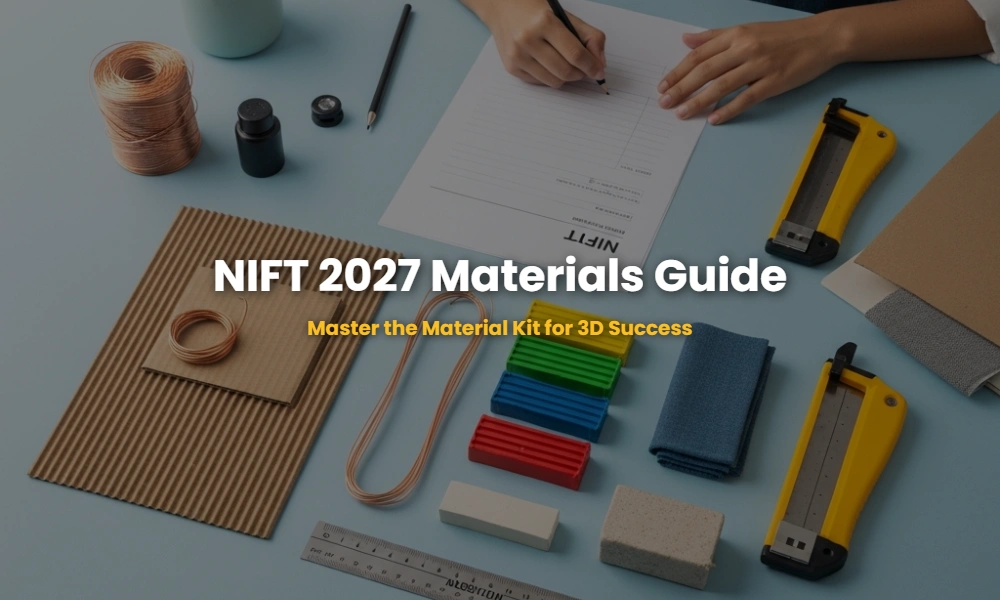
Are you ready to dominate the NIFT Situation Test 2027? The NIFT Situation Test 2027 strictly permits only the material kit provided at the examination center, which typically includes mount board, cardboard, copper wire, aluminum foil, fabric, wool, clay, and translucent sheets. No external materials or tools are allowed, making your mastery over these specific items the only bridge between a mediocre model and a top-tier rank.
🚀 Key Takeaways
- Strict Prohibition: Absolutely no outside materials or stationery items (other than basic sketching tools) are allowed.
- Provided Kit: Expect a mix of paper, wire, fabric, and adhesives provided by the NIFT center.
- Evaluation Criteria: You are judged on material handling, concept, and neatness, not just the complexity of the model.
- Strategic Tool Use: Mastering the provided cutter and glue stick is more important than having fancy tools.
What is the Mystery Material Kit for NIFT Situation Test 2027?
The material kit for the NIFT Situation Test 2027 contains a standardized set of items designed to test your spatial intelligence and creative problem-solving skills. Candidates are typically provided with corrugated sheets, mount board, translucent OHP sheets, copper or aluminum wire, modeling clay, colorful papers, and specific fabrics like cotton or net.
Understanding these materials is the first step toward success. Many students overlook the potential of a simple sheet of aluminum foil or a length of wool. In the competitive environment of the NIFT B.Des Entrance, your ability to transform these mundane objects into a conceptual 3D narrative is what sets you apart from the thousands of other aspirants.
| Material Category | Commonly Provided Items | Purpose in Model |
|---|---|---|
| Structural | Corrugated Sheet, Mount Board | Base, Walls, Rigid Structures |
| Flexible | Copper Wire, Wool, Thread | Connections, Outlines, Textures |
| Pliable | Modeling Clay, Foil | Organic Shapes, Molded Details |
| Decorative | Colored Paper, Beads, Net Fabric | Surface Finish, Embellishments |
💡 Click to Reveal Examiner’s Tip on Material Usage
Don’t use all materials! Using everything provided often leads to a cluttered and confusing model. Select 3-4 primary materials that best convey your concept and use others sparingly for accentuation.
Which Secret Tools Are Permitted to Save Your Model from Collapse?
For the NIFT Situation Test 2027, the only permitted tools are basic stationery items like a pencil, eraser, sharpener, and a stainless steel ruler (30cm). Cutting tools such as paper cutters and scissors, along with adhesives like Fevicol or glue sticks, are typically provided by the invigilators and must not be brought from home.
The 2027 guidelines emphasize that external “design kits” or specialized modeling tools are strictly forbidden. This ensures a level playing field for all candidates. To stay ahead, practice with a standard utility knife and liquid adhesive, as these are the most common tools you will encounter. If you are also preparing for the preliminary stages, check our Creative Ability Test strategies to sharpen your ideation skills early on.
Note on Adhesives: Excess glue is a major points-deductor. Examiners look for “clean” joints. Use the “invisible joinery” technique—where the mechanical structure supports itself, and glue is only a secondary stabilizer.
How Can You Master Material Handling Like a Top Ranker?
Mastering material handling involves techniques like scoring for sharp folds, wire-bending for skeletal frames, and paper-quilling for intricate textures. For NIFT 2027, candidates must demonstrate how to manipulate the inherent properties of materials—for instance, using the transparency of an OHP sheet to mimic glass or the crinkle of foil to represent water.
Consider the “Score and Fold” method. When dealing with thick mount board, cutting halfway through (scoring) allows for a crisp 90-degree bend without breaking the material. Similarly, wire can be wrapped around a pencil to create uniform coils or zig-zagged to provide structural support for clay elements. This level of finesse is essential for high scores in the design evaluation process.
💡 Pro-Tip: The “3-Second” Rule for Clay
Modeling clay provided in NIFT tests can be oily. Knead it for exactly 3-5 seconds to warm it up before shaping. Over-kneading makes it too soft to hold structural weight, while under-kneading leads to cracks.
The Deadly Mistakes in Material Usage You Must Avoid!
The most common mistakes in the NIFT Situation Test include using too much glue (leaving visible stains), creating unstable models that wobble, and failing to provide a write-up that matches the 3D model. In 2027, examiners are expected to focus heavily on “Material Innovation”—using a material for something other than its intended purpose.
Don’t fall into the trap of literal representation. If asked to design a playground, don’t just make a slide out of cardboard. Use the texture of the fabric to represent safety padding or the transparency of the OHP sheet to represent a modern climbing wall. A lack of conceptual depth is why even aesthetically pleasing models fail to crack the top 100 ranks.
Frequently Asked Questions for NIFT Situation Test 2027
Can I bring my own Fevicol or glue stick?
No, you cannot bring any adhesives from home. All necessary bonding agents will be provided in the material kit or at your workstation. Bringing outside adhesives is considered malpractice.
What happens if I run out of a particular material?
Usually, the quantity provided is fixed and no extra material is given. This is part of the test to see how you manage limited resources. Plan your design before you start cutting!
Is the write-up evaluated along with the model?
Yes, the write-up is a critical component. It should clearly explain your concept, the materials you chose, and how they relate to the given theme. It must be in English.
Confused about the NIFT 2027 Selection Process?
Get free mentorship and expert guidance on material handling and model making from our NIFT alumni mentors!
💬 Chat with our Experts on WhatsApp (+91 9526806124)




