
What are the absolute latest stationery requirements for NIFT CAT 2027?
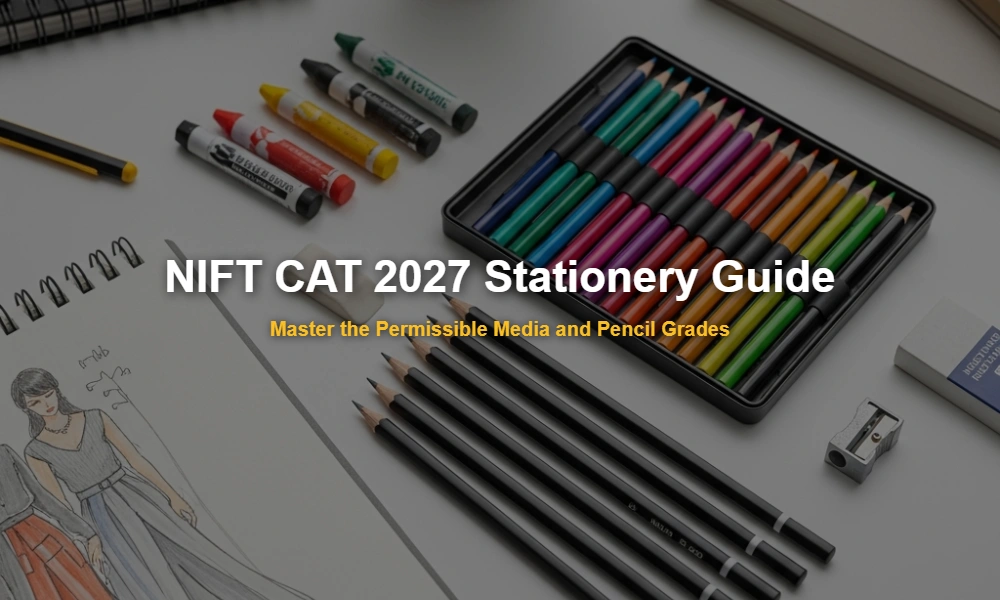
For the NIFT CAT 2027 exam, candidates are strictly required to use dry coloring media, which includes pencil colors, oil pastels, and crayons. Standard pencil grades ranging from HB to 6B are recommended for sketching and shading. Wet media like watercolors, acrylics, and inks are strictly prohibited to ensure paper integrity and scanning compatibility.
🚀 Key Takeaways
- ✅ Permissible Media: Pencil colors, Oil pastels, Crayons, and Sketch pens (for outlines).
- ✅ Pencil Grades: HB (Light), 2B (Standard), 4B (Dark), and 6B (Ultra-dark shading).
- 🚫 Strictly Prohibited: Watercolors, poster colors, acrylics, and glitters.
- 🛠️ Essential Tools: Transparent pencil box, kneadable eraser, and high-quality sharpener.
Table of Contents
Are You Using the Wrong Pencil Grades for NIFT CAT 2027 Shading?
Pencil grades for NIFT CAT 2027 should follow a strategic gradient: use HB for light initial construction, 2B for defining forms, 4B for medium-depth shadows, and 6B for high-contrast accents. Using pencils darker than 6B is discouraged as they tend to smudge easily on the official NIFT drawing paper.
Understanding the “H” (Hardness) and “B” (Blackness) scale is vital. For fashion illustrations and product designs, the 2B pencil is your workhorse. It offers the perfect balance between erasability and depth. Many toppers recommend brands like Steadtler Mars Lumograph or Faber-Castell 9000 series because their graphite consistency prevents the “shiny” wax effect that occurs with cheaper pencils. Remember, the examiner looks for clean lines and professional value-grading. If your drawing looks muddy because you over-relied on a 10B pencil, you are losing valuable points in the NIFT CAT preparation journey.
💡 Pro-Tip: The ‘Light Touch’ Rule
Always start with an HB pencil using minimal pressure. NIFT paper is absorbent; if you press too hard, you leave ‘ghost lines’ that are impossible to erase, potentially ruining your final score.
Will Your Choice of Colors Get You Disqualified in NIFT CAT 2027?
Using prohibited media like watercolors or inks in NIFT CAT 2027 can lead to immediate disqualification or significant marks deduction. The exam strictly mandates dry media—pencil colors and oil pastels—to prevent paper warping and to facilitate high-quality digital scanning of your answer sheet during the evaluation process.
Why the strictness? The National Institute of Fashion Technology uses advanced scanners for evaluation. Wet media causes the 140 GSM paper to buckle, creating shadows and distortions that hide your fine details. Stick to high-pigment pencil colors such as Faber-Castell Polychromos or Prismacolor Premier if your budget allows; otherwise, standard artist-grade sets are sufficient. Oil pastels should be used sparingly for large background fills, as they can be messy. Mastering NIFT Syllabus concepts like color harmony is easier when you use tools that don’t bleed through the page.
| Permissible (Safe) | Prohibited (Danger!) |
|---|---|
| Pencil Colors (Wax/Oil based) | Watercolors & Gouache |
| Oil Pastels & Soft Pastels | Acrylics & Poster Colors |
| Dry Crayons | Calligraphy Inks & Glitters |
| Sketch Pens (Limited use) | Spray Paints |
What Are the Hidden Examiner Preferences for NIFT CAT Paper Rendering?
Examiners for NIFT CAT 2027 look for ‘value depth’ and ‘material rendering’ rather than just a pretty picture. Achieving this requires using a range of pencil grades (HB for highlights, 4B for core shadows) and layering color pencils to create gradients, which demonstrates a high level of design maturity.
Rendering isn’t just about coloring inside the lines; it’s about texture. If the question asks you to design a leather bag, your pencil strokes should convey the sheen and stiffness of leather. If it’s a silk scarf, your color pencil blending should be smooth and fluid. Many aspirants make the mistake of leaving large white gaps. Use a white pencil color for burnishing and blending to give your work a professional ‘finished’ look. This level of detail is what differentiates a rank-holder from a regular candidate in the NIFT Mock Tests and final examinations.
Is Your Stationery Bag Ready? The Ultimate NIFT CAT 2027 Checklist
A complete NIFT CAT 2027 stationery kit must include a set of pencils (HB, 2B, 4B, 6B), a 24-shade pencil color set, oil pastels, a non-dust eraser, a sharpener, and a transparent ruler. Keeping these in a transparent pouch is mandatory for exam hall entry to avoid any security complications.
Beyond the basics, consider adding a kneadable eraser. This tool is a secret weapon for lifting graphite from a drawing without damaging the paper surface, allowing you to create high-precision highlights. Also, carry a micro-tip black pen (0.5mm) for final outlines, but use it sparingly; NIFT examiners generally prefer drawings that show form through shading rather than heavy outlines. Ensure you have practiced with these specific tools during your NIFT coaching sessions to build muscle memory and speed.
Frequently Asked Questions: Don’t Walk Into the Exam Blind!
❓ Can I use markers for NIFT CAT 2027?
While basic sketch pens are often allowed for outlining, heavy alcohol markers are risky as they bleed through the paper, potentially spoiling your work on the other side. Stick to pencil colors for primary rendering.
❓ Are geometry sets allowed in the CAT exam?
NIFT typically discourages the use of rulers and compasses in the CAT to test your freehand drawing skills. However, a transparent 15cm ruler is usually permitted for basic framing. Check your admit card for the latest 2027 update.
❓ Can I use a blending stump?
Yes, blending stumps are excellent for smooth graphite transitions. However, ensure they are clean to avoid transferring unwanted dark spots to highlight areas.
Confused about the 2027 Exam Pattern?
Our experts are here to help you navigate the complex stationery requirements and design concepts for NIFT.
💬 Chat with our Experts on WhatsApp (+91 9526806124)




