
Quick Navigation: Don’t Miss These Sections!
🚀 Key Takeaways
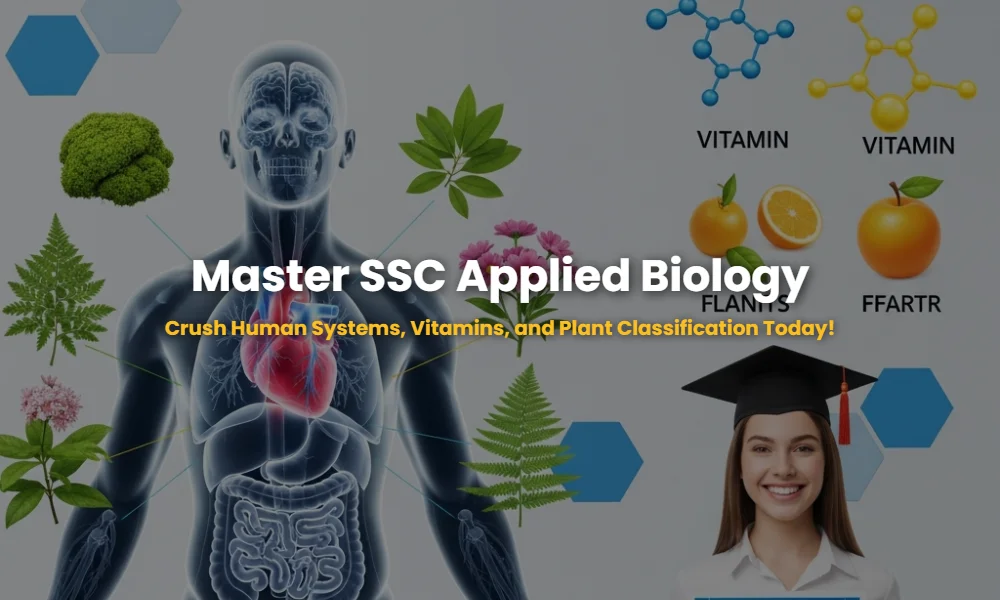
Before we dive into the deep end, here is the essential summary of what makes Applied Biology for SSC a game-changer for your preparation. Mastering these three pillars ensures you stay ahead of the competition.
- Core Dominance: Human body systems like the Circulatory and Endocrine systems contribute to nearly 40% of Biology questions.
- Vitamin Criticality: Water-soluble vs. Fat-soluble vitamins are a recurring theme; knowing chemical names is non-negotiable.
- Classification Mastery: Plant kingdom divisions (Thallophyta to Angiosperms) are often tested through specific examples like Funaria or Spirogyra.
- Strategic Edge: Using biology shortcuts can save you precious seconds during the actual exam.
💀 The Human Body Systems Trap: Why 90% of Aspirants Fail to Score Full Marks
Applied Biology for SSC focusing on Human Body Systems covers the complex interactions between various organs, including the nervous, circulatory, and digestive systems. It requires understanding physiological processes like blood filtration, hormonal regulation, and neural transmission to answer the application-based questions frequently seen in CGL and CHSL exams.
As an expert examiner, I often see students memorizing the names of bones but failing to understand the functional mechanism of joints or the specific role of hormones in the Endocrine system. For instance, the Pituitary gland is the ‘Master Gland,’ but do you know which hormone it secretes to control the Thyroid? Most don’t. The SSC often pivots on these relational questions. You must focus on the circulatory system’s double circulation and the nervous system’s reflex arc. To boost your score, check our SSC science notes for detailed diagrams.
💡 Examiner Pro-Tip: The Heart Valve Secret
Always remember the sequence of valves in the heart using the mnemonic ‘Try Pulling My Aorta’ (Tricuspid, Pulmonary, Mitral, Aortic). This is a classic ‘Elimination-Style’ question in Tier-1.
🍎 The Hidden Vitamin Deficiency Matrix: Decoding the Examiner’s Favorite Trick
Vitamin Deficiencies in SSC Applied Biology refer to the clinical conditions arising from a lack of essential micronutrients, such as Scurvy (C), Rickets (D), or Xerophthalmia (A). Examiners focus on the scientific names (Retinol, Calciferol, Ascorbic Acid) and their specific physiological roles in the human body.
The trick in SSC is not just knowing the vitamin but knowing its chemical name and the specific symptom of its deficiency. For example, Vitamin B12 (Cyanocobalamin) is the only vitamin containing a metal ion (Cobalt), making it a high-yield topic. Below is a comparison table that you should memorize immediately to avoid falling into common traps.
| Vitamin (Chemical Name) | Deficiency Disease | Key Source |
|---|---|---|
| B1 (Thiamine) | Beriberi | Whole grains |
| B3 (Niacin) | Pellagra | Meat, Fish |
| K (Phylloquinone) | Delayed Blood Clotting | Green Leafy Veg |
For a more extensive list, navigate to our comprehensive vitamin chart. Remember, fat-soluble vitamins (A, D, E, K) are stored in the liver, while water-soluble ones (B, C) need daily replenishment.
🌿 Plant Kingdom Classification: The High-Yield Blueprint You Weren’t Told About
Plant Kingdom Classification Themes in Biology involve categorizing plants into five major groups: Thallophyta, Bryophyta, Pteridophyta, Gymnosperms, and Angiosperms based on vascular tissue, seed production, and flower presence. This hierarchical structure is fundamental for understanding evolutionary biology as tested in the SSC General Awareness section.
Aspirants often ignore the distinction between Bryophytes (Amphibians of the plant kingdom) and Pteridophytes (the first vascular plants). In the SSC 2024 landscape, examiners are focusing on specific examples. Did you know that ‘Peat Moss’ (Sphagnum) is a Bryophyte used as fuel? Or that Gymnosperms are ‘Naked Seeded’ plants? These nuances differentiate a ranker from a dreamer. Mastery of this section requires a deep dive into the Alternation of Generations and the role of Xylem and Phloem in higher plants.
💡 SSC Secret: The Thallophyta Trick
Thallophyta includes Algae. If a question mentions ‘autotrophic, non-vascular, and undifferentiated body,’ it is always Thallophyta. Algae types like Chlorophyceae (Green) are high-probability questions.
🎯 The 10-Question Ultimate Mock Challenge: Are You Ready?
Testing your knowledge is the only way to ensure retention. This mock quiz is designed using the latest SSC TCS pattern, focusing on Applied Biology concepts that appear annually.
Q1. Which of the following parts of the human brain is responsible for maintaining body balance and posture?
Q2. Which vitamin is known as ‘Calciferol’ and its deficiency causes bowing of legs in children?
Q3. To which group of the plant kingdom does ‘Marsilea’ and ‘Ferns’ belong?
Q4. Which hormone is known as the ‘Emergency Hormone’ or ‘Fight-or-Flight’ hormone?
Q5. Which of the following vitamins is water-soluble?
Q6. Amphibians of the plant kingdom are:
Q7. What is the average lifespan of Red Blood Cells (RBCs) in the human body?
Q8. Which plant group is characterized by ‘naked seeds’?
Q9. Deficiency of which vitamin causes ‘Pellagra’?
Q10. Which enzyme is responsible for the digestion of proteins in the stomach?
❓ Frequently Asked Questions (FAQ)
Q: Which biology topic has the highest weightage in SSC CGL?
Human Body Systems and Diseases (including Vitamin deficiencies) consistently have the highest weightage, appearing in nearly every shift.
Q: How to remember Plant Kingdom classification easily?
Focus on the evolution of features: Thallophyta (No differentiation) -> Bryophyta (No vascular tissue) -> Pteridophyta (Vascular, no seeds) -> Gymnosperms (Seeds, no flowers) -> Angiosperms (Flowers).
Q: Is NCERT enough for Applied Biology for SSC?
Yes, NCERT Class 9 and 10 Biology are sufficient, but you must practice previous year questions (PYQs) to understand how the concepts are applied in the SSC exam.
Still Confused? Get Personalized Guidance!
Our experts are ready to help you clear your doubts and build a winning strategy for the SSC exam.
💬 Chat with our Experts on WhatsApp (+91 9526806124)




