
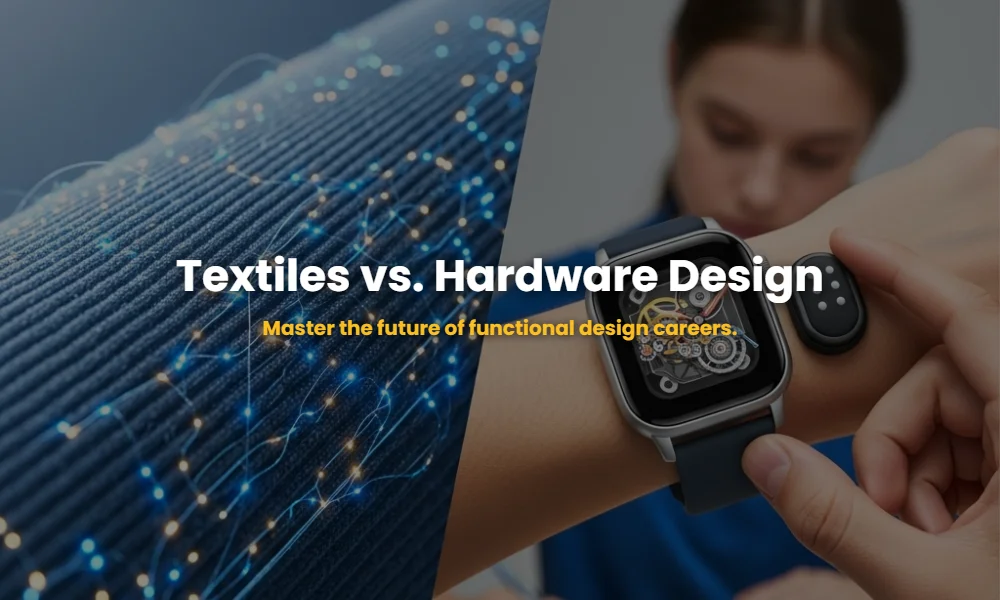
The Secret Roadmap to Future-Proofing Your Design Career
The global design landscape is shifting from aesthetic-only products to high-performance, functional systems. Whether you are aiming for NIFT’s specialized technology courses or general design tracks, understanding the divergence between fiber-based smart innovations and hardware-centric wearable design is no longer optional—it is critical for your survival in the 2025 industry.
🚀 Key Takeaways
- Technical textiles focus on fiber-level properties like thermal regulation and high-strength industrial applications.
- Wearable technology emphasizes the integration of electronic hardware and ergonomic user interfaces.
- Innovation in textiles is chemical and structural; innovation in hardware is mechanical and electronic.
- NIFT aspirants must choose between ‘Fabric Science’ and ‘Product Interaction’ to align with global market demands.
Are You Blind to the Technical Textiles Revolution Sweeping the NIFT Curriculum?
Innovation in technical and smart textiles involves the development of high-performance fibers that react to environmental stimuli, providing benefits beyond traditional aesthetics. This field focuses on ‘invisible’ innovation, where the fabric itself becomes a tool for medical, military, or environmental protection through nanotechnology and advanced polymers.
Technical textiles are the unsung heroes of the fashion technology world. Unlike standard fabrics, these materials are engineered for specific functionalities such as flame resistance, moisture-wicking, or even health monitoring. For a NIFT student, this means diving deep into textile chemistry and material science. The scope is massive, ranging from ‘Agrotech’ (agriculture textiles) to ‘Meditech’ (surgical implants and smart bandages).
💡 Click to Reveal Insider Examiner Tip
NIFT interviewers look for candidates who understand that ‘smart textiles’ aren’t just about LED lights on a dress; they’re about conductive polymers and phase-change materials that regulate body temperature automatically.
Is Wearable Technology and Ergonomic Hardware Design Your Secret Ticket to Global Design Studios?
Wearable technology and ergonomic hardware design focus on the physical interaction between humans and devices, prioritizing user experience, biomechanics, and aesthetic integration of electronics. This path requires a mastery of industrial design principles, sensor placement, and anthropometric data to create products that feel like an extension of the human body.
While technical textiles innovate at the molecular or yarn level, wearable hardware design innovates at the product level. Think of the Apple Watch or an exoskeleton suit; the innovation lies in how the hardware fits the human form (ergonomics) and how the user interacts with the digital interface. Success in this field requires a blend of product design process and digital literacy. For NIFT aspirants, this is the bridge between traditional fashion and the Silicon Valley tech ecosystem.
💡 Click to Reveal Hidden Quiz Question
Which design principle ensures that a wearable device doesn’t cause fatigue during 8 hours of use? (Answer: Ergonomic Anthropometry). Mentioning this in your NIFT GAT/CAT can significantly boost your scores!
The Battle of the Decade: Smart Textiles vs. Ergonomic Hardware – Which Wins?
The primary difference lies in the ‘delivery system’ of the innovation: Smart textiles embed functionality into the substrate (the fabric), whereas wearable technology attaches functionality to the body via a housing (the hardware). Both require distinct research methodologies and design thinking frameworks to succeed in a competitive market.
| Feature | Technical & Smart Textiles | Wearables & Hardware Design |
|---|---|---|
| Core Innovation | Material Science & Nano-coatings | UX/UI & Mechanical Engineering |
| Form Factor | Soft, flexible, seamless | Rigid or semi-rigid enclosures |
| Key Skillsets | Polymer science, knitting/weaving tech | CAD, Biomechanics, Prototyping |
| Top Industries | Healthcare, Defense, Sports performance | Consumer Tech, Gaming, Fitness |
| NIFT Relevance | B.FTech / Textile Design (TD) | Fashion Communication (FC) / Accessory Design (AD) |
The Hidden Innovation Gaps Only Top NIFT Toppers Know About
Identifying innovation gaps involves looking at where textiles fail and hardware succeeds, or vice versa, such as the ‘washability’ of electronics or the ‘power storage’ limitations of flexible fabrics. Bridging these gaps through hybrid designs—where hardware is miniaturized and textiles are used as sensors—represents the most lucrative opportunity for high-paying design roles.
One major gap in technical textiles is the durability of smart functions after multiple wash cycles. In contrast, hardware design faces the ‘obtrusiveness’ gap, where devices are too bulky for daily wear. As a designer, mastering both worlds allows you to enter the realm of sustainable innovation. Companies are desperately seeking designers who can make hardware ‘disappear’ into the clothing.
Your Future Depends on This: The Final Verdict for NIFT Aspirants
The final verdict for NIFT aspirants depends on your cognitive strengths: choose Technical and Smart Textiles if you have an analytical mind for chemistry and materials; choose Wearable Technology and Ergonomic Hardware Design if you are driven by user interaction, aesthetics, and mechanical problem-solving. Both fields offer six-figure salaries at the intersection of tech and fashion.
For those preparing for the NIFT situation test or interview, remember that the industry is no longer siloed. The future is hybrid. Start building a portfolio that shows you understand the ergonomics of a wearable device just as well as the breathability of a smart yarn.
Need personalized guidance for your NIFT journey?
Stop guessing your career path. Talk to our elite academic counselors today!
💬 Chat with our Experts on WhatsApp (+91 9526806124)




