
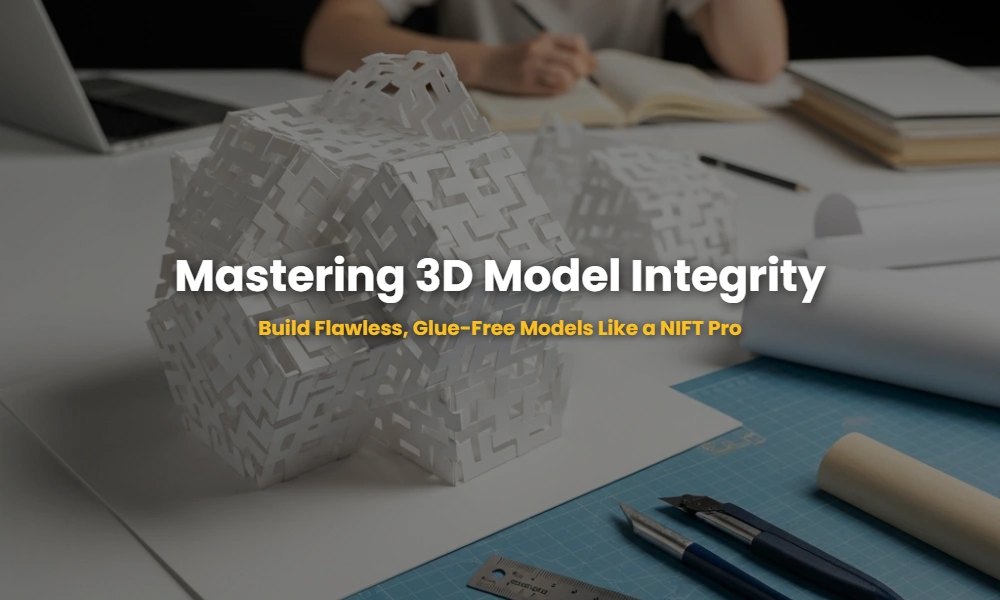
The Secret Formula for NIFT Situation Test Success
To master structural integrity and aesthetic neatness in 3D models without overusing adhesive, you must transition from a ‘paster’ to an ‘engineer’. This involves using mechanical joinery like interlocking slots, tabs, and tension folds which provide a cleaner finish and superior strength compared to messy glue-laden joints. NIFT examiners penalize visible glue marks, prioritizing candidates who demonstrate material intelligence through precise manipulation.
🚀 Key Takeaways
- Mechanical Joinery: Slots and tabs are the gold standard for stability.
- Scoring Mastery: Perfect folds determine the neatness of your final form.
- Tension Distribution: Use geometry, not chemicals, to hold your model upright.
- Minimalist Adhesive: Glue should be a secondary reinforcement, not a primary anchor.
The Invisible Killer: Why Your Dependence on Glue is Destroying Your NIFT Dreams
Excessive adhesive usage results in ‘soggy’ paper, visible stains, and a lack of structural precision. Over-gluing is often a sign of poor planning; it indicates that the candidate is trying to force materials together rather than understanding their inherent properties. In the high-stakes NIFT Situation Test, a model that relies on glue will often sag under its own weight or look ‘tacky’ (literally and figuratively) under the examiner’s flashlight.
Understanding material manipulation techniques is the first step toward high-scoring models. When you use too much Fevicol, the moisture content weakens the paper fibers, leading to warping. Instead, professional designers use dry joinery that maintains the crispness of the material, ensuring that the ‘Aesthetic Neatness’ criterion is met with a perfect 10/10 score.
💡 Pro-Tip: The ‘Dry-Fit’ Rule
Always build your entire model once without any adhesive. If it cannot stand on its own using just slots and gravity, your structure is fundamentally flawed. Glue should only be applied in the final 10 minutes to lock things in place forever.
Structural Secrets: How to Build Rock-Solid Models That Don’t Collapse Under Pressure
Building structural integrity without glue requires the use of ‘Load-Bearing Geometries’ like triangles and cylinders. By creating a skeleton of interlocking paper strips (the ‘Grid System’), you distribute the weight of the model across multiple points. This ensures that even thin materials like translucent paper can support heavier elements like wire or cardboard without buckling.
Mastering NIFT Situation Test preparation means learning the ‘Slot-and-Tab’ method. By cutting a slit half the width of your paper and sliding a matching slit from another piece into it, you create a 90-degree bond that is physically impossible to break without tearing the material itself. This is the hallmark of a high-ranking aspirant.
| Technique | Stability Level | Neatness Factor |
|---|---|---|
| Butt-Joint (Glue Only) | Low (Fails easily) | Poor (Visible stains) |
| Interlocking Slots | High (Self-supporting) | Excellent (Zero mess) |
| Flange/Tab Folding | Medium (Requires care) | High (Hidden joints) |
The ‘Neatness’ Manifesto: Finishing Techniques the Top 1% of Rankers Swear By
Aesthetic neatness is achieved through ‘Scoring’ and ‘Hiding’. Scoring involves lightly running a cutter or a dry pen along a fold line to break the surface tension of the paper, allowing for a razor-sharp 90-degree fold. Hiding involves placing all joinery elements (like tabs and slots) on the interior of the model so that the exterior surface remains smooth and untouched.
When you focus on design thinking processes, you realize that the viewer’s eye follows continuous lines. Any break in that line—be it a glue glob or an uneven fold—distracts from the design concept. Use ‘Valley Folds’ for internal depth and ‘Mountain Folds’ for external ridges, ensuring every edge is burnished with a scale for that factory-finished look.
💡 Click to Reveal: The ‘Toothpick’ Trick
Never apply glue directly from the nozzle. Squeeze a small amount onto a scrap paper and use a toothpick to apply microscopic dots. This prevents ‘squeeze-out’ which is the primary cause of marks on NIFT models.
The Examiner’s Scorecard: What We Actually Judge When We Pick Up Your Model
As NIFT panelists, we evaluate models based on four pillars: Concept Innovation, Material Handling, Structural Stability, and Aesthetic Finish. A model that falls apart when picked up receives an automatic 50% deduction in the ‘Execution’ category. Conversely, a model that stands tall with zero visible adhesive is viewed as the work of a sophisticated designer with high spatial intelligence.
We look for ‘Clean Transitions’—where one material meets another without friction. If you are joining wire to paper, are you using a neat loop-and-hook method, or are you burying it in a mountain of tape? The former shows mastery, the latter shows desperation. Remember, your write-up must explain these structural choices to ensure the panelist recognizes your technical prowess.
Critical FAQs for the Situation Test
Is it okay to use NO glue at all?
Yes! In fact, a completely glue-less model (origami or interlocking based) is often the highest-scoring entry because it demonstrates extraordinary planning and material control.
What do I do if my model starts wobbling?
Add a ‘triangulated brace’ at the base. Triangles are the most stable geometric shape and will stop lateral movement without needing heavy adhesive reinforcement.
Still struggling with your 3D models? Get expert feedback today!
💬 Chat with our Experts on WhatsApp (+91 9526806124)




