
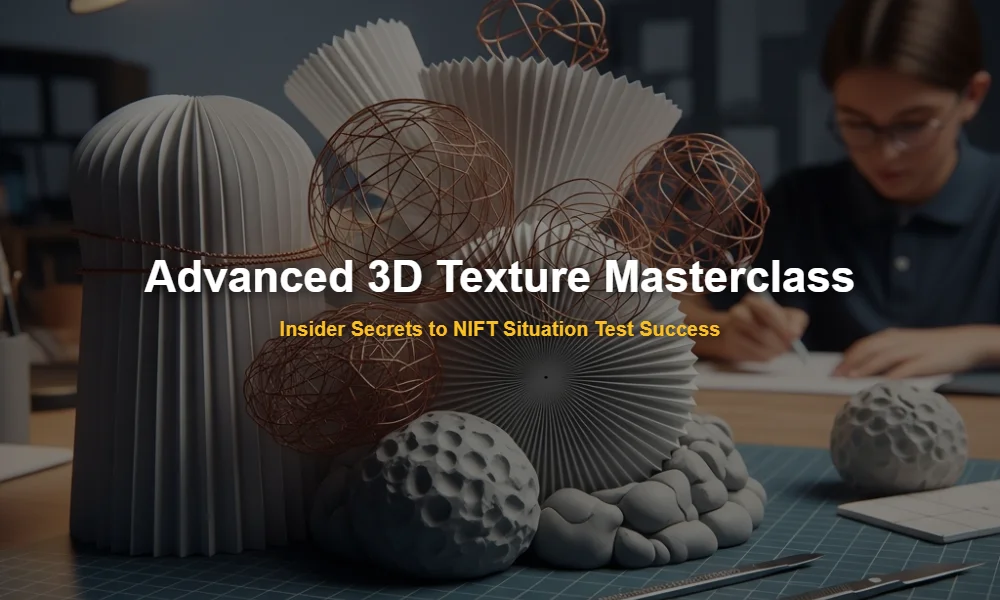
As an admission panelist who has evaluated thousands of models at the NIFT Situation Test, I can tell you that the difference between a mediocre model and a topper’s model lies in the advanced material manipulation techniques used to generate realistic 3D textures. Most students stop at basic folding; the masters use materiality to communicate emotion and function.
🚀 Key Takeaways
- Mastering scoring and pleating for structural paper integrity.
- Using clay for organic fluid textures vs. geometric precision.
- Wire manipulation for creating skeletal frameworks and tension.
- Examiner-grade evaluation criteria for 3D compositions.
The Paper Scoring Secrets NIFT Toppers Use: Why You’re Doing it Wrong
Advanced paper manipulation involves transforming a 2D plane into a high-strength 3D form through precise scoring, crimping, and tessellation. By breaking the surface tension of the paper fibers without severing them, you can create intricate accordion folds and curved surfaces that reflect light dynamically.
To truly excel, you must look beyond simple quilling. Consider advanced origami techniques that focus on structural rigidity. Use ‘half-cuts’ to create hinges that allow the paper to curve without wrinkling. If you are representing a futuristic building, your paper should show triangulation for strength.
💡 Click to Reveal the ‘Feathering’ Technique
To create soft textures like bird feathers or animal fur using stiff ivory sheet, use the edge of your cutter to scrape the paper surface repeatedly until the fibers fray. This creates a soft, organic feel that contrasts beautifully with geometric structures.
Why Your Clay Textures Fail the Professional Look—And How to Fix It
Professional clay texturing in the NIFT Situation Test requires a mastery of both additive and subtractive methods to mimic real-world materials like stone, water, or bark. The secret is to avoid ‘lumpy’ surfaces by using tools (even improvised ones like toothpicks or comb teeth) to imprint consistent patterns.
When working with modeling clay, remember that its plasticity allows for high-detail 3D modeling skills to shine. If your theme is ‘Chaos’, use jagged, irregular subtractive gouges. If it is ‘Harmony’, use smooth, repetitive additive spheres. Never leave fingerprints; they are the mark of an amateur. Use a drop of water or a smooth tool edge to burnish the surface for a factory-finish look.
💡 Pro Tip: The Clay ‘Slip’ Mimicry
To create liquid textures (like spilled milk or melting ice), slightly warm your clay and press it against a cold surface to create a thin, flowing laminate. This adds a level of realism that examiners rarely see.
The Hidden Power of Wire Frameworks: Don’t Just Bend, Engineer
Wire manipulation is the art of linear expression and structural armature; it provides the ‘skeleton’ upon which your story is built. Advanced techniques include ‘binding’ (wrapping thinner wire around thick wire for grip) and ‘tensioning’ to create suspended elements that defy gravity.
Aspiring designers often ignore wire, yet it is the best tool for showing movement. Use a spiral wind to indicate energy or a rigid grid for stability. Integrating wire with paper creates a mixed media masterpiece that demonstrates your understanding of material synergy. Ensure all wire ends are neatly tucked away to avoid ‘safety hazards’—a common point deduction in the Situation Test.
Material Property Comparison Matrix: Choosing Your Weapon
Selecting the right material for a specific texture is 50% of the battle; use the table below to decide which material suits your design prompt’s emotional tone.
| Material | Best Texture For… | Common Mistake |
|---|---|---|
| Paper | Geometric, sharp, pleated | Visible glue marks |
| Clay | Organic, fluid, heavy | Lumpy/Uneven finish |
| Wire | Linear, skeletal, airy | Loose joints/Wobbling |
Evaluation Secrets: What We Write in Your Marksheet
As examiners, we evaluate your model based on the ‘Concept-Material-Execution’ triad. We look for how well the advanced material manipulation techniques serve the narrative of your model rather than just being decorative additions.
If you’re asked to build a ‘Sustainable City’, we check if your model making execution shows efficiency. Are you wasting material? Is your joinery clean? Advanced students use ‘Interlocking’ techniques rather than relying on tape. This shows a high level of design thinking and foresight.
Ready to Crack the NIFT Situation Test?
Don’t leave your design career to chance. Get personalized feedback on your models from ex-NIFTians.
💬 Chat with our Experts on WhatsApp (+91 9526806124)




