
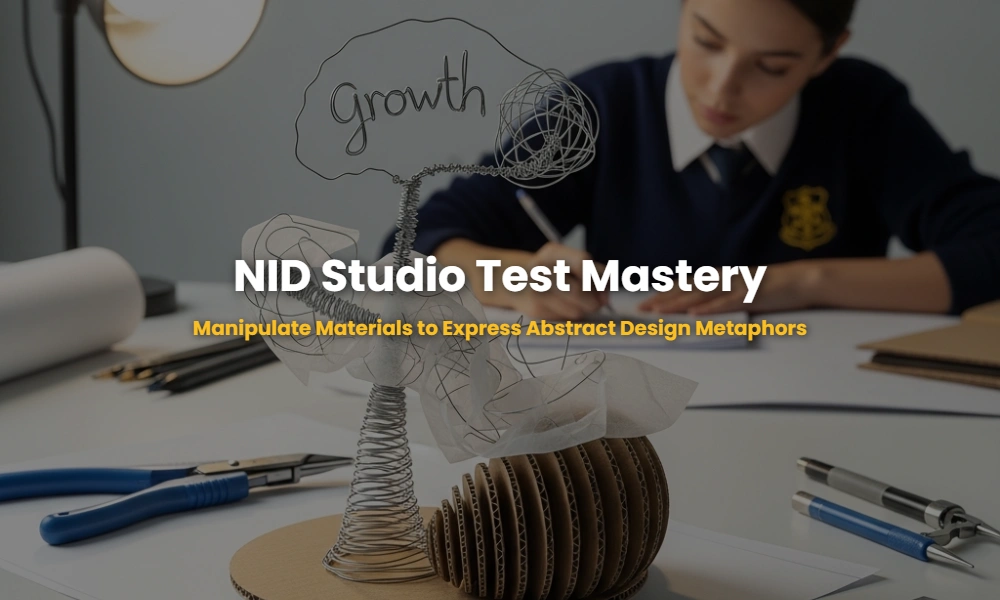
The NID Studio Test is not merely a test of your ability to stick pieces of paper together; it is a rigorous evaluation of your sensory perception, material intelligence, and ability to communicate complex, intangible ideas through tangible forms. To succeed at the National Institute of Design, you must move beyond literal representations and delve into the world of materiality—the physical and conceptual properties of materials—to express abstract metaphors like ‘fragility,’ ‘oppression,’ or ‘metamorphosis.’
🚀 Key Takeaways
- Understand the difference between Material Handling and Materiality.
- Learn to manipulate unconventional materials like wire, tea bags, and mesh.
- Master the art of translating abstract metaphors into 3D structural forms.
- Explore high-level techniques like scoring, interlocking, and tension.
- Insights into the 2025 NID Studio Test trends and jury expectations.
What is Materiality in the Context of the NID Studio Test?
Materiality in the NID context refers to the inherent qualities of a material (its texture, weight, flexibility, and strength) and how those qualities can be exploited to convey a specific narrative or emotion. It is the dialogue between the designer’s intent and the material’s physical response to manipulation.
In the NID DAT Mains syllabus, materiality is tested through 3D modeling tasks where candidates are often given limited, everyday items and asked to solve a problem or represent a theme. The goal is not just a ‘neat’ model but one where the choice of material manipulation reinforces the concept. For instance, if you are asked to represent “Anxiety,” using tightly wound, high-tension copper wire conveys the message much more effectively than smooth, flat cardboard.
💡 Pro-Tip: The ‘Material Honesty’ Rule
Designers at NID value “material honesty.” This means you shouldn’t try to make paper look like wood or clay look like plastic. Instead, celebrate the ‘paperness’ of paper—its ability to fold, tear, and crumple—to express your idea.
Manipulating Unconventional Materials: A Strategic Guide
Success in the studio test often depends on your ability to work with materials you didn’t expect. While standard kits include paper and wire, NID often throws in ‘unconventional’ items like jute, sponges, or even discarded plastic mesh to test your creative thinking skills.
1. Aluminum and Copper Wire
Wire is the ultimate material for expressing line, movement, and tension. Do not just use it as a binder. Instead, use weaving or ‘nesting’ techniques to create volume without mass. For an abstract metaphor like ‘Confusion,’ a chaotic, tangled nest of wire with sharp protruding ends is visually poetic.
2. Clay and M-Seal
These are ‘plastic’ materials, meaning they are highly moldable. They represent fluidity, growth, and organic form. Use them to create focal points or ‘joints’ in your models. To express ‘Stability,’ use clay as a heavy, grounded base that anchors lighter materials.
3. Translucent Materials (Tracing Paper, Mesh)
Transparency and translucency are perfect for metaphors involving secrets, layers, or the passage of time. Layering tracing paper can create a depth that opaque cardboard cannot, allowing you to hide and reveal elements within your 3D composition.
The Alchemy of Metaphor: Connecting Form to Meaning
Translating an abstract concept into a physical object requires ‘Design Metaphor’ thinking. This is the process where a physical attribute (like a sharp edge) represents a conceptual attribute (like aggression).
To master this for the NID Studio Test, follow the Attribute Mapping technique. Identify 3 keywords associated with your metaphor. For “Growth,” keywords might be asymmetry, verticality, and expansion. Now, choose manipulations that mimic these. Verticality can be achieved through stacking; expansion through outward-facing pleats in paper. This level of depth is what distinguishes a top-ranking student.
💡 Practice Challenge
Try to represent the concept of “Silence” using only a single sheet of white A4 paper and no glue. Hint: Think about stillness, lack of texture, and negative space.
Material Properties vs. Emotional Metaphors
The following table provides a quick-reference guide for choosing the right material manipulation for specific abstract prompts often seen in NID Studio Test past papers.
| Manipulation Type | Material Property | Abstract Metaphor |
|---|---|---|
| Tightly Coiled Wire | Stored Elastic Energy | Suppressed Anger / Potential |
| Layered Soft Cloth | Pliable / Dampening | Comfort / Secrecy / Care |
| Scored & Folded Cardboard | Rigid / Architectural | Structure / Discipline / Logic |
| Distressed / Torn Paper | Fragile / Irregular | Decay / Chaos / Fragility |
Mastering 3D Manipulation: Scoring, Weaving, and Tensegrity
Professional model-making involves specific technical skills that demonstrate your manual dexterity and spatial understanding. These three techniques are essential for any NID aspirant.
1. Scoring and Kerfing
Scoring involves cutting halfway through a thick material like mount board to create crisp, clean folds. Kerfing involves making multiple parallel scores to allow a rigid material to bend into a curve. This shows the jury you understand industrial design principles.
2. Tensegrity (Tension + Integrity)
Tensegrity structures are models where the shape is maintained by the balance between solid ‘struts’ (like sticks) and flexible ‘cables’ (like thread). Creating a model based on tensegrity is a high-level skill that proves you understand physics and structural balance—a massive plus for B.Des candidates.
3. Interlocking Joints
NID examiners often look for models that use minimal glue. Learning to create ‘slit-and-slot’ joints or ‘tab-and-groove’ connections shows that you have planned your model before executing it. It also leads to a much cleaner final presentation.
Expert Jury Insider Tips for 2025-2026
Based on recent shifts in the NID admission process, the jury is moving away from purely aesthetic models towards those that show ‘design empathy’ and ‘process clarity.’ Here is what the experts are looking for:
- The Write-up is 40% of the game: If you cannot articulate why you chose a specific material to represent a metaphor, your model loses value. Use design vocabulary like “tactile,” “geometric,” “modular,” and “dynamic.”
- Scale and Proportion: Always consider the human scale. Even if the model is abstract, it should feel like it exists in a real-world space.
- Neatness Matters: Excessive glue marks, jagged edges, and pencil marks on the final model are signs of poor time management. Practicing with a timer is the only way to overcome this.
Frequently Asked Questions (FAQ)
What materials are typically provided in the NID Studio Test?
NID provides a variety of materials which may include: Cardboard, Mount board, Wire (various gauges), Clay, M-Seal, Fabric, Jute Rope, Straws, Rubber Bands, and sometimes recycled items like bottle caps or discarded plastic.
How do I express a ‘dynamic’ metaphor with rigid materials?
Use repetition and rhythm. By repeating a rigid element (like a strip of paper) at varying angles, you create a sense of motion or ‘flow’ even though the material itself is static.
Is it better to make a realistic model or an abstract one?
Always follow the prompt. If the prompt is to build a ‘Working Windmill,’ be literal and functional. If the prompt is to represent ‘Freedom,’ aim for an abstract, conceptual model.
Ready to Ace your NID DAT Mains?
Don’t leave your design career to chance. Get personalized guidance, feedback on your 3D models, and master-level tips from NID alumni.
💬 Chat with our Experts on WhatsApp (+91 9526806124)




