
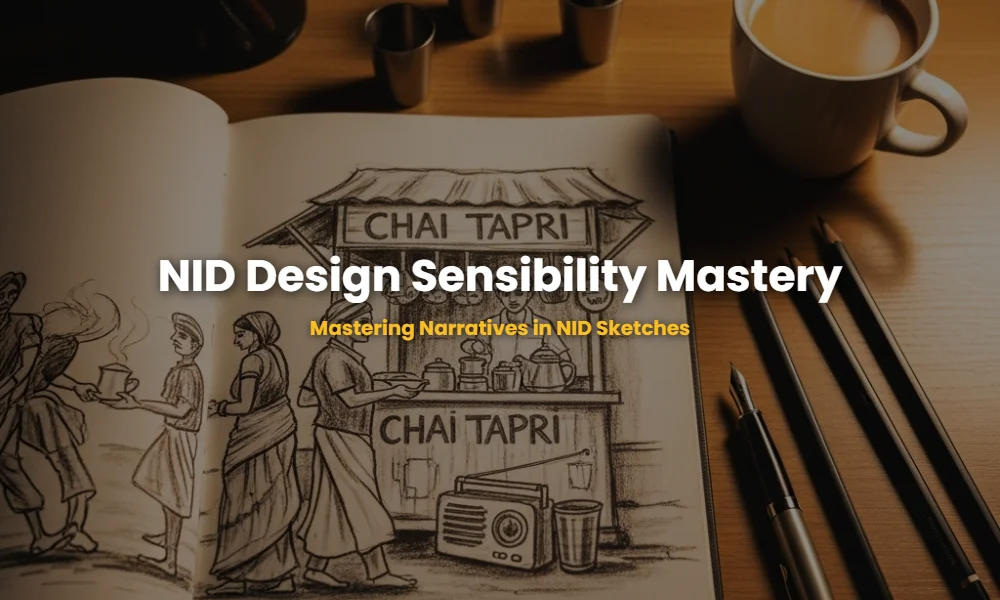
Cracking the NID DAT Mains requires more than just technical drawing skills; it demands a profound level of Advanced Design Sensibility. At this stage, examiners are not looking for a perfect rendering of a chair or a street scene. Instead, they are searching for candidates who can integrate complex socio-cultural narratives into their quick conceptual sketches. This means your sketches must tell a story about who uses the product, the environment they live in, and the cultural values they hold.
🚀 Key Takeaways
- Understand the shift from technical drawing to narrative-driven design.
- Learn to observe and illustrate subtle socio-cultural cues.
- Master the art of ‘Visual Shorthand’ to save time during the exam.
- Implement empathy-driven design in every sketch.
- Strategically prepare for the Studio Test with narrative frameworks.
Table of Contents
What is Advanced Design Sensibility in the context of NID DAT Mains?
Advanced Design Sensibility in NID DAT Mains refers to a candidate’s ability to perceive, interpret, and visually communicate the intersection of human behavior, cultural context, and functional problem-solving. It goes beyond aesthetics, focusing on how design decisions impact society and how well a designer understands the user’s lived experience.
When you sit for the NID Studio Test, the prompt might ask you to design a solution for a migrant worker or a traditional weaver. Design sensibility is what allows you to depict their tools, clothing, and environment with authenticity, demonstrating that you have researched and understood their specific lifestyle challenges. It is about the why behind the what.
💡 Pro-Tip: The ‘Context’ Layer
Always add one element in your sketch that establishes the setting. For a rural Indian context, maybe it’s a specific type of water pot (Lota) or a charpai. This tiny detail boosts your design sensibility score instantly.
How do you integrate Socio-Cultural Narratives into your sketches?
Integrating socio-cultural narratives involves embedding visual clues—such as local motifs, traditional materials, and social hierarchies—into your conceptual drawings. This technique shows the NID jury that your design is inclusive, sustainable, and deeply rooted in the specific reality of the target audience rather than being a generic solution.
To do this effectively, you must practice Ethnographic Sketching. This involves observing how people in different Indian demographics interact with their surroundings. For example, the way a street vendor organizes their cart is a masterpiece of informal design. Capturing that ‘jugaad’ or efficiency in your NID mock tests demonstrates that you value local intelligence.
LSI Keywords to remember: Anthropometrics, semiotics, cultural ergonomics, inclusive design, and visual storytelling.
What are the best techniques for Quick Conceptual Sketching in DAT Mains?
The best techniques for quick conceptual sketching include using ‘Thumbnailing’ for ideation, ‘Wireframing’ for structure, and ‘Indicative Line Work’ to suggest texture and culture without over-detailing. Speed is critical; you must learn to convey complex socio-cultural ideas using minimal lines that imply a larger environmental context.
In the high-pressure environment of the NID DAT Mains, you won’t have time for cross-hatching or perfect perspective. Instead, focus on:
- Action Lines: Show how a person is using your design. Movement conveys narrative better than a static object.
- Scale Comparison: Use a human figure (an ‘Average Joe’ or a specific persona like an elderly woman) to show the size and usability of your concept.
- Call-outs: Use neat annotations to explain the socio-cultural significance of a material or a shape choice.
Refining these skills is essential for a strong design portfolio and winning the exam.
Surface-Level vs. Deep Narrative Sketching
To understand the difference, look at the table below which compares a generic design approach with an advanced design sensibility approach for an NID prompt.
| Feature | Surface-Level Sketching | Advanced Narrative Sketching |
|---|---|---|
| Focus | Aesthetic look of the object. | Relationship between object and user. |
| Character | Generic stick figure. | Defined persona (e.g., a rickshaw puller). |
| Background | White space or gradient. | Contextual setting (e.g., a crowded bazaar). |
| Details | Symmetry and clean lines. | Signs of wear, local materials, cultural motifs. |
Expert Insider Strategies for NID DAT Mains
Experienced NID mentors suggest that the “Secret Sauce” to scoring high is the ‘Problem-Solution-Narrative’ triad. Don’t just solve a problem; solve it within a specific story. If you are designing a lighting solution for a remote village, your sketch should show it being used for communal gathering or late-night studying, highlighting the social impact.
Use your sketches to answer: “Who is left out by current designs?” By sketching for the marginalized, you demonstrate high emotional intelligence and advanced design sensibility.
🔍 Click to reveal a common mistake!
Many students forget to consider ‘Body Language’. A person from an urban corporate background sits differently than a rural farmer. Capturing this posture in your sketch shows incredible observational depth.
Frequently Asked Questions (FAQs)
No. While basic sketching skills are required, NID values your ideation and sensibility over artistic perfection. A simple, meaningful sketch beats a complex, hollow one every time.
In the Mains, you often have 5-10 minutes per concept. Practice speed-sketching where you spend 1 minute on the frame, 3 minutes on the core design, and 1 minute on socio-cultural annotations.
Start observing the ‘unnoticed’. Watch how people use public transport, how grandmothers handle kitchen tools, or how street vendors manage space. Keep a ‘Visual Journal’ of these observations.
Ready to Ace the NID DAT Mains?
Get personalized coaching, mock studio tests, and portfolio reviews from NID alumni.
💬 Chat with our Experts on WhatsApp (+91 9526806124)




