
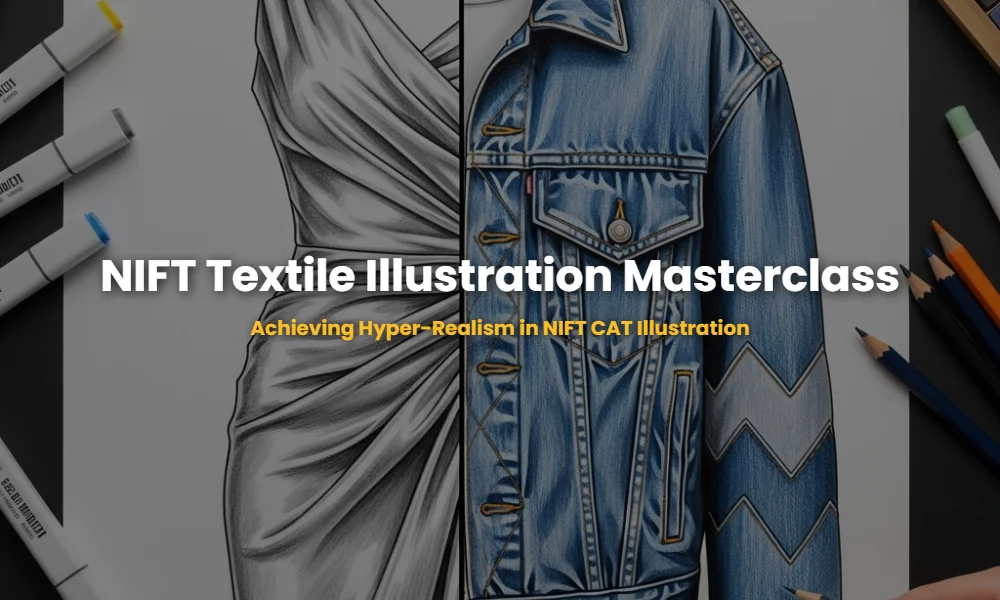
How can you master the comparative analysis of textile textures and fold dynamics for NIFT advanced fashion illustration realism?
Mastering the comparative analysis of textile textures and fold dynamics is the definitive edge for NIFT aspirants looking to excel in the Creative Ability Test (CAT). This involves understanding how different fabric weights, weaves, and fibers react to gravity and bodily movement. By analyzing the physical properties of textiles—such as the stiff resistance of denim versus the fluid drape of silk—you can translate 3D tactile reality into 2D visual impact, ensuring your illustrations demonstrate professional-grade realism and material awareness.
🚀 Key Takeaways
- Understand the 7 fundamental fold types: Pipe, Zig-zag, Spiral, Diaper, Half-lock, Drop, and Inert.
- Differentiate between high-tension fabrics (denim/canvas) and low-tension fabrics (chiffon/satin).
- Master light-to-shadow ratios to communicate fabric luster and surface depth.
- Learn how NIFT examiners evaluate “materiality” in your CAT submissions.
- Implement advanced rendering techniques for diverse textures like fur, leather, and knits.
Table of Contents
What is the role of textile textures in advanced fashion illustration?
Textile texture rendering is the visual translation of a fabric’s physical feel and surface structure onto paper. For NIFT aspirants, this means using light, shadow, and line weight to signal whether a garment is made of rough tweed or smooth satin. Textures define the mood of the illustration; while a coarse texture implies durability and warmth, a smooth, high-shine texture suggests luxury and fluidity. Mastering this requires a deep understanding of advanced rendering techniques including stippling, cross-hatching, and blending.
The Interaction of Light and Weave
To achieve realism, one must observe how light interacts with the weave. A ‘plain weave’ like cotton calico scatters light evenly, appearing matte. In contrast, a ‘satin weave’ has long floats of yarn that reflect light in sharp, high-contrast highlights. When illustrating for the NIFT CAT, remember that texture isn’t just about the surface pattern—it’s about the edge quality. A fuzzy wool sweater will have a soft, blurred silhouette, whereas a patent leather jacket will have sharp, crisp edges and high-specular highlights.
💡 Pro-Tip: The Pencil Grade Secret
For rough textures like denim or burlap, use a 2B or 4B pencil on slightly textured paper to naturally catch the tooth of the page. For silk or sheer fabrics, use a hard H-grade pencil or a smudge-proof fineliner to maintain cleanliness and transparency.
How do fold dynamics change across different fabric types?
Fold dynamics are determined by the ‘drape’ and ‘hand’ of a fabric, which dictates how it responds to tension points (shoulders, elbows, knees). Lightweight fabrics create numerous, small, and intricate folds (like the spiral folds in a chiffon sleeve), while heavyweight fabrics produce fewer, larger, and more structural folds (like the pipe folds in a heavy wool overcoat). Understanding these dynamics allows you to accurately depict how a garment hangs on a fashion croquis.
The Physics of Folds
Every fold is a result of tension (pulling) or compression (pushing). Zig-zag folds occur at the joints where the fabric is compressed, typical in tight denim jeans behind the knee. Pipe folds are vertical, tube-like folds seen in flared skirts or wide-leg trousers where the fabric hangs freely from a fixed point. In NIFT illustrations, the thickness of the line at the fold’s ‘valley’ (shadow) versus its ‘crest’ (highlight) is what creates the illusion of depth.
💡 Practice Drill: The Hanging Towel
Drape a towel over a chair and draw it five times, each time imagining it is a different material (e.g., silk, leather, denim). Notice how the fold shapes must change from sharp angles to soft curves to represent the shift in weight.
Comparative Analysis of Textile Properties
This table provides a comparative framework for rendering common fabrics found in NIFT exam scenarios. Use this as a reference for your NIFT CAT preparation to ensure your material depiction is logically sound and visually convincing.
| Fabric Type | Fold Dynamic | Light Interaction | Key Rendering Focus |
|---|---|---|---|
| Chiffon/Organza | Small, frequent spiral folds | High transparency, soft highlights | Overlapping layers, edge control |
| Heavy Denim | Angular zig-zag and half-lock folds | Matte, absorbs light | Highlight on outer ridges, deep seam shadows |
| Silk Satin | Fluid, large drop and pipe folds | High contrast, sharp specular highlights | Extreme value range (darkest darks vs white) |
| Knit/Jersey | Curvilinear, clinging folds | Soft, diffused lighting | Body contouring, subtle shadows |
What do NIFT examiners look for in fabric rendering?
NIFT examiners evaluate your ability to think like a designer, which means your illustrations must be technically accurate. They look for ‘materiality’—the ability to identify the fabric just by looking at the sketch. They check if the folds logically align with the body’s posture and if the shading reflects the specific fiber properties (e.g., the sheen of velvet vs. the dullness of wool). Achieving this level of realism demonstrates that you understand how a garment will move and behave in real life.
Common Mistakes to Avoid in CAT
- Gravity Defying Folds: Ensure folds always pull downwards unless there is a specific tension point or wind movement.
- Uniform Line Weight: Using the same thickness for the silhouette and the inner folds makes the drawing look flat. Use thicker lines for the outer contour and thinner, lighter lines for highlights.
- Generic Shading: Don’t shade every fabric the same way. A leather jacket needs high-contrast ‘hotspots,’ while a cotton tee needs soft, blended gradients.
💡 Examiner Insight: The Power of the Hemline
The hemline tells the story of the fabric’s weight. A thin, wavy hemline suggests silk or chiffon. A thick, structured, and slightly curved hemline suggests heavy wool or double-knit jersey. Always pay extra attention to how you draw the bottom edge of a garment!
Frequently Asked Questions
1. Which medium is best for rendering textures in the NIFT CAT?
While pencil colors are the most common, a mix of markers for base colors and color pencils for texture details (like the grain of denim or the fuzz of wool) works best for speed and realism in the exam hall.
2. How do I show transparency in my illustrations?
Draw the body croquis clearly first. When adding the garment, use very light strokes and allow the skin tone to peek through. Focus on adding darker shadows only where the fabric folds and layers over itself, increasing opacity.
3. Are digital illustrations allowed in NIFT CAT?
No, the NIFT CAT is a paper-based exam. You must master traditional mediums like graphite, charcoal, markers, and color pencils. However, studying digital rendering can help you understand light and shadow logic.
Ready to Crack the NIFT CAT?
Don’t let complex textures hold you back. Get expert guidance and mock test feedback to refine your illustration skills!
💬 Chat with our Experts on WhatsApp (+91 9526806124)




