
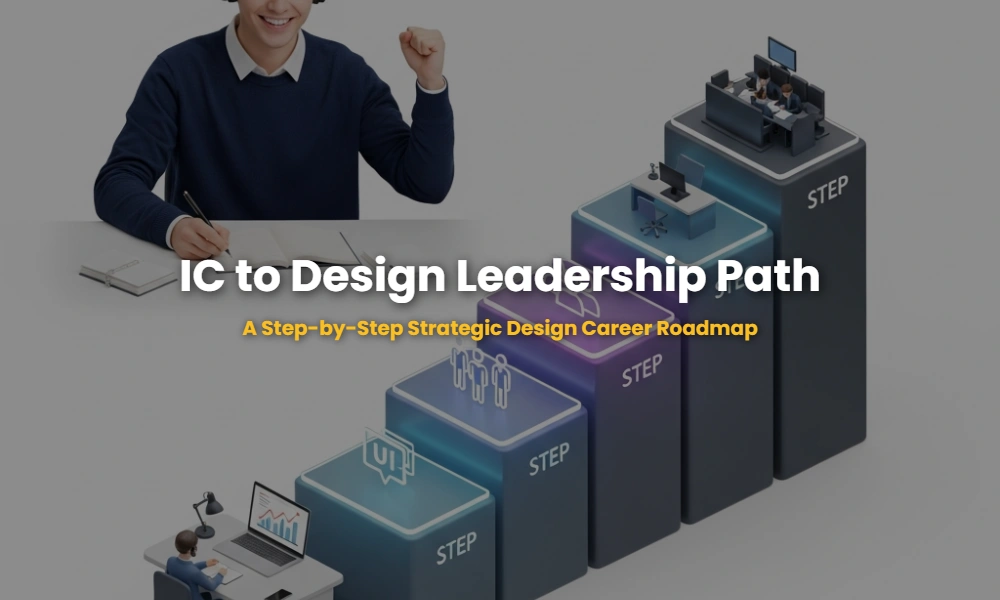
The Evolution of a Designer: From IC to Strategic Leader
Navigating the trajectory from individual contributor roles to Design Management and Strategic Leadership positions requires a fundamental shift in mindset, moving from ‘doing’ the work to ‘enabling’ the work. This guide provides a granular flowchart designed for NID aspirants and professionals aiming for the C-suite.
🚀 Key Takeaways
- ✅ Mindset Shift: Moving from craft mastery to business impact.
- ✅ Skill Transition: Evolution from technical tools to soft-skill influence.
- ✅ Strategic Design: Aligning design outputs with organizational ROI.
- ✅ Leadership Levels: Understanding the 5 distinct tiers of growth.
Table of Contents
1. What defines an Individual Contributor (IC) in Design?
An individual contributor is a design professional responsible for the direct execution of creative assets, technical interfaces, or user experiences. Their primary focus is the mastery of design craft, tool proficiency, and delivering high-quality visual or functional solutions based on project briefs.
Level: Junior to Senior Designer
At this initial stage, your design portfolio is your currency. You spend 90% of your time in Figma, Adobe Creative Suite, or prototyping tools. You are solving micro-problems: a button’s hierarchy, a specific user flow, or a brand’s color palette. In the NID ecosystem, this represents the foundation of Design Studies where execution is paramount.
💡 Pro-Tip: Winning the IC Stage
Focus on ‘Deep Craft.’ Master typography, grid systems, and accessibility. Learn to articulate why you made a design choice, not just how you made it. This builds the foundation for future leadership communication.
2. How do Lead ICs influence without managing people?
Lead Individual Contributors influence organizational design quality by setting standards, mentoring junior staff, and owning complex, multi-layered projects. They provide technical leadership and creative direction without the administrative overhead of direct reports or performance reviews.
Level: Principal / Staff Designer
This is the ‘Expert’ track. You are no longer just pushing pixels; you are defining Design Systems. You ensure consistency across entire platforms. You are the go-to person for complex architectural design questions. For Strategic Design Management aspirants, this is where you start understanding the intersection of design and scale.
3. What is the core responsibility of Design Management?
Design Management’s core responsibility is the optimization of people and processes to ensure high-velocity, high-quality design output. This involves recruitment, career coaching, budget management, and bridging the gap between design teams and external business stakeholders.
Level: Design Manager
Welcome to the first true leadership pivot. Your success is no longer measured by your Figma files, but by the success of your team. Key skills include: 1. Empathetic Coaching, 2. Conflict Resolution, 3. DesignOps (workflow efficiency), and 4. Hiring. You are the shield for your team, protecting them from ‘scope creep’ while ensuring they deliver business value.
4. How does Strategic Design Management differ at the Director level?
At the Director level, Strategic Design Management focuses on long-term vision, cross-departmental alignment, and design maturity. Directors do not manage individual tasks; they manage managers and set the strategic north star for how design integrates with Product, Engineering, and Marketing.
Level: Design Director / Head of Design
You are now a business leader who happens to specialize in design. You are looking at the 12-24 month roadmap. You advocate for design at the executive level and ensure that ‘Design Thinking’ is not just a buzzword but a core operational methodology. In the context of NID, this aligns with the M.Des in Strategic Design Management curriculum.
5. What is the pinnacle of Design Strategic Leadership?
The pinnacle of Design Strategic Leadership is the Chief Design Officer (CDO) or VP of Design role. At this level, design is a core business driver used to influence stock value, organizational culture, and global brand positioning, sitting directly on the Board of Directors.
Level: VP of Design / CDO
This is ‘Design Governance.’ You are responsible for the entire design organization’s health and output. You deal with mergers and acquisitions, global design culture, and the ethics of design at scale. You are a peer to the CEO, CTO, and CMO. This is the ultimate goal for students pursuing advanced management degrees at premier institutes like NID or IIT-IDC.
IC Roles vs. Management: The Critical Shift
| Feature | Individual Contributor (IC) | Design Management |
|---|---|---|
| Primary Goal | Perfecting the Output | Perfecting the Team |
| Typical Day | Deep work, Design sessions | 1:1s, Strategy meetings, Hiring |
| Key Metrics | Usability, Aesthetics, Specs | Team Retention, ROI, Velocity |
| Problem Solving | How do I design this feature? | Who is the best person for this? |
Career Transition Quiz: Are you ready for Leadership?
Reflect on these questions to see if you are ready to pivot from IC to Management.
💡 Question 1: Do you enjoy mentoring more than designing?
If you find more satisfaction in helping a junior designer solve a grid problem than solving it yourself, you have the ‘People First’ trait essential for management.
💡 Question 2: Can you handle ‘Ambiguity’ over ‘Certainty’?
Leaders deal with abstract business goals. ICs deal with concrete design specs. If you enjoy the challenge of defining the ‘Why’ when it’s unclear, management is for you.
Expert Advice for NID Candidates
In the NID Studio Test or the Strategic Design Management Interview, focus your narrative on the ‘Bridge.’ Show that you understand how a user-centric design (IC skill) creates a competitive business advantage (Leadership skill). Use terms like Design Value Stream and Stakeholder Empathy to show your maturity level. Leadership isn’t just a promotion; it’s a commitment to the growth of others and the health of the organization.
💬 Chat with our Experts on WhatsApp (+91 9526806124)




