
🚀 Key Takeaways
- ✅ Speed of Growth: Agency paths often offer faster title changes but higher burnout risks.
- ✅ Skill Pivot: Transitioning from ‘doing’ to ‘managing’ usually occurs around Year 5.
- ✅ NID Advantage: Strategic thinking taught at NID accelerates the move to CDO roles.
- ✅ C-Suite Goal: A CDO role requires business acumen equal to creative prowess.
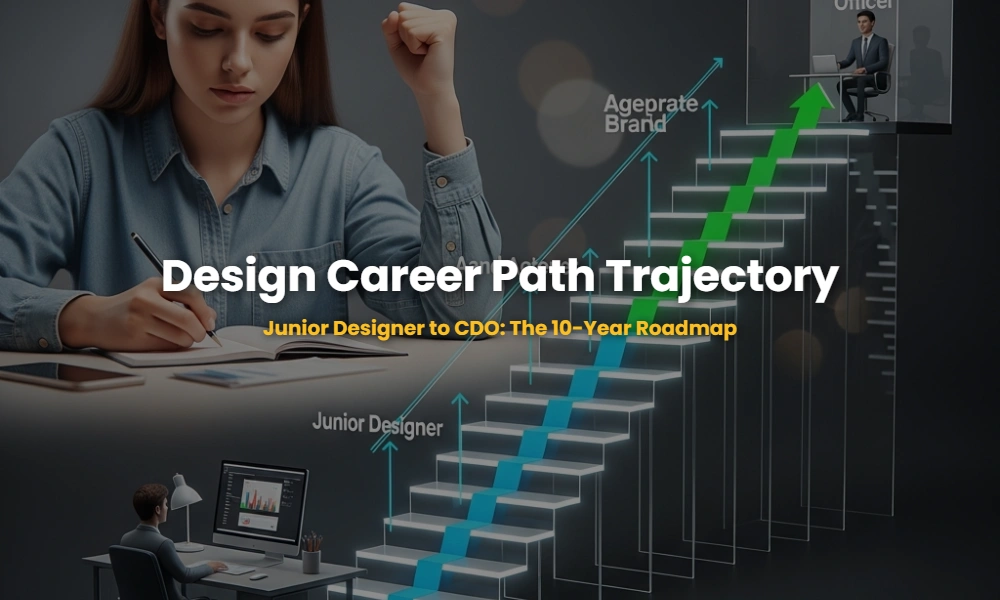
How can you visualize the 10-year growth trajectory in design?
The 10-year growth trajectory from Junior Visual Designer to Chief Design Officer (CDO) involves a fundamental shift from technical execution to strategic business leadership. In agencies, this path focuses on diverse client portfolios and rapid creative iteration, while corporate paths emphasize brand consistency, long-term product roadmaps, and cross-functional stakeholder management.
Understanding this design career roadmap is essential for NID aspirants planning their long-term professional journey. Whether you land in a fast-paced agency or a stable multinational corporation, the core progression remains anchored in increasing levels of responsibility, decision-making power, and organizational impact.
Phase 1: The Execution Specialist (Junior Visual Designer)
The first phase of the 10-year growth trajectory focuses on mastering the craft, understanding design systems, and learning to work within professional constraints. This is where your foundational NID skills are put to the ultimate test in real-world environments.
🏢 Agency Setting
In an agency, a Junior Designer handles high-volume tasks for multiple clients. You will learn to switch ‘creative hats’ quickly, moving from a luxury brand’s social media assets to a tech startup’s landing page in a single afternoon.
- Focus: Rapid prototyping & tool mastery.
- KPI: Billable hours & creative output speed.
🏙️ Corporate Setting
Corporates focus on depth rather than breadth. You’ll become a guardian of a single brand identity, ensuring every pixel aligns with the global design language system (DLS). Collaboration happens with product managers and engineers.
- Focus: Brand consistency & documentation.
- KPI: Adherence to brand guidelines.
💡 Pro-Tip: Winning the Junior Phase
Focus 80% of your energy on mastering Figma/Adobe Suite and 20% on learning how to explain ‘the why’ behind your design choices. This prepares you for the ‘Senior’ leap early.
Phase 2: The Project Lead (Mid to Senior Designer / Art Director)
During the middle years of the trajectory, the focus shifts from individual contribution to project ownership and mentorship of junior talent.
Strategy Thinking
Direct Design
Mentorship
At this stage, you are expected to handle complex briefs with minimal supervision. In an agency, you might become an Art Director, leading the visual vision for specific campaigns. In a corporate setup, you become a Senior Product Designer, optimizing user flows and conducting A/B tests to improve business ROI. This is the perfect time to explore specialized design management to prepare for the C-suite.
Progress Bar: Skill Acquisition
65% Progress toward Chief Design Officer (The ‘Golden Pivot’ point).
Phase 3: The Executive Leader (Creative Director / VP of Design to CDO)
The final stage of the 10-year trajectory involves moving into the executive suite. As a Chief Design Officer, you no longer design screens; you design organizations, cultures, and business strategies.
A CDO in a corporate environment works directly with the CEO and CTO to ensure design is a core pillar of the company’s business model. This requires a deep understanding of design thinking in business. You are the advocate for the user at the highest level of decision-making.
Frequently Asked Questions
❓ Can I switch from Agency to Corporate mid-career?
Yes! In fact, most CDOs have experience in both. Agencies build speed and creative diversity, while corporates build the ability to scale and manage complex organizational systems. Switching at year 4 or 5 is common.
❓ Does an NID degree help in reaching the CDO level faster?
Absolutely. The NID curriculum focuses heavily on systemic thinking and human-centered design, which are the exact skills needed for high-level strategic roles. NID alumni often bypass several ‘Junior’ hurdles due to their strong conceptual portfolios.
Ready to Start Your Design Journey?
Whether you’re aiming for a creative agency or a corporate giant, the path starts with the right education and guidance. Let us help you navigate your NID preparation and beyond.
💬 Chat with our Experts on WhatsApp (+91 9526806124)




